

Australia’s rental market is showing an unusual disconnect, with rents stalling across most capital cities despite vacancy rates remaining at critically low levels.
Domain’s September Quarter 2026 Rent Report shows combined capital city house rents were unchanged at $700 a week over the quarter, while unit rents rose 1.5 per cent, or $10, to a record $690.
Annual growth remains positive at 7.7 per cent for houses and 6.2 per cent for units, although Domain said much of that growth reflects increases recorded earlier in 2026 rather than recent market conditions.
The disconnect between supply and rents is particularly stark in some of the country’s tightest markets.
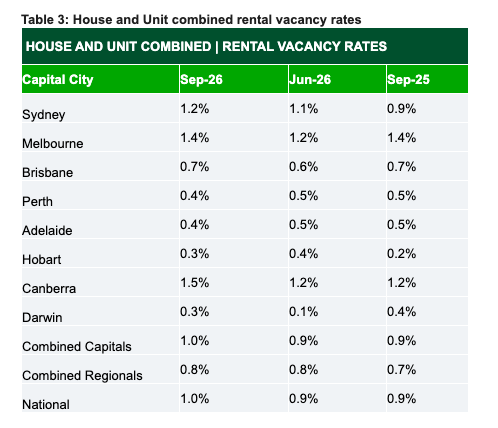
Perth and Adelaide recorded vacancy rates of just 0.4 per cent in September and Brisbane sat at 0.7 per cent, yet both house and unit asking rents were unchanged across all three capitals.
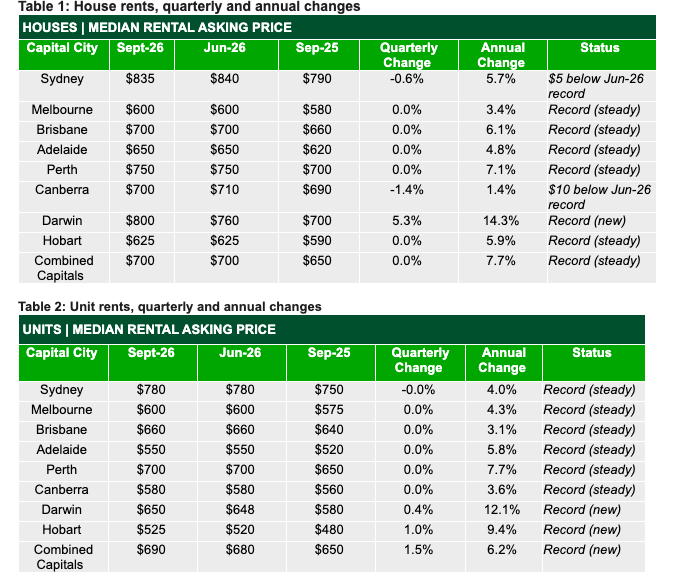
Melbourne also recorded no quarterly movement in either house or unit rents, while Hobart had a vacancy rate of just 0.3 per cent. Hobart house rents remained steady at $625 a week, although unit rents increased 1 per cent to a record $525.
Domain Chief Residential Economist Dr Nicola Powell said the failure of extremely tight vacancy rates to translate into higher rents was highly unusual.
“I mean, it’s so unusual that we still have landlords markets across all of our major capital cities, but it’s not seeing that transmission into fast or growing rents,” Dr Powell said.
“It’s very unusual to have a landlord’s market and rents actually falling in markets like Sydney and Canberra. I don’t know if I’ve seen that before.”
She said the divergence between vacancy rates and rents pointed to the limits of tenants’ capacity to pay more.
“”This disconnect between where the vacancy rate sits and what’s happening with rents says a lot about the ceiling that tenants have reached – their ability to absorb further rent hikes is probably quite limited.””
Dr Powell said higher living costs were also changing tenant behaviour and making it more difficult for property managers to achieve further increases.
“I think that it is becoming harder for property managers to push through higher rents because I think tenants are, becoming more sensitive, selective, selective, and mindful of what they commit to.”
She said the combination of low vacancy rates and weaker rental growth increasingly pointed towards affordability becoming the constraint.
“I think the fact that we still got low vacancy rates but not seeing higher rates of rent growth does point to that affordability ceiling.”
Sydney house rents fall
Sydney was one of only two capitals to record a fall in house rents during the September quarter.
Median asking house rents declined 0.6 per cent, or $5, to $835 a week, the first quarterly decline since December 2024, according to Domain. Unit rents remained steady at $780 a week.
Sydney’s combined house and unit vacancy rate also increased to 1.2 per cent in September, from 1.1 per cent in June and 0.9 per cent a year earlier.
Dr Powell said the increase had given tenants greater choice.
“So it’s the highest September vacancy rate since 2021,” she said.
“So the choice has increased, which I think is helping to alleviate some of the conditions, and helping to drive that flat line of unit rents.”
But she said supply was only part of the equation in Australia’s most expensive capital city rental market.
“There is the affordability undercurrent as well … Sydney is very much in that bucket because it’s such a high priced market to to rent.”
Canberra was the other capital to record a fall in house rents, down 1.4 per cent, or $10, to $700 a week. Unit rents held at $580, while the city’s vacancy rate increased from 1.2 per cent in June to 1.5 per cent in September.
Darwin goes the other way
Darwin continued to defy the broader trend, recording the strongest house rental growth of any capital.
House rents jumped 5.3 per cent, or $40, over the quarter to a record $800 a week and were 14.3 per cent higher than a year ago.
Unit rents increased 0.4 per cent to a record $650 a week, taking annual growth to 12.1 per cent.
The increases came as Darwin’s vacancy rate sat at just 0.3 per cent in September, compared with 0.1 per cent in June and 0.4 per cent a year earlier.
“Darwin really is defying what’s happening in the other markets and is leading the nation,” Dr Powell said.
“The dynamic with Darwin is it is a transient market.”
She said interstate movement and people relocating for relatively short periods for work helped underpin rental demand.
“There’s lot’s of interstate movement, people relocating for short periods of time for jobs, for defence, government … everything feeds into that. And so the demand for temporary accommodation or rental properties is much higher.”
Supply remains the risk
While the September quarter points towards affordability putting a brake on rental growth, Dr Powell cautioned against assuming the latest figures represented a permanent change in direction.
September is typically a seasonally weaker period for rental growth, meaning the busier rental changeover period will provide a clearer indication of whether the slowdown persists.
At the same time, Dr Powell said slowing investor activity could restrict the addition of new rental properties and reinforce existing supply shortages.
“I think the outlook is really finely balanced,” she said.
“I think you’ve got dynamics where investor activity is slowing. That’s going to constrain the delivery of additional housing supply, additional new rentals. That’s gonna reinforce existing supply shortages.”
Higher borrowing costs and changes to housing policy were adding another layer of uncertainty, with Dr Powell saying the full impact on rental supply was yet to emerge.
“I think my concern is we probably haven’t fully seen the impacts of these,” she said.
For property managers and landlords, that leaves the market caught between two competing forces: an acute shortage of available rental properties and tenants whose capacity to absorb further increases appears increasingly stretched.
“I think the question comes how much are can landlords push through higher rents? I mean, how much more can tenants actually absorb?” Dr Powell said.
“And I think that that’s the fine balance that we’re in because I don’t think that the rental markets and tenants can absorb much more.”