
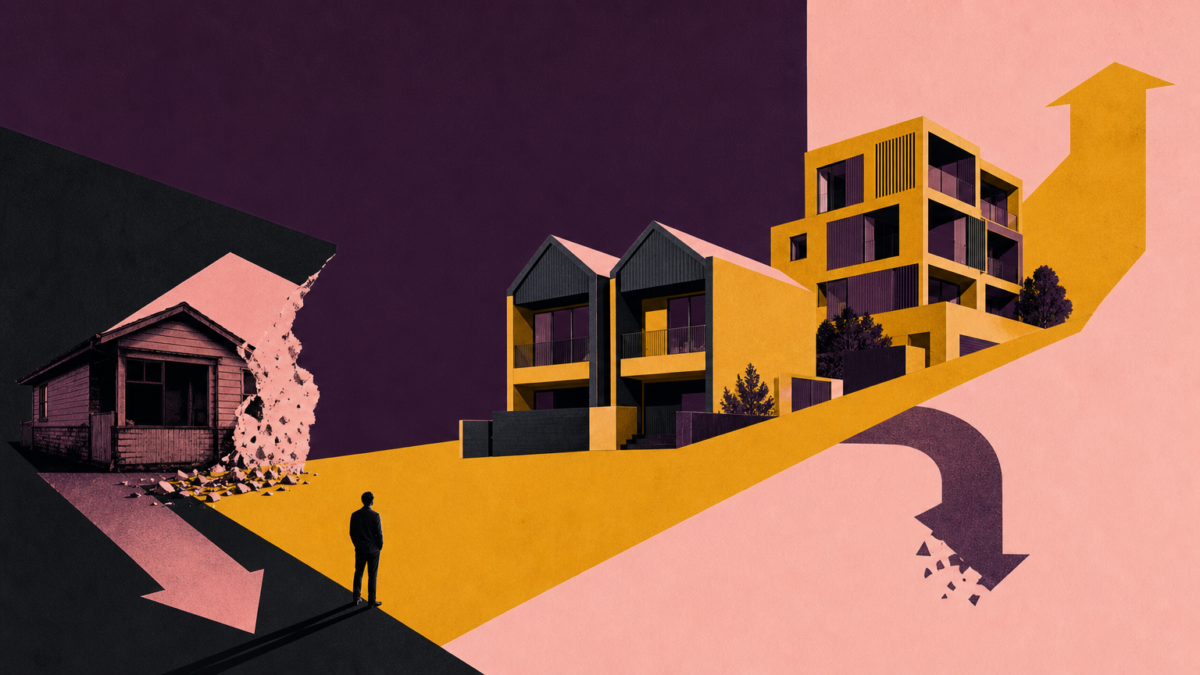
Investment in new home builds has risen 20 per cent over the past four years, while spending on knockdown rebuilds – where an existing home is replaced one-for-one – has dropped 32 per cent over the same period, according to new KPMG Australia analysis.
The shift is largely being driven by planning reforms that now allow larger blocks to be developed for multiple dwellings, where a knockdown rebuild was previously the only option.
KPMG urban economist Terry Rawnsley said homeowners were increasingly weighing up their options differently.
“People are rethinking their options and prioritising what makes economic sense. A few years ago, an old house with restrictive planning controls would have been a renovation or a knockdown rebuild. Now, the option to add more dwellings like duplexes to a site is much more viable.”
“A consistent drop in one-for-one replacement coupled with the boost in new home investment shows that densification is slowly starting to work as more land in established suburbs is unlocked to help increase overall housing stock,” Rawnsley said.
Renovation spending remains strong despite the trend, making up 37 per cent of all housing spending and rising almost 5 per cent to $56.2 billion in 2025-26, close to its 2021-22 pandemic peak. NSW is the biggest renovating state at $19.6 billion, followed by Queensland ($13.7 billion), Victoria ($13 billion) and Western Australia ($5 billion).
Terry attributed the resurgence to pandemic-era habits combined with the 2025 rate environment.
“COVID fundamentally changed the way Australians used their homes and sparked a wave of renovation activity that still remains well above the 10-year average despite soaring construction costs and governments encouragement of more new housing to be built,” he said.
“In 2025, comparatively lower interest rates increased household budgets, and rising house prices may have encouraged people to invest in their existing homes boosting the pipeline of reno spending before interest rates rose again in early 2026.”
The state data shows distinct patterns. In NSW, new dwelling spending overtook renovation spending in 2025-26, a reversal of 2021-22 when renovation spend exceeded new builds for the first time since 2012-13. Renovation activity there remains concentrated in the Northern Beaches, Sutherland Shire, and inner-city heritage pockets.
Victoria recorded $24.4 billion in new dwelling investment in 2025-26 – its highest level since before the pandemic – alongside $13 billion in renovations and $4.2 billion in one-for-one replacements. Rawnsley said Victoria’s larger lot sizes made knockdown rebuilds more viable than in Sydney.
“The historical subdivision pattern has yielded larger lots in Melbourne compared to Sydney. These larger lots are better suited to a knock-down rebuild as opposed to the smaller lots in Sydney, which may be more expensive to knock down and rebuild.”
Queensland’s new build spending rose to $17.9 billion in 2025-26, up from $14.1 billion in 2021-22, while renovation spend eased slightly to $13 billion. The City of Brisbane accounted for almost $1.5 billion of that renovation activity, while Noosa recorded the highest renovation share of any leading local government area, at 32 per cent of residential building activity.
Western Australia remains the most new-build-dominant state, with $8.2 billion spent on new dwellings in 2025-26 against $5 billion on renovations and $556 million on one-for-one replacements. New build spending there grew 11.4 per cent over the year.
“There is simply a lot more space in Perth to build new housing in desirable locations,” Terry said.