

More borrowers are switching to interest-only repayments or relying on lender exceptions to manage higher mortgage rates, according to new analysis from Ray White Group chief economist Nerida Conisbee.
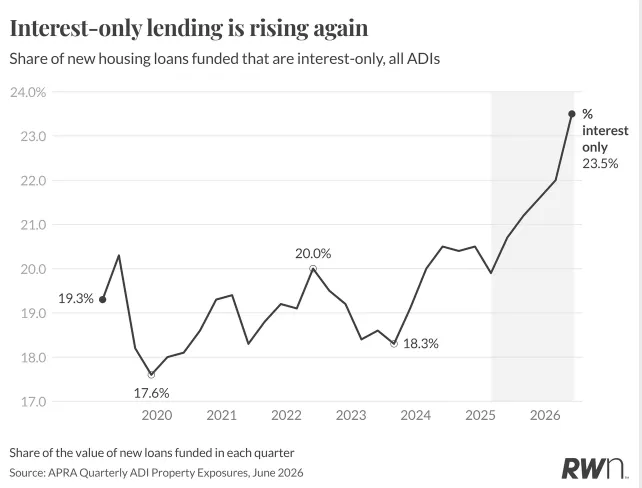
Interest-only loans accounted for 23.5 per cent of new housing lending in the June quarter, according to APRA data cited by Nerida.
That is up from 20.5 per cent at the end of 2024 and 19.9 per cent in March 2025, and the highest level since the current APRA series began in 2019.
While investors remain the dominant users of interest-only loans, Nerida pointed to a shift among owner-occupiers as the more notable trend.
Outstanding owner-occupied interest-only lending has risen from $45.8 billion in June last year to $51.5 billion now, an increase of around 13 per cent. That is the highest level since December 2021, when it stood at $52.2 billion, after falling to a low of around $44.5 billion in early 2024.
For an owner-occupier, Nerida said, moving to interest-only repayments reduces the immediate monthly repayment because they stop paying down principal. She said the recent increase suggests more households are looking for ways to manage cash flow as mortgage rates remain high.
Banks are also making greater use of exceptions to their standard serviceability policies, which accounted for 5.8 per cent of new lending in the June quarter, up from 5.1 per cent in March and 4.6 per cent at the end of 2024 – also the highest proportion since the APRA series began in March 2019. Nerida noted that until late 2023, these exceptions had generally sat between 2 and 3 per cent of new lending before climbing above 4 per cent and continuing to rise.
She said the exceptions do not necessarily mean borrowers cannot afford their loans, and can include refinancing cases where someone has a strong repayment history but no longer passes a lender’s standard serviceability assessment because rates are higher.
Even so, she said the increase suggests more borrowers are needing flexibility.
Traditional measures of mortgage stress remain relatively benign. Non-performing housing loans sat at 1.01 per cent of outstanding housing credit in June, slightly up from 0.99 per cent in March but below the 1.07 per cent recorded a year earlier.
Offset account balances totalled around $340 billion in June, equivalent to 13.3 per cent of outstanding housing credit – down from 13.9 per cent in December and March, but still well above levels seen earlier this decade.
“For now, the picture is one of adjustment rather than distress,” Nerida said.
She said further rate rises would put more pressure on this position, making interest-only lending, serviceability exceptions, arrears and offset balances important indicators to watch.
“We are not yet seeing widespread forced selling. Owners who do not need to sell can instead delay their decision when market conditions are weak,” she said.
“A meaningful rise in forced selling would change that dynamic, but the mortgage data suggest we are not there yet.”