

In a digital-first market, being searchable matters as much as being successful. Yet most agent content is short-lived, unstructured and invisible to search, meaning the thinking behind strong results never reaches the people actively researching expertise.
By compiling these experiences into structured editorial content and publishing them through Elite Agent, AILSA helps ensure an agent’s thinking remains visible to vendors, developers and future clients searching for demonstrated experience.
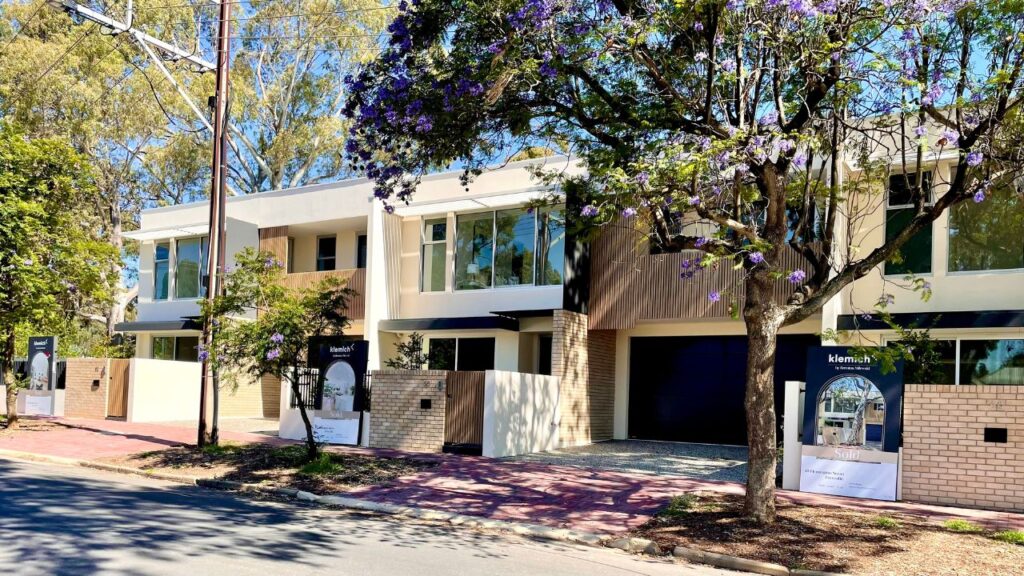
Brenton Milewski’s recent campaign of three properties on Flemington St, Frewville in Adelaide’s east has been featured on AILSA, with each listing serving as a clear example of how that process works in practice.
The three newly built townhomes had already passed through two agents without securing offers in the guided range.
When Brenton, Klemich Real Estate partner, took over, he identified that the issue was not the homes themselves, but the way their story had been told.
“The previous agents didn’t really focus on the quality of the build,” he says.
“And the large gum trees were being positioned as a negative.”
Rather than attempting to neutralise those perceived drawbacks, Brenton reframed the narrative, highlighting the setting, the landscaping and the craftsmanship behind the homes.
“When I put the marketing together, I used the surrounds as a highlight,” he says.
“The developer was extremely proud of the work … the solid double-brick construction, the three-metre ceilings, the American oak floors, the commercial-grade windows and doors.”
That shift in focus helped deliver a $2 million sale for 52 Flemington Street within ten days, followed by a $1.9 million result for number 50 and a $1.75 million off-market sale for number 48.
What makes the campaign notable is not only the outcome, but what happened after settlement.
Through AILSA, Brenton’s insights from the campaign were captured via an AI-led interview and compiled into a structured, long-form article published on Elite Agent.
“AILSA makes it very easy way to construct an interesting and relevant real estate article that has the potential to be read by a wide and varying audience,” he explains.
“With the growing trend to use AI to research areas such as real estate, it is really important to have as many ‘points of truth’ that you can in order to be recognised by your potential market as a credible and successful agent. AILSA provides you with that resource.”
In an industry where most content is transactional and time-bound, the objective was to preserve process: how the product was assessed, how the narrative was reshaped and how the campaign was sequenced to build momentum.
For Brenton, that process began with a detailed understanding of the homes themselves.
Each of the Flemington Street residences was built to a consistent standard, with careful attention paid to materials, sound insulation and liveability.
A key feature was the use of solid double-brick party walls, a construction detail Brenton believed addressed a common concern among buyers considering attached housing.
“There’s always that thought about hearing what the neighbours are doing,” he says.
“But these properties had solid brick, double-brick walls separating each home.”
High ceilings, quality appliances and commercial-grade windows were combined with thoughtful orientation and landscaping, creating a sense of privacy despite the urban setting.
Rather than minimising the presence of the established gum trees, the landscaping worked with them, reinforcing the character of the site and providing natural screening.
The sales strategy was equally deliberate. Rather than launching all three properties simultaneously, Brenton and the developer agreed to take the largest, corner-positioned home, number 52, to market first.
“That was going to set the price alignment for the rest,” he says.
“If we achieved a great result there, it allowed us to set the guide for the others at the maximum level we could achieve.”
Buyer numbers were steady rather than overwhelming, but Brenton says the quality of enquiry became clear early.
Holding inspections across both Saturday and Sunday allowed him to identify repeat visitors and genuine intent, rather than relying on raw foot traffic.
“It became pretty evident to me quite quickly who my buyer was going to be,” he says.
Once number 52 was under contract, momentum carried through to the remaining homes.
Number 50 followed with a $1.9 million sale, while number 48 was secured off market after buyers inspecting number 52 expressed interest in a smaller, three-bedroom option.
Rather than immediately moving to a full public campaign, Brenton set clear expectations with those buyers.
“I told them the offer would need to be really compelling for us not to go to market,” he says.
“And if they wanted to make it as strong as possible, it would need to be unconditional.”
The buyers agreed, and the transaction was completed without a public listing.
It is this level of process detail, the sequencing, buyer identification and conversations that shaped outcomes, that is often lost once a campaign ends.
In many cases, the only public record that remains is a sold price.
By capturing campaign insight in structured editorial form, that thinking remains accessible to those actively researching demonstrated experience.
Rather than relying on claims of success, vendors and developers are able to assess how decisions were made and how challenges were addressed.
For Brenton, the outcome was the result of clarity rather than complexity.
“It was just a matter of making sure the right aspects were highlighted and focused on,” he says.
Documented through AILSA, the Flemington Street campaign now forms part of a broader professional record.
It reflects not only what was sold, but how results were achieved, and preserves that thinking well beyond settlement.

