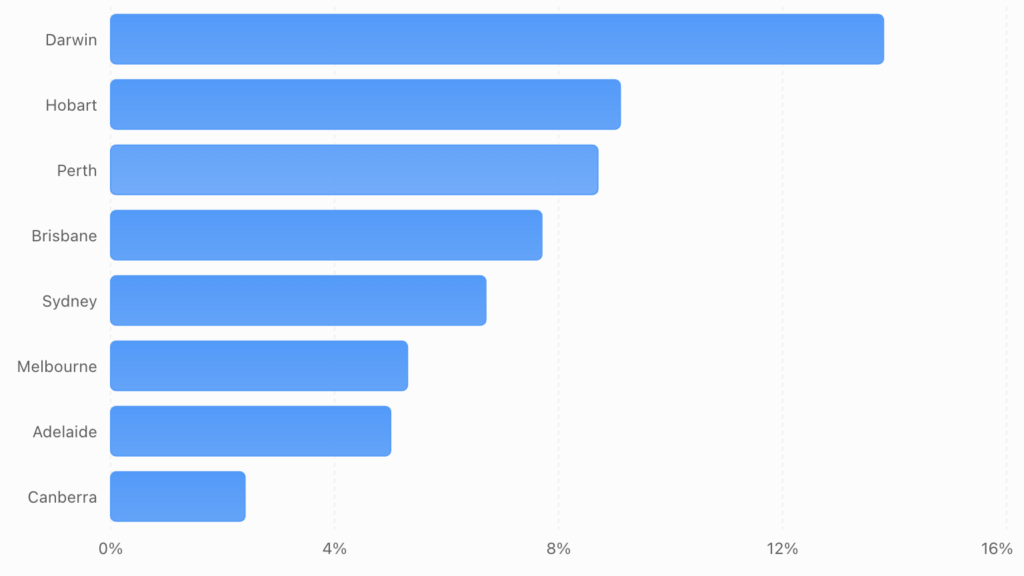
Australia’s rental market is becoming increasingly divided, with capital city rents rising at more than twice the annual rate of regional Australia, despite an improvement in rental availability across the country.
The latest realestate.com.au Rental Report reveals advertised rents across the capitals increased 7.7 per cent over the year to September, compared with just 3.4 per cent across regional areas, highlighting a widening gap in rental growth.
Capital city median advertised rents reached $700 a week, up 1.4 per cent during the September quarter, while regional rents remained unchanged at $600 a week.
For property managers and investors, the figures point to a rental market where national averages are increasingly masking substantial differences in local conditions, with metropolitan markets driving growth while some regional areas show signs of stabilisation.
Realestate.com.au Senior Economic Analyst Megan Lieu and report author said the divergence was becoming more apparent as rental availability improved.
“Annual growth in regional rents is softening, while the reverse is happening in capital cities.
“Despite vacancies being slightly lower in regional areas, the improvement in available rentals has been larger at 0.4ppt compared to 0.2ppt in our capitals, which may be influencing price movements.”
National advertised rents nevertheless reached a record $675 a week in September, increasing 1.5 per cent over the quarter and 5.5 per cent annually.
That represents an additional $1,820 a year compared with September 2025, although quarterly growth moderated from the 2.3 per cent recorded in June.
The national vacancy rate also increased to 1.5 per cent, its highest level since February 2022, indicating a modest improvement in rental availability.
However, the improvement has been uneven, with Perth, Hobart and Adelaide continuing to record vacancy rates at or below 1 per cent.
Sydney remains Australia’s most expensive capital city rental market, with median advertised rents holding at $800 a week during the September quarter.
Despite the quarterly pause, Sydney rents are 6.7 per cent higher than a year earlier, equivalent to an additional $2,600 annually, and $15,600 a year higher than five years ago.
The city’s vacancy rate reached 1.7 per cent in September, up 0.5 percentage points over the year.
Melbourne, meanwhile, is among the country’s most affordable capital city rental markets, with median advertised rents of $600 a week, equal to Hobart.
Melbourne rents increased 5.3 per cent annually, while its vacancy rate reached 1.9 per cent, among the highest of the capitals.
The contrast with Perth is particularly pronounced.
Perth’s median advertised rent reached $750 a week, representing annual growth of 8.7 per cent, while its vacancy rate remained at just 0.9 per cent.
Over the past five years, Perth recorded the strongest rental growth of any capital, with advertised rents now 60 per cent higher than in September 2021.
“Typical advertised rents are the highest in Sydney at $800 per week, and the lowest in Melbourne and Hobart at $600 per week. Rents grew the most in Perth over the past 5 years, with prices now 60% higher than September 2021.”
Brisbane’s median advertised rent reached $700 a week, up 7.7 per cent annually, with vacancies at 1.1 per cent.
Adelaide recorded annual rental growth of 5 per cent, taking its median to $630 a week, while its vacancy rate remained particularly tight at 1 per cent.
Darwin recorded the strongest annual growth of any capital, with advertised rents increasing 13.8 per cent to $740 a week.
It also recorded the largest quarterly increase, at 5.7 per cent.
Canberra was the only capital to record a quarterly decline in median advertised rents, falling 0.8 per cent to $635 a week.
While capital city rents are rising more rapidly overall, the regional figures reveal a more complicated picture than a uniform slowdown.
Median advertised rents remained unchanged during the September quarter across every regional state and territory market on an all-dwellings basis, but annual increases were still substantial in several areas.
Regional Tasmania recorded annual growth of 8.7 per cent, followed by regional Western Australia at 7.7 per cent and regional South Australia at 7.1 per cent.
Regional Queensland recorded annual growth of 6.1 per cent, with its median advertised rent reaching $700 a week, equal to Brisbane.
Regional Western Australia also recorded a $700 weekly median, placing both markets above the advertised rental medians of Melbourne, Adelaide, Hobart and Canberra.
The report’s more detailed geographical data highlights the extent to which individual regional markets are diverging.
The Northern Territory’s Outback region recorded annual advertised rent growth of 25 per cent, while Far West and Orana in NSW increased 12.8 per cent and Western Australia’s Outback South region rose 12.7 per cent.
Launceston and North East Tasmania recorded growth of 12.5 per cent, matching the increase in Victoria’s Warrnambool and South West region.
Within the capital cities, Brisbane’s eastern suburbs recorded annual growth of 10.4 per cent, followed by Sydney’s Inner South West at 9.9 per cent and Sutherland at 8.6 per cent.
The figures demonstrate that while regional rental growth is slowing overall, individual markets continue to experience substantial increases, reinforcing the importance of local market analysis when assessing rental returns and pricing.
The report also identifies a difference between houses and units nationally, with advertised unit rents increasing 6.3 per cent annually compared with 4.6 per cent for houses.
National median advertised rents reached $670 a week for units and $680 for houses.
In Brisbane, units recorded annual growth of 7.2 per cent compared with 6.7 per cent for houses, while Perth units increased 7.7 per cent compared with 7.1 per cent for houses.
Sydney recorded the reverse pattern, with house rents increasing 6.9 per cent annually compared with 4 per cent for units.
The difference reinforces the extent to which rental performance is being shaped by both location and property type.
For property managers, the latest figures point to a market in which rental appraisals and landlord expectations need to be informed by increasingly specific local evidence.
While capital cities are driving national rental growth, some regional locations are still recording stronger annual increases than major metropolitan markets, and vacancy rates remain low across much of the country.
Rental growth varies across the capitals