
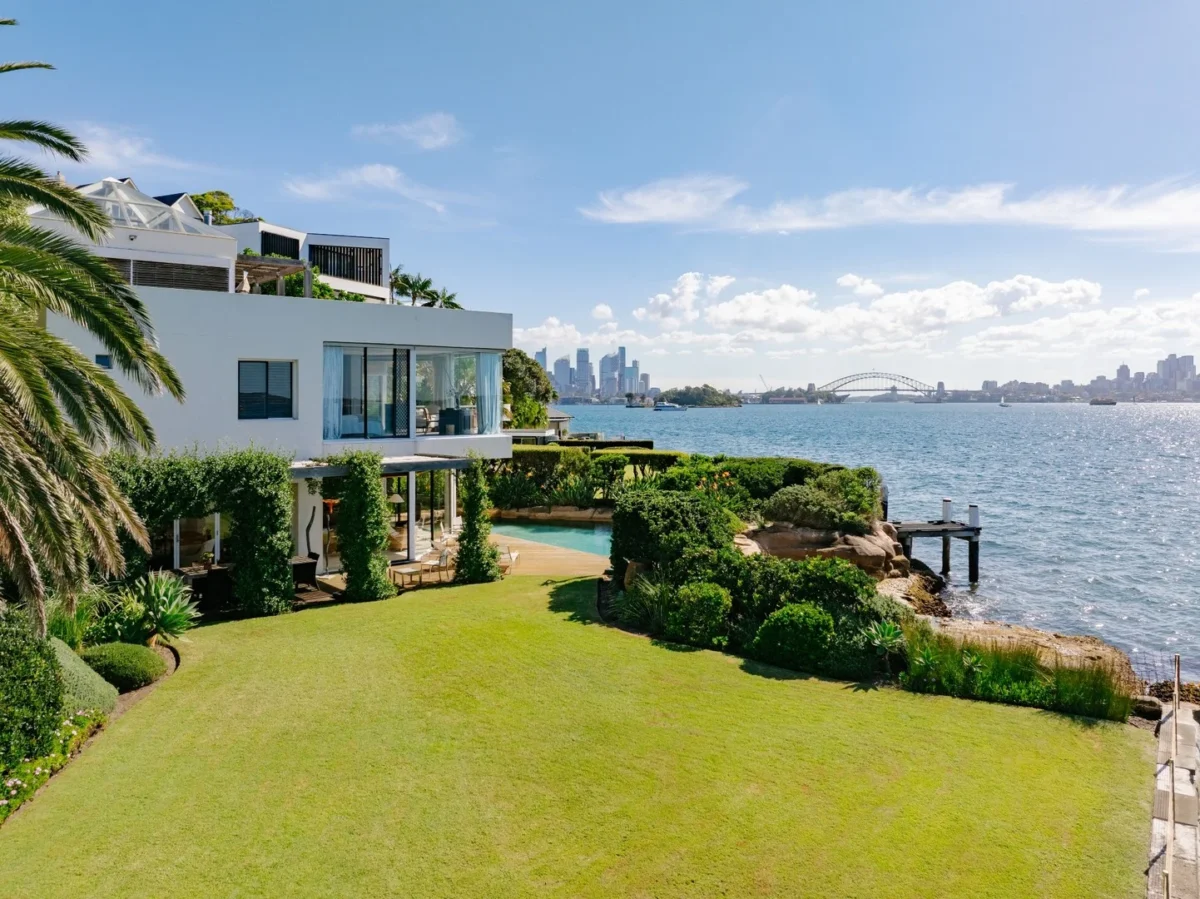
Sydney’s prestige property market could be within 5 per cent of its bottom, according to Simon Feilich, director at Dyson Austen Valuation + Advisory, who points to renewed buyer competition and a return of $20 million-plus transactions as signs the sector is beginning to stabilise after months of subdued activity.
Simon Feilich, director at Dyson Austen Valuation + Advisory, believes the market is establishing a new pricing benchmark as vendors adjust their expectations and buyers become increasingly willing to transact, according to his own assessment.
His assessment follows the release of the firm’s September quarter Top 10 Prestige Residential Survey, which found Sydney’s 10 highest residential sales totalled $341.8 million, down 16 per cent from $400 million during the corresponding quarter last year.
The entry point to the top 10 also declined 22 per cent, from $29.9 million to $23.5 million, reflecting the softer conditions that have characterised the upper end of the market.
However, activity strengthened considerably as the quarter progressed, with five of the 10 largest sales occurring in September, compared with three in August and two in July.
Simon said the change in transaction activity was particularly significant following a period of uncertainty that had kept many prestige buyers on the sidelines.
“I don’t think you’re going to see another 20% reduction,” he said.
“I think we’re within 5%.”
He believes the return of transactions is providing the market with greater clarity around pricing, while competition among buyers is helping establish a firmer foundation.
“There is some competition. For the transactions that are happening and as the competition increases, that will firm up the base,” he said.
“And before long, you’ll start to see things continuing at this level or increasing.”
For agents operating in Sydney’s premium suburbs, the shift is significant because completed transactions provide fresh evidence of what buyers are prepared to pay, particularly after a period in which pricing expectations had been difficult to reconcile.
Simon said the market had experienced a pronounced slowdown following the federal Budget, with uncertainty around taxation and economic conditions contributing to buyer hesitation.
Activity began returning gradually in July before gathering momentum through August and September, when revised pricing started attracting greater interest.
“There was a real unknown, and I’ll even say panic, and there was a pause,” he said.
He said the absence of substantial transactions had made it difficult for buyers and sellers to establish confidence in prevailing market values.
That began to change as individual sales above $20 million were completed, providing reassurance to other buyers considering entering the market.
“And within a short space of time, you saw a few $20,000,000 sales,” he said. “And from that, it then builds, and the confidence builds within the market.”
The September quarter’s largest transaction was the reported $75 million sale of 6 Wolseley Crescent, Point Piper, negotiated by Michael Pallier of Sydney Sotheby’s International Realty in conjunction with Brad Pillinger of Pillinger.
The result was Sydney’s highest residential sale of 2026 to date, exceeding the $61.8 million highest transaction recorded during the corresponding quarter last year.
Other significant transactions included a $39 million apartment in Darling Point and a $33 million residence in Longueville, demonstrating that substantial deals were still being completed despite softer conditions across the broader prestige market.
Simon said the relatively small number of transactions at the highest end of the market meant individual sales could play an important role in rebuilding confidence.
He described the sector as a finite market, with activity influenced by factors that extend beyond the borrowing costs affecting mainstream residential buyers.
In particular, he believes movements in financial markets have a significant bearing on demand for prestige property.
“There is a direct correlation between the equity market and the premium prestige residential market,” he said.
“If the equity market jumped 10% or 20% over a 12 month period, you would see this market move in parallel.”
However, Simon cautioned that further interest rate increases could alter the outlook, even if their direct impact on wealthy buyers was less pronounced than in other parts of the housing market.
“Whilst interest rates don’t in themselves move this market, they impact on other markets that impact on this market,” he said.
Beyond pricing, Simon said the complexity of prestige transactions remained an important consideration for agents working at the highest end of the market.
Simon pointed to the $66 million sale of three apartments at 56–58 Wolseley Road, Point Piper, as an example of the complexity involved in prestige transactions.
The off-market deal, put together by Bill Malouf of Highland Double Bay Malouf and Peter Leipnik of Bradfield BadgerFox Double Bay, took seven months to complete, according to Simon.
He said the agents collaborated to assemble the three apartments into a single site, navigating agreements, planning approvals and negotiations involving four sets of lawyers before the transaction became unconditional.
The example highlights the level of coordination sometimes required to complete substantial prestige deals, particularly where multiple owners, legal arrangements and development considerations are involved.
For agents, the September quarter’s results suggest that realistic pricing and the ability to identify committed buyers remain critical, even as confidence improves.
While the cumulative value of Sydney’s largest sales remains below last year’s level, Simon believes the renewed activity is helping establish a more stable pricing environment.
His assessment is that the market may be approaching its bottom rather than preparing for an immediate return to previous highs, with the emergence of buyer competition providing the clearest indication that conditions are beginning to change.