

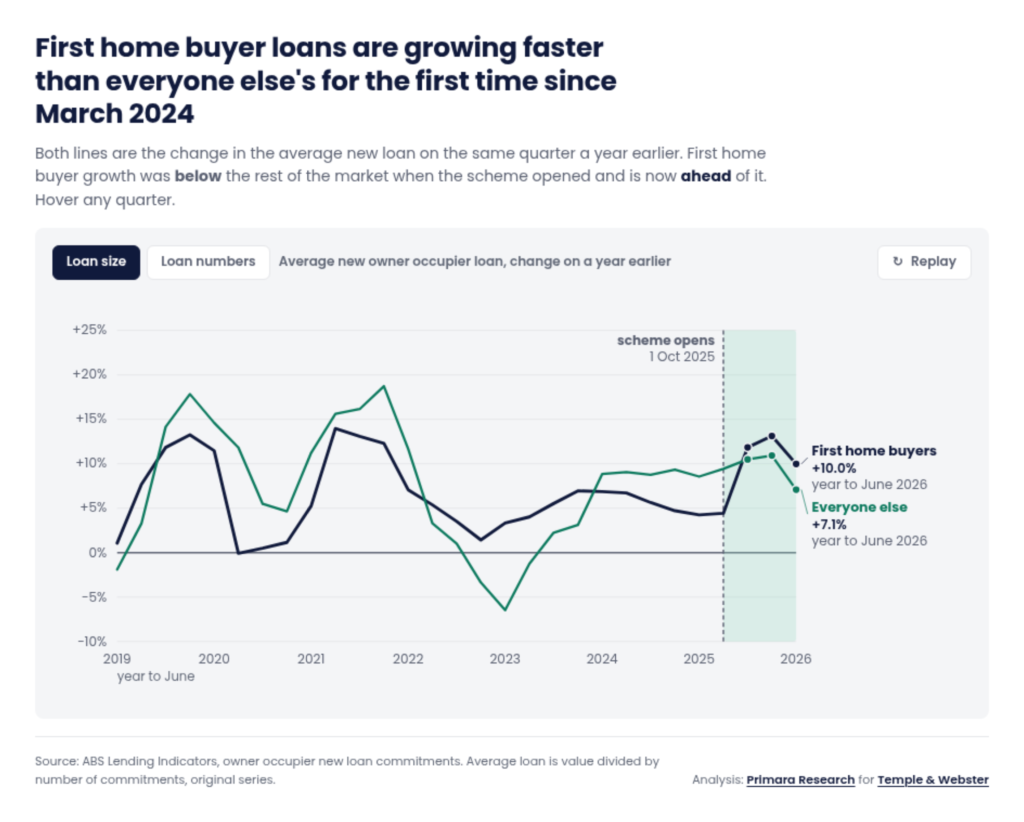
First home buyer lending grew faster than the rest of the market over the 12 months to June 2026, the first time that has happened in two years.
But the more significant shift is the size of the loans themselves, according to new research from Temple and Webster using ABS Lending Indicators data.
The First Home Guarantee opened to all first home buyers with a 5% deposit on 1 October 2025, removing income caps and lenders mortgage insurance. In the year to June 2026, first home buyer lending grew 3.3%, against 1.9% for the rest of the market, turning positive for the first time since September 2024.
That doesn’t mean more people are actually getting loans. Seasonally adjusted first home buyer loan numbers are down 2.3% on the pre-scheme quarter, and remain 39.9% below their June 2009 peak of 50,097.
What has changed is the average loan size. It reached $610,063 in June 2026, up 8.9% since the scheme opened.
Almost all of that increase landed in the first three months, with an 8.5% jump in the December quarter, the single largest quarterly rise in a series stretching back to September 2002. Loan sizes then grew just 0.4% over the following two quarters.
Non-first home buyer loans grew 4.4% over the same period, meaning first home buyer loan sizes grew at nearly twice that rate. The gap above market growth held across seven of the eight states. Western Australia was the only state where buyer numbers fell despite recording the country’s largest loan increase, up 16.0%.
Modelling on the average loan puts the cost of that extra borrowing at roughly $587 a month over 30 years, with the scheme removing about $96,000 upfront and breaking even after 13.7 years. Rate rises since October have already eroded more than a third of that upfront benefit.
Peter Drennan, Head of Research and Data at Primara Research, said the extra repayment changes how new homeowners manage money day to day.
“First home buyers are keeping pace with the market for the first time in two years, but it’s coming with a loan nearly $50,000 bigger, all committed to the mortgage, not spending money,” Peter said.
“An extra $587 a month changes how a new homeowner budgets, and rising rates only make that harder to plan around.”
Peter said the impact differs depending on how buyers used the scheme.
“Not every first home buyer using this scheme is in the same position,” he said.
“Some didn’t have that last deposit saved, so the extra $587 a month comes out of an already tight budget. Others had it ready and chose to keep it in the bank, carrying the same $587 a month but with cash on hand for furnishing. How they set up their new home depends on which one they are.”