

New home approvals fell in July, with the latest figures raising fresh questions about the pipeline of housing supply as investor activity, higher rates and immigration policy reshape the market.
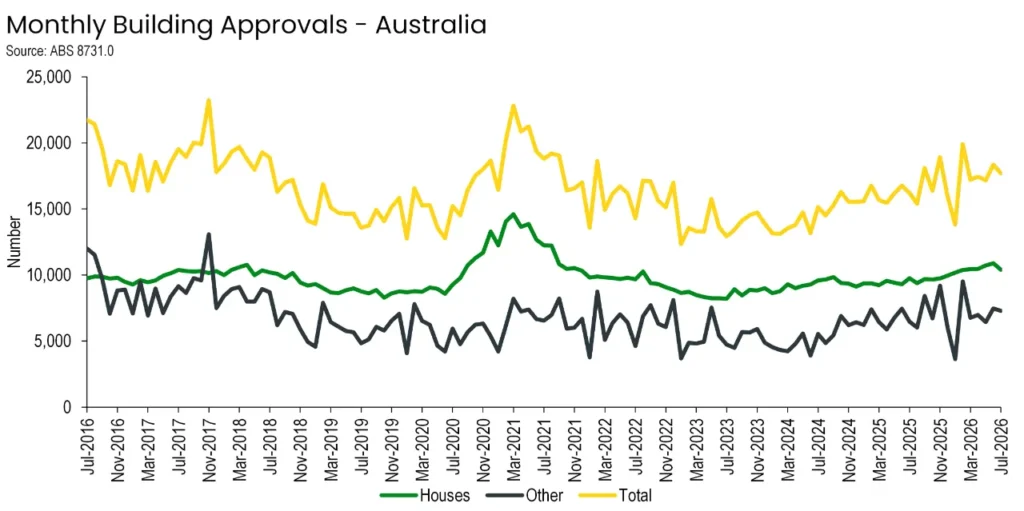
Building approvals for new homes fell 3.6 per cent in July, with detached houses down 4.5 per cent and multi-unit approvals falling 2.4 per cent, according to new Australian Bureau of Statistics data.
The monthly decline comes despite approvals remaining well ahead of the same period last year, highlighting the increasingly uneven outlook for Australia’s housing construction pipeline.
HIA Senior Economist Tom Devitt said approvals over the three months to July were 8.3 per cent higher than a year earlier, driven by a 12.4 per cent lift in house approvals.
Multi-unit approvals were 2.5 per cent higher.
“There are long lags between changes in market conditions, building approvals and construction activity,” Mr Devitt said.
He said new home building had entered 2026 with “good momentum”, supported by strong population growth, low unemployment and persistent housing shortages.
But that momentum is now facing a series of headwinds.
“This year, the Australian government has increased taxes on housing investors, while restricting the ability of SMSFs to invest in housing,” Mr Devitt said.
“Combined with rising interest rates, global conflict and surging fuel costs, this has interrupted an expansion in home building that was already underway.”
The supply warning for agents
For real estate agents, the significance extends beyond construction activity.
A sustained slowdown in new-home supply could further tighten an already undersupplied market, while changes to investor participation have the potential to affect both established property transactions and rental stock.
Mr Devitt said the impact of weaker established-market activity was already flowing through to the new construction pipeline, with new home sales declining for three consecutive months to July.
“This adverse shock to new housing supply is yet to emerge in building approvals data,” he said.
He also pointed to a sharp decline in established-market lending, saying loans to investors had fallen almost 20 per cent in the first half of the year.
Dwelling prices are also declining nationally, “especially in Melbourne and Sydney”, he said.
Immigration adds another layer
The latest approvals data also lands as the role of migration in Australia’s housing equation comes under renewed scrutiny.
CEDA Chief Executive Melinda Cilento has warned that calls for major reductions in migration need to account for the economic consequences beyond housing demand.
Ms Cilento said migration policy could not be viewed in isolation from the labour market and the industries that rely heavily on migrant workers.
ABS data cited by CEDA shows 6.9 million jobs were held by migrants in 2022-23.
The construction sector is particularly relevant to the housing debate, with around one in five construction workers identified as migrants.
Healthcare and social assistance has an even higher reliance, with more than one in three workers coming from abroad, while migrants account for nearly 40 per cent of employment in transport and logistics.
That creates a potentially important tension for housing policymakers: reducing migration may ease some demand pressure, but it could also reduce the workforce available to build the homes Australia needs.
“As the debate on immigration policy continues, transparency around what these trade-offs look like and how they will be managed needs to be the starting point for policymakers,” Ms Cilento said.
Where approvals are holding up
Despite the national monthly fall, several states are still recording significantly higher approval levels than a year ago.
In seasonally adjusted terms, Tasmania recorded the strongest three-month increase, with approvals 44.9 per cent higher than a year earlier.
Queensland followed at 24.0 per cent, ahead of Western Australia at 15.3 per cent, South Australia at 9.5 per cent and Victoria at 2.8 per cent.
New South Wales was the only state in the comparison to record a decline, down 1.3 per cent.
In original terms, approvals in the Northern Territory were 60.8 per cent higher, while the Australian Capital Territory recorded a 15.6 per cent decline.
For agents, the message from July’s figures is less about one month’s fall and more about what happens next.
Approvals are still above last year’s levels, but weaker new-home sales, softer investor lending and rising financing and construction costs suggest the pipeline could come under greater pressure in the months ahead.
And with policymakers simultaneously debating migration settings, investor taxes and housing affordability, the industry’s supply challenge is becoming increasingly difficult to separate from the broader economic policy debate.
“Increasing the supply of housing and sustainably improving affordability requires the cost of construction to be reduced,” said Mr Devitt.