

Australia’s regional property market is entering a fundamental structural shift, with traditional lifestyle hotspots slowing down and buyers pivoting toward affordable interior and resource-heavy markets, according to new research from Ray White Group.
Following a volatile start to 2026 marked by persistent inflation, global uncertainty, and major investment policy shifts, real estate analysts say the decade-long regional expansion has officially entered a distinct fourth phase.
The latest national data shows regional house prices rising approximately 12 per cent over the past year, with regional sales accounting for 35.1 per cent of all transactions nationwide.
However, beneath that top-line performance sits a complete reversal of market momentum.
Ray White Group economist Atom Go Tian noted that the market is undergoing a period where former high-flying coastal destinations are being replaced by previously overlooked inland areas.
“Could we be entering a fourth phase? If we are, it’s one where the old winners have become the laggards, and a genuine broadening is underway as buyers hunt for value in an increasingly expensive market,” said Mr Tian.
To understand the current pivot, market analysts track regional Australia’s trajectory across three distinct eras leading into today’s conditions.
The first phase began before the pandemic, when buyers focused heavily on satellite cities within commuting distance of Sydney and Melbourne.
Between 2016 and 2019, those specific regional hubs captured the majority of buyer activity while the rest of regional Australia saw modest annual growth of three to five per cent.
Regional Australia’s share of national home sales held in a tight band between 35 and 36 per cent throughout that period.
The pandemic and the rapid adoption of flexible working arrangements ushered in the second phase; free to prioritise lifestyle over commute times, buyers flocked to the coast and country.
The Gold Coast and Sunshine Coast became the prime examples of this surge, driving a broader wave that saw regional annual price growth peak near 28 per cent.
By May 2021, regional home sales reached 38.9 per cent of total national sales, marking a decade-high share.
As coastal prices spiked toward capital-city levels, buyers shifted focus again from lifestyle toward work opportunities.
Between 2023 and 2025, a third wave swept through mining and resource regions across Queensland and Western Australia, adding another six to eight per cent to regional values.
However, because those transactions were concentrated in a smaller number of markets, regional Australia’s share of national sales fell to a low of 34.3 per cent in mid-2024.
Now, mapping every regional statistical area level 2 (SA2) by median house price and annual growth demonstrates that the fastest growth is being captured by affordable western and interior markets, while expensive coastal locations lag behind.
“Five years of lifestyle migration did what strong demand always does,” Mr Tian said. “It lifted coastal prices to a point that increasingly sits beyond the reach of the next buyer in line.”
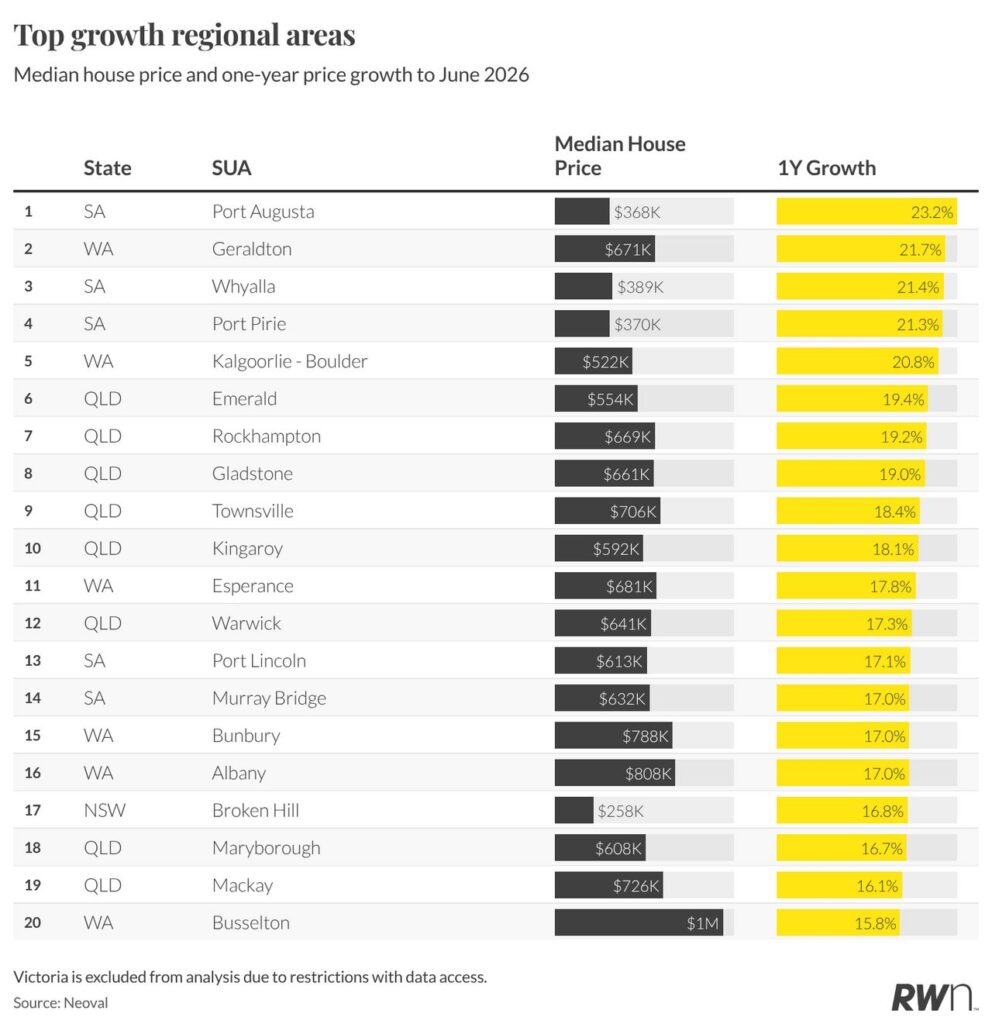
When ranking regional Australia’s SA4 statistical areas by annual growth, the geographic concentration becomes clear.
The fastest-growing regions are located almost entirely in Western Australia’s Outback South and Wheat Belt, South Australia’s Outback, and a string of inland Queensland regions stretching from the Darling Downs to Central Queensland.
Even in New South Wales, the inland Far West and Orana region leads the state, while coastal markets fill the lower end of the table.
Mr Tian explained that two distinct underlying forces are driving this trend.
“Affordability explains the shape. Growth is running fastest exactly where prices are lowest, which is why the ranking sorts so cleanly by price. The resource economy explains which of those affordable regions lead. The areas at the very top are agricultural and mining country, where local industry gives cheap housing a working economy to stand on,” he said.
While part of the current momentum reflects a structural recovery from the regional downturn of the late 2010s rather than purely fresh demand, industry professionals are watching closely to see if the trend sustains itself.
“One year does not make an era, and the months ahead will test whether this is a genuine fourth phase,” he said.
“Either way, the task now is less about forecasting the next hotspot than about reading the map honestly. Growth is broadening, the old order is loosening, and the places that were long overlooked are quietly moving to the front.”