
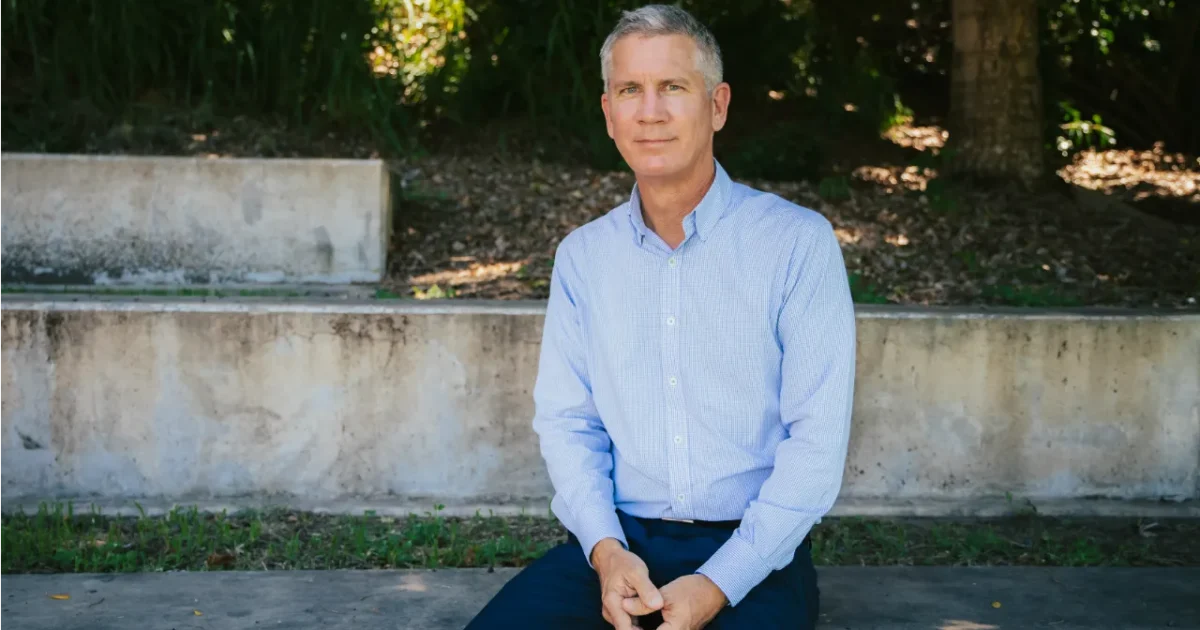
Few industries have evolved as quickly or as visibly as real estate.
Technology has reshaped how properties are marketed, how buyers search, and how agents operate day to day.
But according to Explore Property founder Andrew Acton, the fundamentals of what makes a great agent have barely changed.
After nearly 25 years in the industry, Andrew has had a front-row seat to that transformation.
“I remember when realestate.com.au was offering you a free spot on the site as they tried to establish themselves,” he said.
“I remember RP Data just getting going. I remember deciding if you wanted black and white or colour ads for the Saturday paper.”
The tools, platforms and processes have all evolved. But the core of the profession, he says, remains unchanged.
“I think great agents are basically as they’ve always been. They are great at building relationships and getting people to go with them and believe in them.”
That perspective sits at the heart of how Andrew views both leadership and long-term success in the industry.
Real estate is a business of decisions
Strip everything back, and Andrew believes real estate is defined by one thing.
Choice.
“Real estate, like all businesses, is a business of decisions,” he said.
It is not just the big, career-defining moments that matter, but the small, consistent decisions made every day.
How agents respond to challenges, how they handle setbacks, and how they choose to interpret the situations in front of them.
“You decide to accept challenges and meet them as they are. You decide to work through them and rise above them.”
That mindset, he says, is what separates those who endure from those who burn out.
Resilience, courage and consistency are not optional traits. They are the baseline required to stay in the game long enough to succeed.
The reality of mountains and valleys
One of the frameworks Andrew returns to often is what he describes as the law of mountains and valleys.
“If you want to climb mountains, you have to go through valleys to get there,” he said.
It is a simple idea, but one that reframes how agents view adversity.
Too often, people treat difficult periods as exceptions. In reality, Andrew argues, they are the norm.
“As soon as you reach the top of a mountain, you look across to the next one and the only way to get there is through a valley.”
That perspective removes the element of surprise from challenges. Instead of reacting emotionally to setbacks, agents can begin to expect them, prepare for them, and work through them with greater clarity.
“I’ve always wondered why people are so surprised at the difficult situations that arise when in reality they are just the norm. That’s business and that’s life.”
It is a mindset reinforced by a quote he recently came across from Winston Churchill.
“Success is not final, failure is not fatal. It is the courage to continue that counts.”
For Andrew, it is a reminder that progress in real estate is rarely linear.
Cutting through the noise
Despite the increasing complexity of the industry, Andrew believes one of the biggest risks for agents today is overcomplicating things.
“We make things complicated and that’s being forced on us a bit by the world in general,” he said.
Between new technologies, data platforms, and constant demands on attention, it is easy for agents to lose focus on what actually drives results.
His approach is to strip things back.
“We need to believe in ourselves and cut through the jargon and never-ending demands.”
That does not mean ignoring innovation. It means not allowing it to distract from the fundamentals.
At its core, real estate is still about people.
And that is where Andrew believes many agents lose their edge.
Why human connection still wins
With the rapid rise of AI and automation, there has been increasing discussion about how technology will reshape the role of the agent.
Andrew sees it differently.
“I don’t see the threat of AI. I see it pushing people to seek the personal connection even more.”
While technology can enhance efficiency, provide insights, and create opportunities, it cannot replace the human element that underpins every transaction.
“Someone has to have the human conversations,” he said.
And in an industry built on trust, emotion and high-stakes decisions, those conversations matter more than ever.
“You can have data-driven opportunities, but if you can’t talk to and engage at a high level with people, the tech, data, AI is useless.”
It is a point he believes is already playing out across the market.
“The opportunities are created, but then the final piece is the human-to-human contact.”
Without that final step, even the best systems fall short.
People still choose people
Ultimately, Andrew’s philosophy comes back to a simple truth.
“People go with who they like.”
In an industry that often focuses heavily on systems, scripts and strategies, he believes likeability remains one of the most underrated assets an agent can develop.
And it is one that cannot be automated.
“Being likeable is a human trait only,” he said.
That belief has shaped the way Explore Property has been built.
Positioned between large franchise models and independent operators, the group has focused on creating a network that prioritises connection, support and shared values.
“We have a closely connected, boutique-style network that values relationships and support. That’s our point of difference.”
For Andrew, the goal has never been to follow the traditional paths available in the industry, but to create something that reflects how he believes real estate should be done.
Working with good people. Supporting each other. And maintaining a strong focus on the human side of the business.
“That’s what our life here at Explore is about,” he said.
In a market that continues to evolve at pace, Andrew’s message is clear.
The tools will change. The platforms will change. The pace will accelerate.
But the agents who succeed will still be the ones who can connect, communicate, and build trust.
Because in the end, real estate has always been, and will remain, a people business.