

In a market more commonly associated with mining cycles than multimillion-dollar prestige sales, a new benchmark has been set in Karratha, forcing a rethink of what “premium” really looks like in regional Western Australia.
Just weeks after opening Acton | Belle Property Karratha, principal Dylan Rakich has delivered a standout off-market result, securing a $2.7 million sale in Baynton that has reset the region’s residential price record.
The transaction at 27 Nyamina Road, Baynton represents not just a new high-water mark for Karratha, but a signal that tightly held Pilbara markets are capable of producing capital city level outcomes in places few would expect.
“It probably would have sat in the low twos if it had gone to market,” Dylan said. “But it was about timing, alignment, and understanding both sides of the equation.”
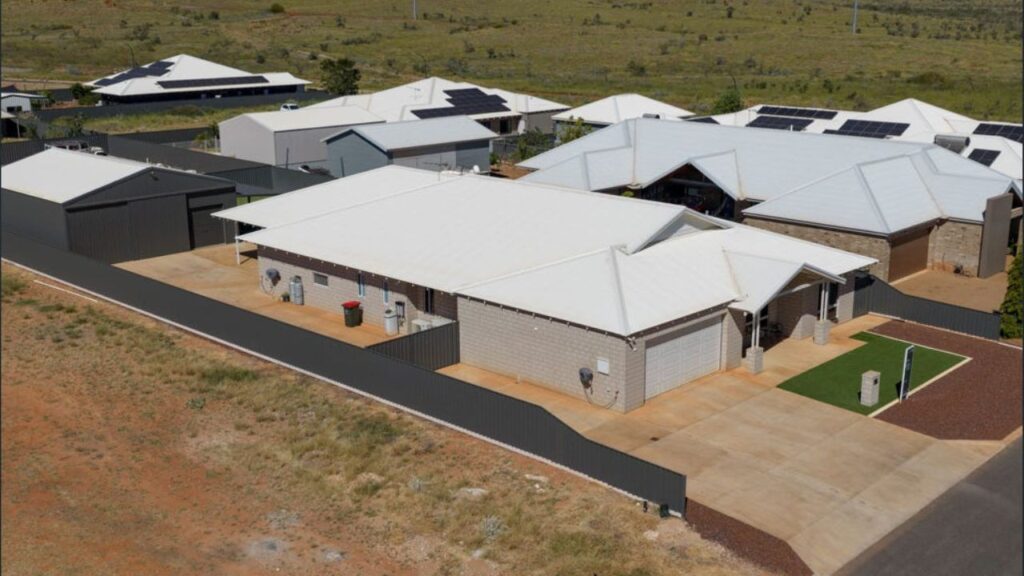
That alignment proved decisive. The buyers, local business owners already established in the area, had made it clear they were willing to stretch beyond $2 million for the right long-term family home. The vendors, meanwhile, were not actively selling but were open to the right opportunity given their longer-term relocation plans.
What followed was a tightly managed, relationship-driven negotiation that culminated in a $2.7 million agreement, significantly above the previous Karratha residential record of $2.15 million, also set by Dylan in September 2025 in Dampier.
A market where $2 million is still an outlier
To understand the significance of the result, you have to understand the market context.
Karratha, a remote Pilbara hub roughly 1,500 kilometres north of Perth, is best known as a critical service and logistics centre for Western Australia’s resources sector; it is not a traditional prestige market.
In Baynton, where the record sale occurred, median values sit well under $1 million, with most transactions clustering closer to the high $800,000 range. Even in the broader Karratha market, properties above $2 million remain rare, often limited to bespoke builds or highly specific lifestyle offerings.
“We are not a market with 10 to 15 buyers at any one time with $2 million plus budgets,” Dylan said. “Sometimes there is one. Sometimes there are two. And when they transact, it shifts the top end.”
That scarcity is precisely what makes results like this possible and increasingly, repeatable.
Off-market strategy driving the new top end
The sale was negotiated off-market, following a targeted introduction based on known buyer demand.
Dylan identified alignment between a qualified buyer profile and a tightly held property that was not formally listed for sale. From there, the deal evolved over a two-week negotiation process that moved through multiple price points before settling at $2.7 million, a figure reached while Dylan was overseas in Japan.
“The final stages came down to timing and circumstance,” he said. “You are dealing with people who cannot replace the property in today’s market, even over a two to three year horizon, so the value shifts.”
That make me move dynamic, increasingly common in constrained regional markets, is becoming a defining feature of high end Pilbara transactions.
A small town with outsized market behaviour
Despite its remote location and modest population base, Karratha behaves in ways that increasingly resemble a micro high end ecosystem.
Employment cycles tied to mining and energy, combined with a transient but well remunerated workforce, continue to drive demand for quality housing stock, particularly at the top end where supply remains structurally limited.
But as Dylan points out, in country towns, relationships, not just economics, underpin outcomes.
“This is a community where you see the same people at the shops, at the gym, at the pub,” he said. “Trust and reputation matter because if you lose that, you lose your market.”
That dynamic creates a tightly interwoven buyer and seller pool, where agents often represent both sides of the transaction lifecycle within short timeframes.
A new benchmark and a shifting ceiling
The $2.7 million result is unlikely to be the last record to fall in the region.
Recent comparable sales in nearby Dampier have already edged into the low $2 million range, suggesting incremental upward pressure at the very top of the market, particularly for newly built or architecturally considered homes.
But whether Karratha sustains this level of pricing remains uncertain.
“I do not know if it holds forever,” Dylan said. “But for now, it is probably a fairly strong benchmark given the scarcity of stock and the replacement cost environment.”
What is clear is that the traditional assumptions around regional price ceilings are being tested, not by volume, but by highly specific, relationship driven transactions that sit outside the standard market cycle.
Early momentum for a new office
For Acton | Belle Property Karratha, the result represents a significant early milestone, coming just weeks into operation and ahead of any meaningful scale in listings volume.
Dylan has set a target of 50 transactions within the first 12 months, with ambitions to expand into a broader team structure as momentum builds.
“It is a relationship business first,” he said. “The sales follow from that.”
In a market better known for resource exports than record setters, Karratha has delivered a reminder that price ceilings are rarely fixed, they are negotiated.
And sometimes, they are negotiated from the most unexpected corners of the country.