
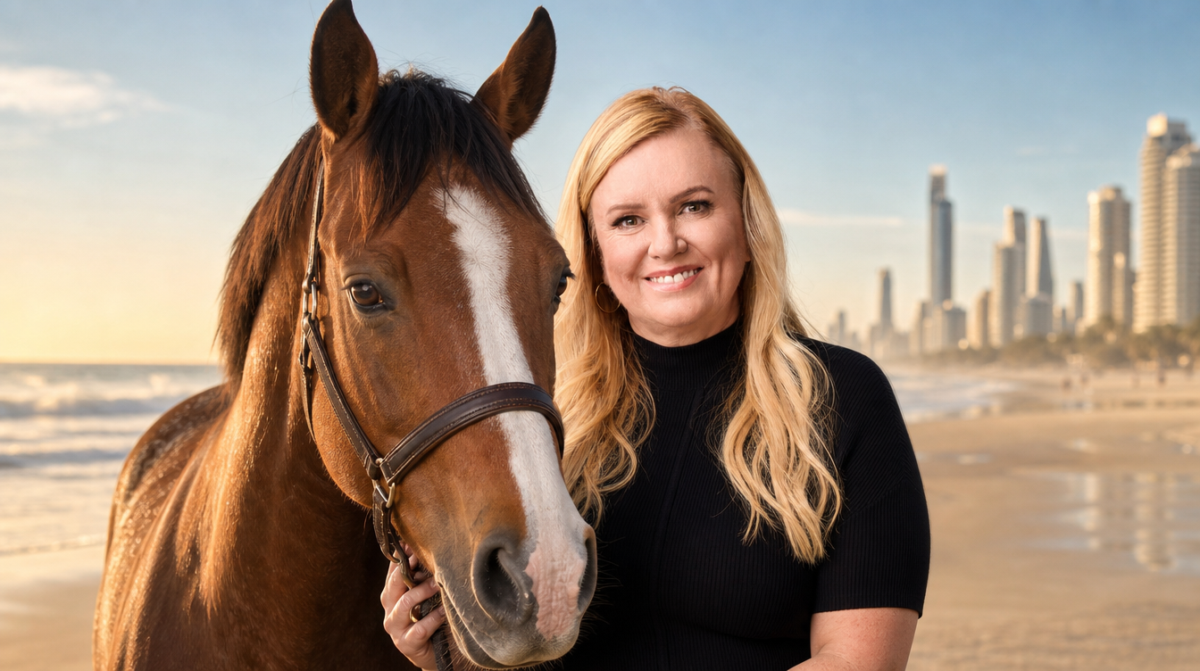
By now you’ve probably seen it. A Riverhills listing in Brisbane, led with a postcard-perfect hero image: horses leaning over a timber fence, stables, the whole lifestyle fantasy. Click a few photos deeper and the backyard was empty. No horses. No stables. Just grass.
The agency director, Helen Saba, defended the image. She’d actually rung the council to ask whether horses could be kept on the property, and council said they might be – subject to approval. So the picture, she said, was meant to “illustrate a potential lifestyle opportunity,” not to suggest the horses were already there.
Here’s what I hope was happening: I think she was trying to sell a lifestyle, which is the job. But the horses ended up unlabelled, in the hero slot, with the backyard looking nothing like it.
And that’s the bit that turns a good intention into a problem.
It’s not an isolated case. News.com.au pointed to other examples too – including a Ray White Aspley listing where the hero shot showed a pristine white house with a picket fence, while the actual home had a chain-link fence and a different paint job entirely.
Ray White Aspley Group CEO Robert Green apologised, and said something I thought was genuinely fair: “AI technology is new, and its use in real estate is uncharted territory.
“We want to be part of the conversation and help navigate how AI can be used ethically within our industry.”
Then there was the Ross Realty listing in WA, where a generous-looking lounge turned out to barely fit the sofas that had been crammed in for the shoot.
So let’s have the conversation. Because the answer isn’t that all “AI images are bad.” The answer is that many agencies are using a genuinely useful tool in the wrong place.
What the law actually says (it’s simpler than you’d think)
There’s no blanket rule against editing real estate photos.
Lighting, wide lenses, tidying up, staging – all generally fine, especially when it’s labelled.
Emily McMullan, principal solicitor at McMullan Lawyers, put the real test plainly to news.com.au: under Australian Consumer Law, “property advertising cannot be misleading or deceptive – and that covers the words, the images, the medium and the overall impression.”
That’s the whole thing. Not “did you use AI…” Photoshop has been able to alter images digitally for years.
It’s “does the overall impression mislead the buyer.”
A coffee table that isn’t there? Low stakes.
A fence, a paint colour, or livestock that change what the property fundamentally is?
Now you’re on a spectrum that ends in broken trust – lost listings, an unhappy buyer, and a regulator who’s increasingly interested.
And here’s where a lot of the coverage gets it slightly wrong. People keep pointing to the NSW rental rules – the Residential Tenancies Amendment (Protection of Personal Information) Bill 2025, which would require disclosure when a rental image has been altered in a way that could mislead, with proposed penalties of $5,500 for an individual and $22,000 for a business.
But read the word that matters: rental. It doesn’t touch sales advertising – and it isn’t even law yet. It passed the Legislative Assembly in October 2025 but, at the time of writing, is still before the Legislative Council, referred to committee for inquiry. So you can’t rely on it as the rule for a sales campaign – or any campaign… yet.
For the listings in this story – all of them sales – the relevant law is bigger, and it’s already here. Under the Australian Consumer Law, making false or misleading representations about land (section 30) is the exposure, and since the recent penalty increases, the maximum penalty for a company is the greater of $100 million, three times the benefit gained, or 30 per cent of turnover during the breach period.
In Queensland, where two of these listings sit, the Property Occupations Act 2014 (section 212) separately prohibits false or misleading representations about a property, with penalties of up to 540 penalty units (currently around $90,000). So $22,000 isn’t the ceiling. It’s the small end of the stick.
California’s Altered Image Law (AB 723), in force since 1 January 2026, requires agents to clearly label materially digitally altered images and to make the unedited originals available alongside them – including via a link or QR code. Breaching it is a misdemeanour – a criminal offence, not just a civil one.
And, in November 2025, the New York Department of State issued a public ‘trend alert’ warning homebuyers about a sharp rise in AI‑generated listing photos and the deceptive‑advertising risks they pose. NSW, California, New York – the law isn’t catching up. It’s already here. The agencies that get ahead of it now are the ones who’ll never have to apologise later.
Meg Dalling from the Consumer Action Law Centre had the line that should sit uncomfortably with all of us: buyers, she said, now have to “start from the point of scepticism.”
Read that again. The default posture of the Australian home buyer towards our industry isn’t trust. That’s the actual cost here – not one embarrassing listing, but yet another slow erosion of the thing our entire industry runs on.
The simple rule: the portal is for what is
Here’s where I’d draw the line, and it’s clean enough to train a whole team on.
The portal or anything public shows reality. Professional photography of the property as it actually exists. That’s non-negotiable.
The public listing or advertisement is a factual document, not a mood board.
If a buyer can stand in the room and feel deceived, you’ve failed the McMullan test – regardless of whether a court ever gets involved.
It’s also worth asking how the horses got onto the portal at all. The major portals have their own image and virtual-styling standards, and the obvious question this story raises is one of enforcement – how did an unlabelled fantasy make it all the way to a live hero image?
In California, the listing platforms have become the enforcement layer – the MLSs there rewrote their own rules (CRMLS Rule 11.5.2) to mirror AB 723 and demand the original alongside the altered one. Maybe we will see something similar from our portals too.
But my advice: don’t wait for the portal to catch it. The standard has to start in your office, not someone else’s.
So if AI doesn’t belong on the hero image… where does it belong?
In the conversation: That’s where it can be genuinely useful.
Move the tools into the 1:1
The mistake everyone’s making is treating AI imagery as advertising. It’s not. It’s a conversation tool.
And the moment you move it from a public advertisement to a private, labelled, sitting-down-with-someone context, having a reasonable conversation about what could be, the value goes up.
In the olden days before magazines became extinct, we went through photos of celebs and asked the person with the scissors, “Will this suit me?”
These days, we have an app on our phones that will show you exactly how those bangs will look before you let anyone near your hair with scissors. (Something I wished I’d had in the 80s when everyone thought spiral perms were a good idea… )
Same principle here: some folks who are visual people need a visual:
- A young family walks the empty fourth bedroom and sees… an empty room. So you sit beside them and show a version set up as a kids’ playroom, clearly marked “a possible layout – AI visualisation.”
- A downsizer wants to see the same room as a reading nook and a guest bed.
- An investor wants to see a multi-family configuration or a study for a future tenant.
Same house – three completely different use cases.
AI lets you have a personal 1:1, visual conversation about potential with each cohort – without ever pretending any of it already exists. Clearly labelled as a tool, you’re helping someone see themselves in the home – which is one of the advantages of using AI well.
So the horses, honestly, could have been a brilliant idea – if they’d stayed off the advertisement.
But, moving an image off the ad doesn’t move it outside the law. The Australian Consumer Law covers what you say and show in a lounge room just as much as what you publish online. What counts is the honest framing and the clear label.
Which is exactly this rule should hold wherever the image lives: if it isn’t real, you say so.
Where AI can be genuinely useful
You know the awkward styling conversation. The one where you have to tell lovely people that the maximalist feature wall, the cluttered garage, and the tired front fence are costing them buyers. It’s a hard conversation because you’re asking them to spend money and effort on a hunch.
Now imagine showing them. “Here’s your living room as it is. Here’s the same room decluttered and styled. Here’s the façade if we repaint the fence and tidy the garden.”
Suddenly the decluttering and pre-sale spend isn’t your opinion versus theirs – it’s a side-by-side they can see. AI turns “trust me” into “look.” It makes the renovation-for-sale and styling conversation concrete, and it helps vendors make confident decisions faster.
When Mark and I renovated our Broadbeach Waters home – his sixth flip, on a brutally tight timeline before auction – I used ChatGPT and Midjourney to visualise the designs before we committed a cent to tiles.
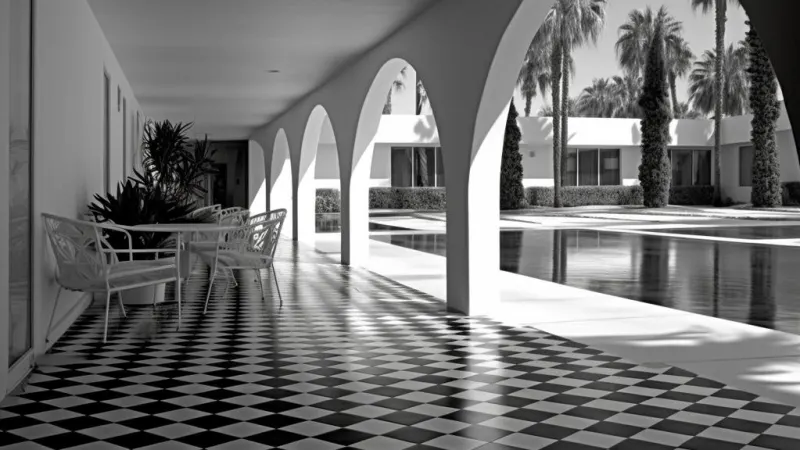

The part that’s easy to skip past: AI imagined it, but Mark still did every bit of the actual hard work.
That’s AI working for the relationship instead of against it.
Two things to put in place this week
1. Be transparent, on purpose. Transparency isn’t a confession – it’s a positioning. The agent who says “yes, we use AI, and here’s exactly how, and here’s where we’d never use it” is the agent who looks like they’ve thought about this harder than anyone else on the street.
If you don’t have an AI usage policy yet, we built a free one to get you started – the Elite Agent AI Policy Generator at aipolicy.eliteagent.com. It drafts a customised policy in a couple of minutes, informed by Australia’s AI Ethics Framework and the REIA Code of Ethics. (It’s a starting point, not legal advice – tailor it to your circumstances.)
2. Train your team. This is the one I’d underline. AI in the right hands is a tool that can help build trust. In untrained hands, it’s a misleading-conduct complaint, a headline with your agency’s name in it, and – for a business that gets it badly wrong on a sale – exposure that runs into the millions, not the thousands. The situations weren’t caused by bad people – they were caused by powerful tools moving faster than the rules and the training around them. This is happening in every industry.
Every person in your office who touches a listing needs to know the line: portals show reality, the consult shows possibility, and everything that isn’t real gets labelled – wherever it lives. That’s a ten-minute team meeting that could save your brand.
Use the tool. Tell the truth. Train your people.