
A decade ago, the “million-dollar suburb” was almost exclusively an Auckland phrase. Analysis from Ray White Group economist Atom Go Tian shows that in 2016, New Zealand had 79 suburbs with a median house price above $1 million, and 76 of them were in Auckland.
The only other three were Kennedys Bush in Christchurch, Opito Bay on the Coromandel Peninsula, and Kelvin Heights in Queenstown.
The pandemic boom pushed million-dollar suburbs into almost every region, but the downturn that followed pulled many of them back, and unevenly.
Wellington’s count fell from 37 to 11. Auckland’s eased from 183 to 135.
Christchurch, by contrast, grew to 12 million-dollar suburbs by 2022 and has kept climbing to 15.
Many smaller markets followed the same pattern as Christchurch, gaining million-dollar suburbs during the boom and holding or growing that tally through the downturn.
According to the analysis, that durability suggests the spread into Canterbury, Central Otago and the Bay of Plenty reflects a lasting shift in the country’s geography of wealth, rather than a temporary effect of the boom.
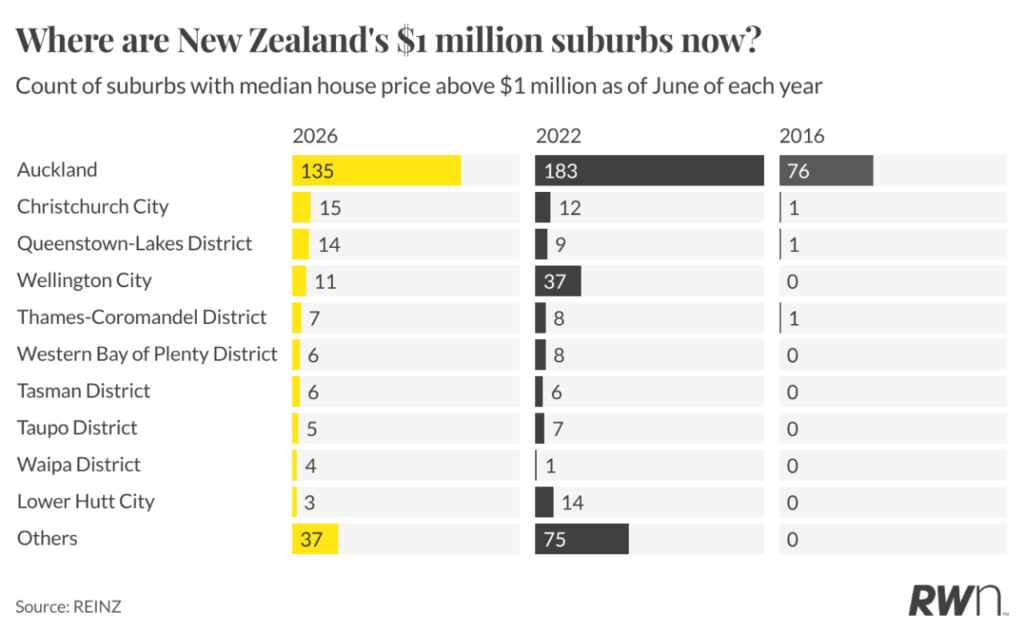
Auckland remains by far the country’s largest concentration of million-dollar suburbs, but its count has slipped from its peak, and the growth has moved elsewhere.
The suburbs closest to crossing the $1 million mark next sit almost entirely outside Auckland, clustered in the regions that held their ground through the downturn.
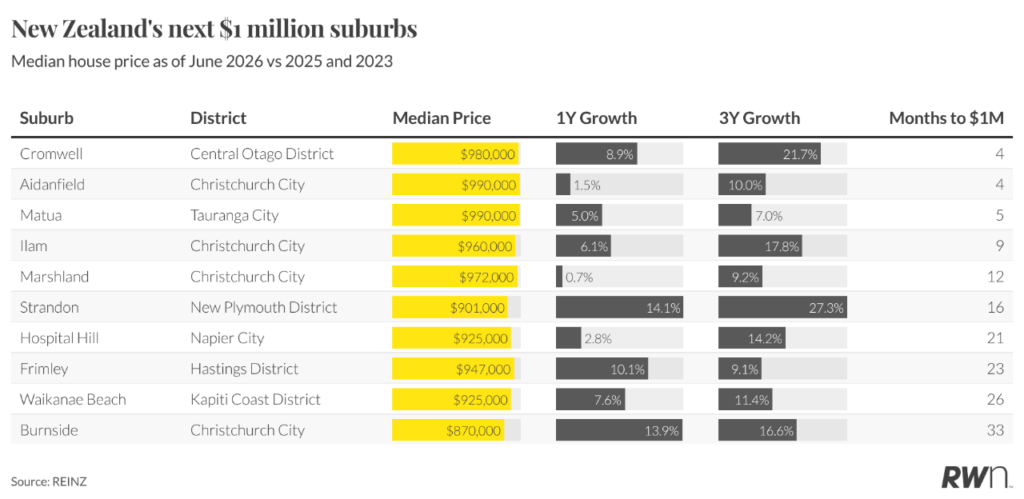
If recent growth rates hold, Cromwell in Central Otago, Aidanfield in Christchurch and Matua in Tauranga – all currently between $980,000 and $990,000 – would cross $1 million within six months, the analysis found.
Ilam and Marshland, both in Christchurch, at medians of $960,000 and $972,000 respectively, would follow within a year.
A second group sits one to two years behind on the same trajectory: Strandon in New Plymouth, Hospital Hill in Napier, and Frimley in Hastings.
Further out again, within two to three years, are Waikanae Beach on the Kāpiti Coast and Burnside in Christchurch – provincial and suburban names that rarely feature in conversations about million-dollar housing.
Auckland and Wellington are notably absent from that pipeline. At current trends, neither city has a suburb approaching $1 million from below.
Prices in both have drifted rather than climbed since the boom, and their existing million-dollar suburbs have thinned rather than multiplied.
That doesn’t mean Auckland is losing its status – it still holds more million-dollar suburbs than the rest of the country combined. But the tag that once belonged to it exclusively no longer does.
The analysis points to Cromwell, Napier and the Kāpiti Coast as the next places where it will turn up.
Whether the $1 million line keeps rising to meet those suburbs depends on the same conditions that carried it there: steady demand, limited supply, and prices with room left to climb.
The figures are based on REINZ median sale prices at suburb level, measured over rolling 12-month periods to June each year, and included only suburbs with at least 30 sales in the past year.
Projected timeframes assume each suburb’s three-year growth rate continues at its recent pace.