
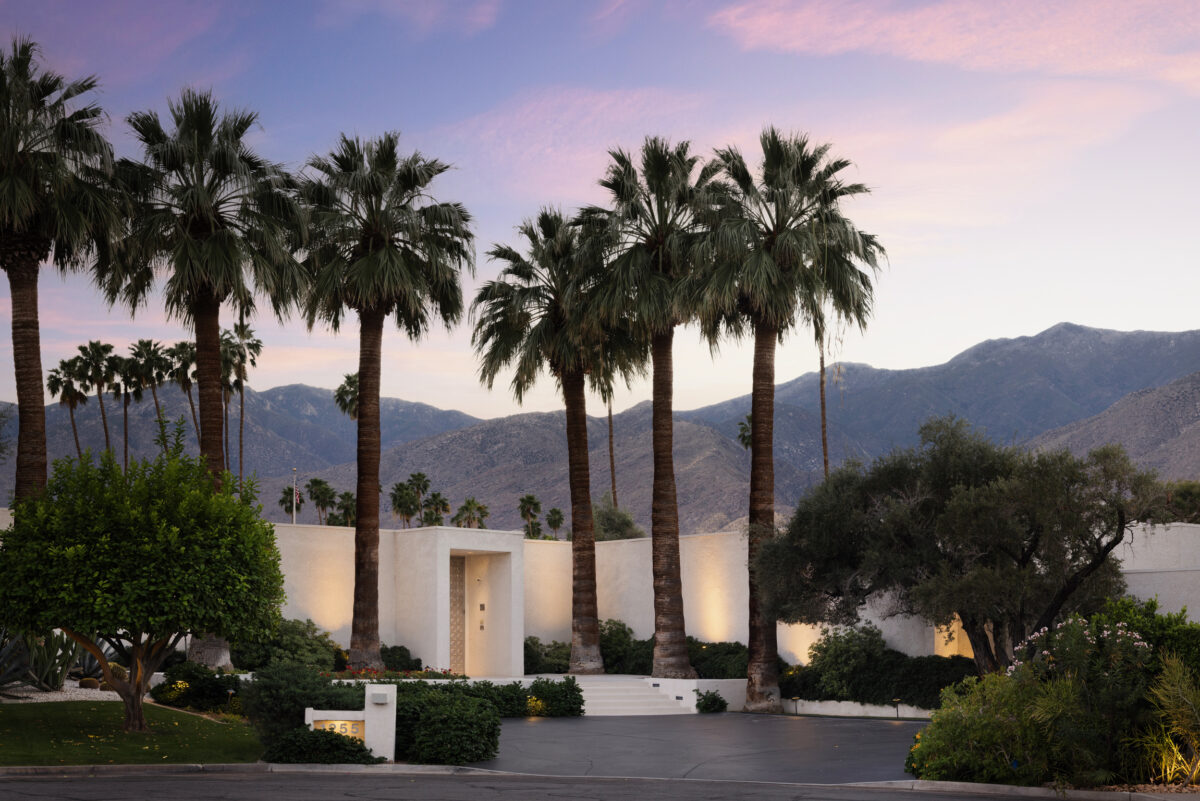
From the street, there is little to suggest what lies behind the towering walls of 1255 E Via Estrella in Palm Springs.
But step through the enormous aluminium doors and the property reveals an extraordinary world of mirrored sculptures, bronze-tinted glass, bold artworks and interiors that have barely changed since 1969.
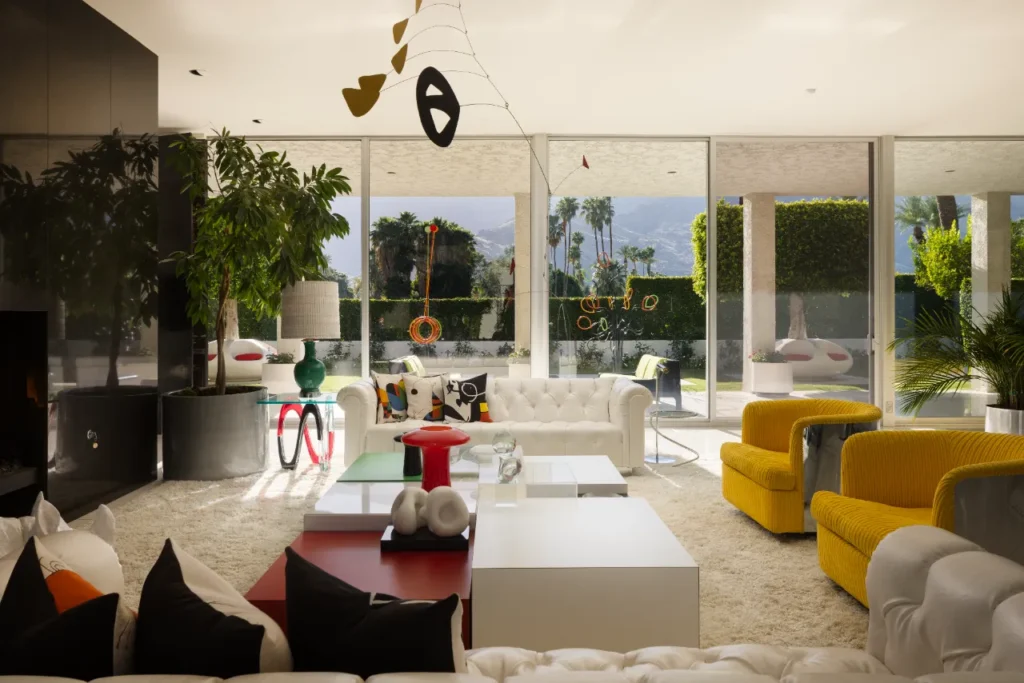
Now on the market for US$6.395 million (approximately A$9.8 million), the Factor Residence is one of the desert city’s more unusual architectural offerings, not least because of the colourful family history behind its creation.
The three-bedroom, five-bathroom estate was built for financier Jerome Factor, whose father was a notorious Chicago swindler, whose uncle helped build one of Hollywood’s biggest beauty empires, and whose family story included kidnappings, gambling interests and a presidential pardon from John F. Kennedy.
And while most homes of this vintage have undergone substantial renovations, this one has retained so much of its original character that even the cocktail napkins at the bar reportedly date back to the original owners.
From Chicago’s underworld to Palm Springs glamour
The story begins long before the house was built, with Jerome’s father, John ‘Jake the Barber’ Factor.
A convicted swindler with reported connections to Chicago’s criminal underworld, Jake was also the half-brother of Max Factor, the Hollywood make-up pioneer whose cosmetics empire became a household name.
In 1933, the family found itself at the centre of two sensational kidnapping cases.
Jerome, then 19, was abducted in Chicago and held for eight days before being released.
His father subsequently reported his own kidnapping, although the circumstances surrounding that incident became the subject of decades of legal disputes and competing accounts.
Jake later became involved in the Stardust Hotel and Casino in Las Vegas, a property that would become synonymous with the city’s colourful gambling history.
But perhaps the most remarkable twist came on Christmas Eve in 1962, when President John F. Kennedy granted Jake a full presidential pardon for a 1943 mail-fraud conviction.
The pardon was also signed by Attorney General Robert F. Kennedy.
Several years later, Jerome commissioned a Palm Springs retreat that would become a showcase for art, architecture and the kind of lavish entertaining associated with the desert playground’s Hollywood heyday.
A home built to impress, and to disappear
Designed in 1969 by Los Angeles architects Hank Webber and Don Staska, the 508sq m residence takes privacy to an entirely different level.
A nearly windowless, 3.7-metre-high stucco wall shields the house from the street, while monumental three-metre-high aluminium doors provide the dramatic entrance.
Inside, the atmosphere changes completely.
Soaring ceilings, terrazzo floors, bronze-tinted glass and a polished black granite fireplace create an interior that feels more like a private art gallery than a conventional family home.
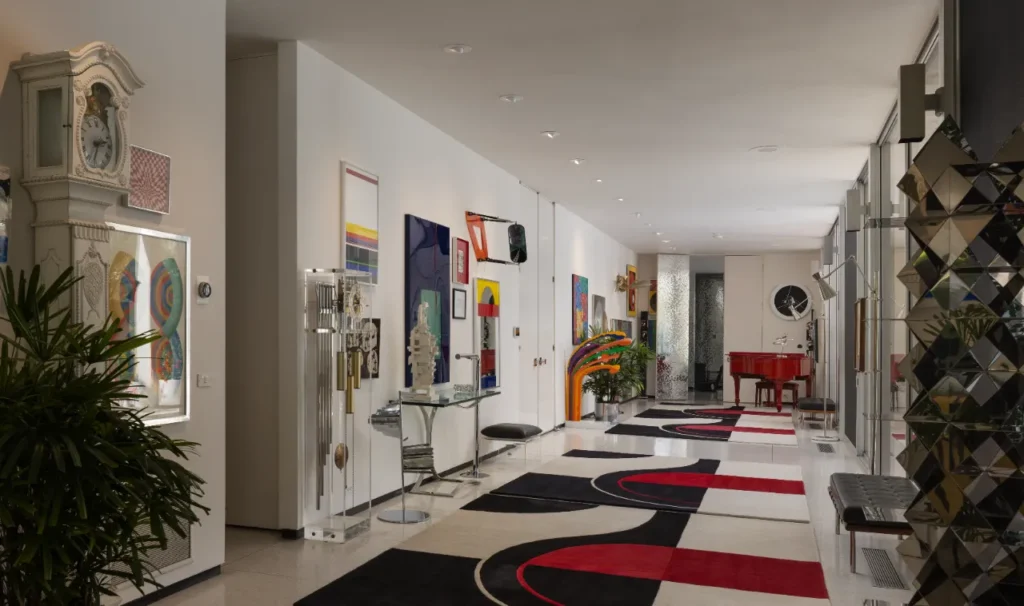
Chicago interior designer Richard Himmel was responsible for the original decorative scheme, combining 19th-century Chinese Coromandel screens with Lucite, chrome, mirrored sculpture and striking contemporary furniture.
Himmel, who was inducted into the Interior Design Hall of Fame in 1985, also designed interiors for Hugh Hefner’s Playboy Club and Resort at Lake Geneva.
The Factor Residence was featured across six pages of House Beautiful in April 1973, and remarkably, much of what appeared in those photographs is still in place today.
According to the listing agent, the surviving details extend beyond the furniture and artwork to family photographs and the original cocktail napkins.
The home was also designed around the Factors’ significant collection of postwar contemporary art.
A long terrazzo gallery and expansive display walls accommodate works attributed to artists including Alexander Calder, Victor Vasarely, Francisco Sobrino and Jesús Rafael Soto.
The original art and furniture collection is available to purchase separately, potentially allowing a new owner to preserve the complete decorative scheme.
And for buyers who like to entertain, the house has another extraordinary feature.
According to its original House Beautiful coverage, the swimming pool could be covered to create a dance floor, while the landscaped grounds could accommodate tented dinners for as many as 300 guests.
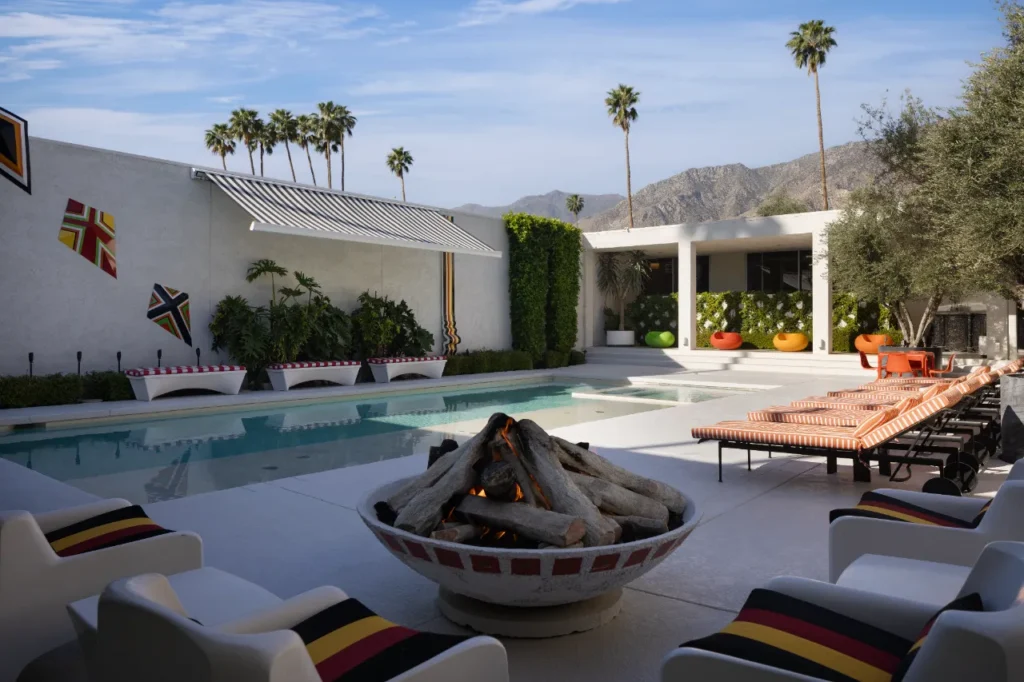
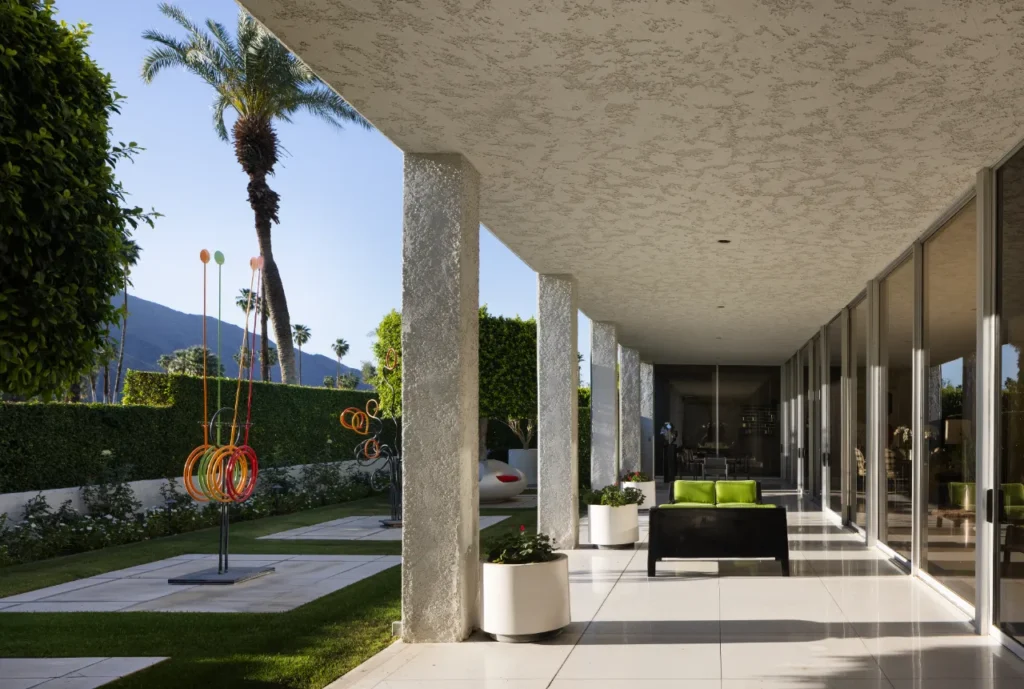
There is also a sunken granite-topped bar, a built-in hibachi and extensive indoor-outdoor entertaining areas.
Set on approximately 2,266sq m alongside the Canyon Country Club golf course, the property features views of the San Jacinto Mountains, sculpture gardens, rose gardens and a private pool courtyard.
The original landscaping was designed by David Hamilton, while subsequent owners have refreshed the pool terrace without substantially altering the historic interiors.
For your buyer, the appeal is about more than midcentury architecture or a prestigious Palm Springs address.
It is the opportunity to acquire a house that has survived more than five decades with much of its original personality intact, along with a remarkable connection to Hollywood, Las Vegas and one of America’s more colourful family histories.
The property is listed with Eric Lavey of Eric Lavey + Partners.