
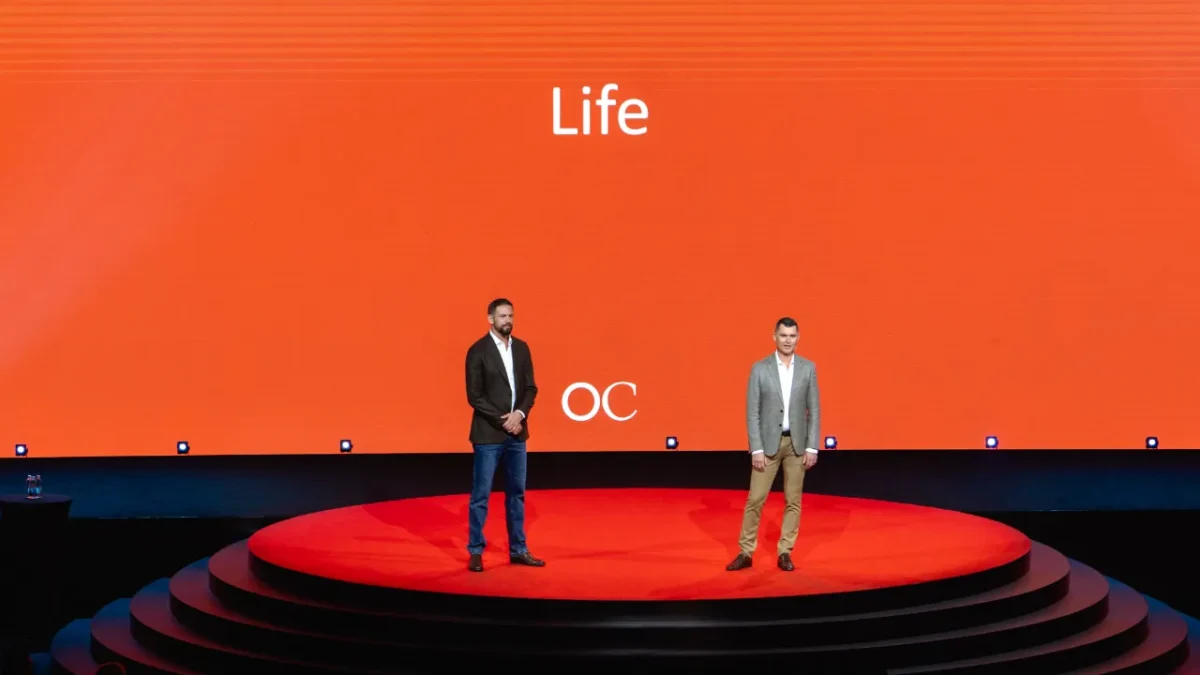
Alex Ouwens’s son was diagnosed with cancer during COVID. Nathan Casserly’s wife broke her pelvis on a ski trip in New Zealand. Both happened while they were scaling OC.
“Life doesn’t care about your business plan,” they told the AREC audience. “You can have the best business plan in the whole world until life punches you in the face.”
The OC co-founders framed their six lessons not as theory but as things they learned when circumstances forced them to.
Build trust before you need it
Fifteen years ago, OC brought in a specialist leadership consultant. He’s still with them. They agreed on productive and unproductive behaviours as a team, building what they call a self-leadership model – before they knew how much they’d need it.
“Your business moves at the speed of trust,” Alex said. “With scale, it’s impossible as a leader to be across everything.”
When life intervened – Alex’s son’s illness, Nathan’s wife’s accident – that trust infrastructure meant the business kept running without them holding every thread.
Ownership changes behaviour
Nathan shared a story from one of their offices. He arrived early after a windy night. Rubbish had blown against the front of the building. He sat in his car and watched as staff arrived. One by one, people walked past it. Some stepped over it.
Eventually, one person stopped and picked it all up. It was a shareholder.
“Something really does change when people actually feel responsibility for a place,” Nathan said. “That’s when culture scales beyond the founders.”
Build your pit crew before pressure hits
Alex said every elite performer has their own pit crew – coaches, mentors, advisers, people you trust when things get hard.
“Sometimes, when you are inside the jar, it’s hard to read the label on the outside,” he said.
OC has had an advisory board in place for more than ten years, meeting monthly with people from different backgrounds who challenge their thinking. But a pit crew isn’t just about business – it’s health, fitness, mindset, family, or simply one person who thinks clearly when you’re under pressure.
Champion teams over individual stars
Five years ago, OC identified half a dozen people aged 18 to 21 – no database, no profile, no real estate experience. Just attitude and work ethic. They put them through a cadetship program and developed them one skill at a time.
“Five years later, most of them are still with us,” Nathan said. “Three of them are in the room here today.”
Those three are now part of some of the highest-performing teams in the business and across Adelaide.
“Not everyone wants to be the number one agent in Australia. Some people want balance. Some want growth. Others want leadership. Our job is to allow people to be their own version of success.”
The customer needs to feel heard
Alex said OC had created too much friction with clients during disputes, particularly in property management. They adopted the Ritz-Carlton model of empowering managers to fix problems immediately, with budget authority in the moment.
“Sometimes, the customer just needs to feel heard, felt and seen,” Alex said. “Reputation is everything. None of us are perfect, but repeated poor experiences shape how the public sees you, your business, and sometimes the entire industry.”
Leading with vulnerability
Early in their careers, both co-founders believed leaders needed to have every answer and never show uncertainty.
“What got us through was actually our ability to put our hand up and say, ‘We need help. We don’t have all the answers,'” Nathan said. “It didn’t weaken our business – it strengthened it. People stood up. Leaders emerged. Trust deepened.”
On their fifteen-year partnership, Alex said they had stayed aligned on their north star, values and agreed behaviours. When they have differing views, they try to step back and ask what the most balanced, wise business mind would do – rather than trying to win the argument.
What OC is building toward 2030
The co-founders closed with what they called their accountability piece – what they want to have built by 2030.
For agencies, they see four priorities: an elite performance platform for agents, AI-enabled real-time dashboards and insights, culture built through shared leadership and empowered people, and disciplined growth decisions that protect profit.
For agents, the requirements shift too. They’ll need to become elite relationship managers – tech fluent, strong communicators, highly trusted, with clear personal brands and clear values.
“Agents are going to need to be disciplined enough to block out the noise,” Nathan said.
What OC will measure: NPS and customer comfort, profitability for shareholders to reinvest in the platform, market share to give back to communities, lead generation, secondary revenue through industry partners, and talent retention.
“The agency will build the platform,” Nathan said. “The people will bring it to life.”
Their closing invitation: build something that can still thrive when life happens – and build it with the people you want to be around each day.
Your Tuesday morning to-do list
- Write down the three behaviours you expect from your team – and the three you won’t accept. If you’ve never made these explicit, do it this week. Trust gets built on agreed standards, not assumed ones.
- Think about the last client complaint that escalated further than it should have. Could the person who first heard it have resolved it on the spot? If not, give your frontline team a budget and the authority to fix problems in the moment.
- Identify one person in your business aged 18 to 25 who has the attitude but not the experience. Offer to mentor them for the next quarter – one skill at a time, no pressure to be a top performer by Friday.
- Ask yourself honestly: when did you last tell your team you didn’t have the answer? If you can’t remember, find one situation this week where you can be genuinely open about what you don’t know.
- Name your pit crew – the three to five people you’d call at 2am if everything went sideways. If you can’t name them, that’s the gap to fill first.