

Long-term renting is no longer just a temporary holding pattern for young Australians saving for a deposit – it is rapidly hardening into a permanent way of life.
Australia has been ranked 15th among 39 OECD member nations in Luxo Living’s Forever Renter Global Index, a new composite study the online retailer says reveals how price decoupling and structural market shifts are embedding lifelong tenancy across advanced economies.
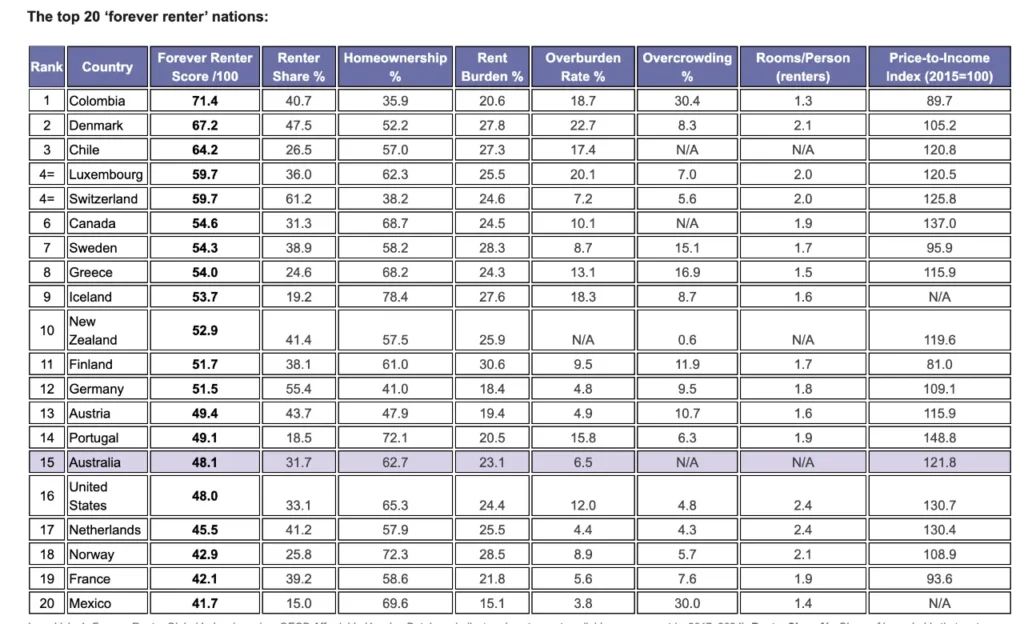
The research, compiled by Luxo Living using OECD Affordable Housing Database metrics, scored Australia 48.1 out of 100, placing the nation inside the top 20 most rent-entrenched countries worldwide according to the index, directly ahead of the United States (48.0) and alongside nations such as Finland, Germany, and Mexico.
The entrenchment of long-term renting is already reshaping commercial markets and residential living patterns, as tenants adapt to making rental properties feel like long-term homes.
“Forever renters’ are no longer a niche group, they’re shaping how an entire generation lives, decorates and invests in their homes. Just because homeownership feels out of reach doesn’t mean people stop wanting a home that feels considered and lasting. As renting becomes the default rather than a stepping stone, furniture suppliers like us have had to evolve, shifting toward modular, multi-use pieces built for a generation that’s always on the move,” says Winston Tu, CEO of LuxoLiving.
While Australia sits near the middle of the international pack overall – well behind index leaders Colombia (71.4), Denmark (67.2), and Chile (64.2) – it delivered one of the study’s most dramatic statistics in price escalation relative to wages.
Australia’s house price-to-income index reached 121.8 against a 2015 baseline of 100.
This indicates that property prices have grown almost 22 per cent faster than household incomes over the past decade.
The gap represents the sixth-steepest rise in house prices relative to earnings among the 31 OECD countries with available price-to-income data, trailing only Portugal (148.8), Canada (137.0), the United States (130.7), the Netherlands (130.4), and Switzerland (125.8).
The findings align with broader institutional data highlighting a generational retreat from homeownership.
According to Australian Housing and Urban Research Institute (AHURI) studies, three-fifths (60 per cent) of Australian renters now expect they will never own a home.
AHURI modelling projects that by 2040, nearly half of younger Australian households will remain in private rental housing past the age of 50, transforming what was once a transitional tenure into a permanent destination.
Australian Bureau of Statistics (ABS) Census data illustrates how starkly the market has shifted over 20 to 30 years.
In 1991, young adults (aged 25 to 39) were three times more likely to own their homes outright than Millennials in the same age bracket today.
Three decades ago, overall homeownership hovered near 70 per cent, with outright owners representing over 40 per cent of all households.
Today, total homeownership has fallen to 62.7 per cent, with outright ownership contracting to 31 per cent as buyers take on larger, longer mortgages to bridge a price-to-income ratio that has expanded from roughly four times median annual income in the 1990s to more than 10 to 12 times earnings in major capital cities today.
Despite local political focus on rental pressures, Australian tenants compare relatively moderately on international housing cost burden metrics.
Australian renters spend a median of 23.1 per cent of disposable income on housing costs, including rent, utilities, and taxes. This figure sits in line with peer markets such as the United States at 24.4 per cent and the Netherlands at 25.5 per cent.
Furthermore, severe housing cost overburden – defined as spending more than 40 per cent of disposable income on housing – afflicts 6.5 per cent of Australian households.
That rate remains well below several European nations in the top 20, such as Denmark, where 22.7 per cent of households face severe overburden, or Luxembourg at 20.1 per cent.
New Zealand ranked higher on the index, in 10th place with a score of 52.9.
New Zealand’s position was driven primarily by a larger tenant population, with renters representing 41.4 per cent of households compared to Australia’s 31.7 per cent, and a lower national homeownership rate of 57.5 per cent.
Global top 20: Forever Renter Index
Source: Luxo Living’s Forever Renter Global Index (OECD Affordable Housing Database. Supplementary datasets: Australian Bureau of Statistics (ABS) Census & AHURI.