
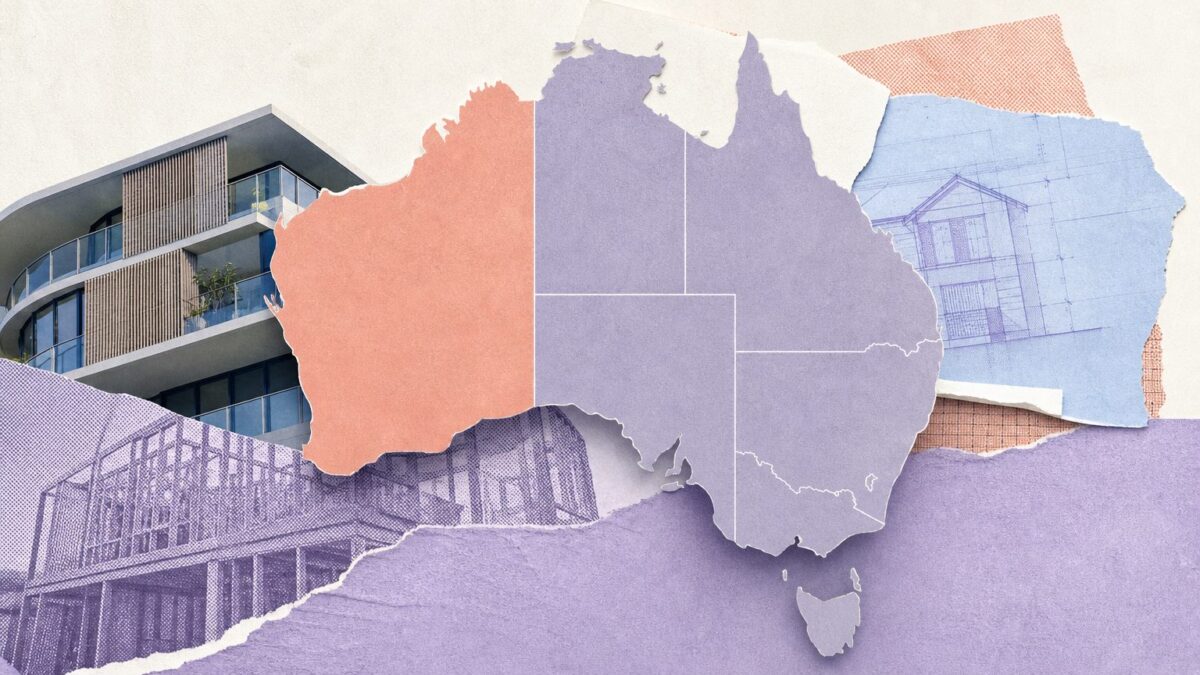
Western Australia has recorded the nation’s sharpest increase in population relative to its housing stock, with years of undersupply pushing property prices to record highs while the number of homes changing hands continues to fall.
New research from HomeLoanRates.com.au, using Australian Bureau of Statistics (ABS) population and housing data, reveals WA now has 258 people for every 100 dwellings, up from 240 in mid-2018.
The increase of 18 people per 100 dwellings is more than five times the next largest rise recorded by any state or territory, highlighting the growing imbalance between population growth and housing supply.
Over the same period, NSW and Victoria have moved in the opposite direction, with the number of people per 100 dwellings falling from 253 to 245 in NSW and from 245 to 236 in Victoria.
The shift has taken WA from sixth place nationally in 2018 to second, behind only the Northern Territory.
For real estate agents, the figures help explain a market where buyer competition has intensified, prices have climbed sharply and fewer properties are available to transact.
According to the research, WA has failed to build enough homes to accommodate its population growth every year since 2019, creating a cumulative shortfall that continues to put pressure on the established housing market.
In the four years to March 2026 alone, the state fell 60,484 homes short of the number required to accommodate population growth.
Over the year to March 2026, new housing supply met just 70 per cent of estimated demand, the lowest proportion of any state.
The consequences are increasingly evident in Perth, where house prices have reached record levels despite a sharp contraction in sales volumes.
Perth’s median house price climbed 18.8 per cent to $1.01 million, while WA’s mean dwelling price increased 22.9 per cent over the year, the strongest growth nationally.
Over five years, WA’s mean dwelling price has risen 92.5 per cent, compared with 35.2 per cent nationally.
That growth has dramatically changed the state’s position in the Australian housing market.
Five years ago, WA was the fourth cheapest of the eight states and territories, with mean dwelling prices 28 per cent below the national average. It is now the third most expensive, with prices sitting 2 per cent above the national average.
The transformation is particularly significant for agents operating in a market that was historically regarded as one of Australia’s more affordable capital city alternatives.
Peter Drennan, Head of Research and Data at Primara Research, said the figures demonstrated how sustained population growth had collided with insufficient housing construction.
“WA’s numbers describe a very physical squeeze: more people for every home in the state, and fewer of those homes coming up for sale to ease it,” Mr Drennan said.
“It built while WA was still relatively affordable. The people arrived faster than the homes, and WA prices have since outgrown every other state.”
Sales volumes tell another part of the story
Perth recorded a 7 per cent decline in property sales over the 12 months to March 2026, with the annual fall deepening to 13 per cent by June.
That was the steepest decline among the 15 property markets tracked nationally by the ABS.
The research also points to a stamp duty change on 7 May, which gave some buyers an incentive to delay signing contracts, as a contributing factor to the weaker June result.
However, the broader decline in transactions predates that change, suggesting the slowdown cannot be attributed to stamp duty timing alone.
For agents, the combination of rising prices and falling sales volumes presents a different challenge from a conventional market downturn.
Rather than signalling a widespread retreat in property values, the figures point to a market where the supply of homes available for purchase has struggled to keep pace with underlying housing demand.
The research also challenges the idea that WA’s population pressure has been driven by a local baby boom.
The state’s natural population increase, which measures births minus deaths, has nearly halved since 2018, falling from 7.59 to 3.97 per 1,000 residents.
According to the analysis, that represents WA’s lowest annual natural increase since the ABS series began in 1981.
This suggests migration, rather than natural population growth, has played a major role in increasing pressure on the state’s housing stock.
The findings also highlight the increasingly different conditions confronting real estate professionals across the country.
While WA has experienced a substantial increase in the number of residents relative to its dwelling stock, NSW and Victoria have recorded declines on the same measure.
That does not necessarily mean housing is plentiful or affordable in either eastern state, but it does demonstrate how differently population growth and housing supply have evolved across Australia’s major markets.
For WA agents, the most significant finding may be the duration of the imbalance.
With housing construction failing to match population growth every year since 2019, the current pressure has developed over several years rather than emerging from a single period of unusually strong demand.
And while Perth’s record prices have attracted attention, the underlying figures suggest the state’s housing challenge extends well beyond the capital’s latest price movements.
The longer the gap between population growth and new housing supply persists, the more difficult it becomes for additional construction to relieve pressure on the established market.
For an industry accustomed to measuring market strength through prices and transaction volumes, WA is demonstrating why the two indicators do not always move together.
Prices can continue to rise even as sales decline when housing supply remains constrained relative to demand.
That is the defining feature of WA’s current property market, and one that could continue to shape conditions for buyers, sellers and agents until housing construction begins to close the accumulated supply gap.