
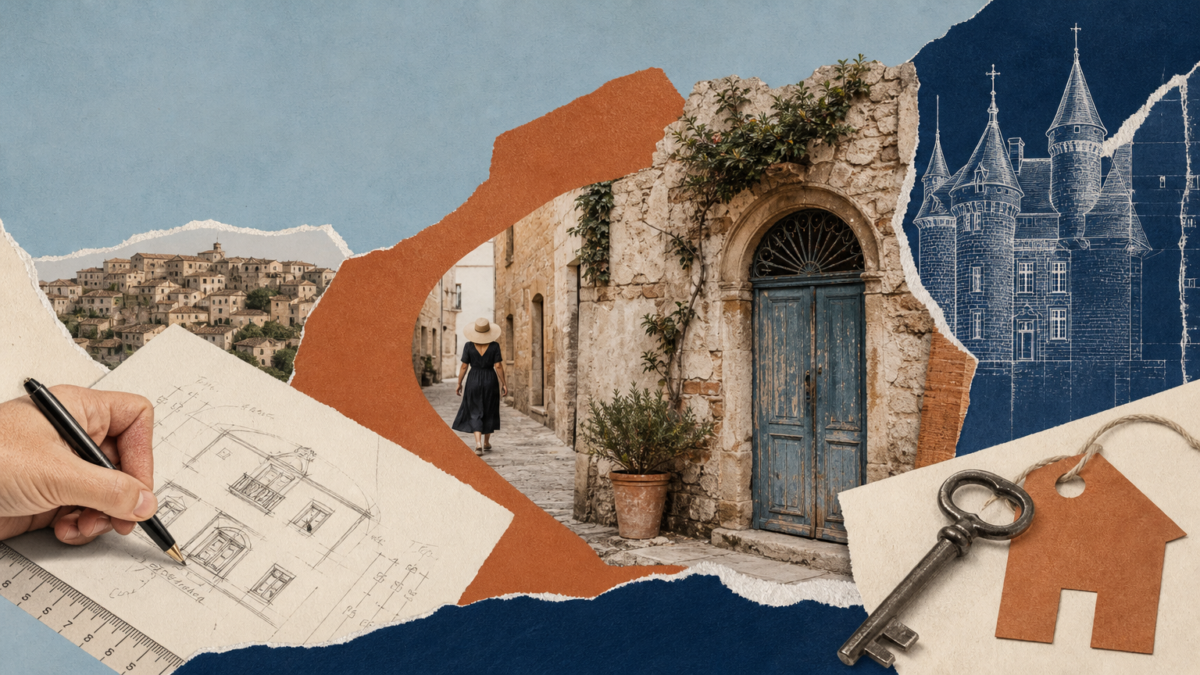
Forget the traditional three-bedroom home. In Europe, buyers can pick up an abandoned Italian property for just €1 or spend millions securing a centuries-old castle, with unusual properties continuing to attract interest from international purchasers.
At one end of the market, Italian villages are offering abandoned homes at nominal prices in an effort to attract new residents and revive declining communities.
At the other, a specialist property platform has brought together more than 3,500 castles, palaces and historic estates across 25 countries, offering everything from restoration projects to grand residences with multimillion-dollar price tags.
And somewhere in between sits a Sicilian home purchased for just €1 by two familiar Australian television personalities, which has since undergone a dramatic transformation.
The €1 homes with a catch
Italy’s €1 housing movement continues to attract international attention, with villages including Zungoli and Naro promoting schemes designed to restore abandoned buildings and bring new residents into historic town centres.
The concept is simple enough. Buyers can secure a property for a nominal €1, provided they agree to renovate it within a specified timeframe and meet the local municipality’s requirements.
In Zungoli, a medieval village in southern Italy, buyers are generally required to submit renovation plans and complete restoration work within three years.
The catch, of course, is that the €1 purchase price is only the beginning.
Legal fees, administrative costs, building approvals and potentially extensive renovations can quickly turn a bargain purchase into a significant financial commitment.
Australian television personalities Shaynna Blaze and Darren Palmer have experienced that process firsthand.
The pair, best known as judges on The Block, took on an abandoned property in Castronovo di Sicilia as part of their Channel Nine renovation series, 1 Euro House with Shaynna and Darren.
The property, as documented on their Instagram page 1eurohouse.au had reportedly been abandoned for around 40 years, with foundations believed to date back as far as 400 years.
While the pair were accustomed to judging multimillion-dollar renovations in Australia, restoring a deteriorating home in a small Sicilian village proved to be a very different experience.
As detailed in Homes To Love’s coverage of the renovation, the project required the pair to navigate unfamiliar building regulations, language barriers, local working practices and the challenges of restoring a centuries-old property.
They spent approximately four months in Sicily, working alongside local artisans and tradespeople to preserve the building’s historic character while introducing contemporary interiors.
Traditional plastering techniques, locally sourced materials and restored architectural features became part of the transformation, with the designers also adjusting to the different pace of village life.
After completing the renovation, the property has now been listed for approximately €190,000 (A$300,000).
The finished home features two bedrooms, two living areas, a renovated kitchen, outdoor space and parking, taking it from a deteriorating building to a Mediterranean-inspired retreat.
Shaynna announced the decision to sell in a video shared on social media.
“I’m so proud of what Darren and I have been able to achieve with our minimal budget, our timeline, and our lack of help,” she said.
“But I think it’s time for a new adventure for me, so I’m going to put it on the market.”
Darren also promoted the completed property as an opportunity for someone wanting to experience life in Sicily without taking on the renovation themselves.
“It’s a great holiday place, a place to have guests or family, and where you can live that brilliant Sicilian lifestyle,” he said.
While the difference between the original €1 purchase price and the €190,000 asking price is considerable, it does not reflect the costs of restoration, materials, labour and other expenses associated with the project.
Fancy a castle instead?
For buyers with a considerably larger budget, Europe’s historic property market offers another unusual alternative.
Specialist property marketplace Castle Collector says it has assembled more than 3,500 listings for castles, palaces and historic estates across 25 countries, bringing together properties marketed by more than 1,200 agents.
According to its 2026 European Castle Market Report, the median asking price for a European castle is approximately €1.7 million (A$2.8 million).
France accounts for a substantial share of the market, with everything from smaller historic residences requiring restoration to grand estates commanding several million euros.
In Italy, the median castle asking price is approximately €2.83 million (A$4.7 million), while Spain sits at around €2.2 million (A$3.6 million).
There are also comparatively affordable options, with some castles advertised for less than €500,000 (A$825,000), although restoration requirements, heritage protections and ongoing maintenance can add considerably to the overall cost.
The marketplace features a broad range of properties, including medieval fortresses, vineyard estates, historic châteaux and castles that have been converted into hotels or wedding venues.
Rather than handling transactions directly, Castle Collector connects prospective purchasers with the agents and owners responsible for the listings.
A bargain isn’t always a bargain
Despite the enormous difference in asking prices, Italy’s €1 homes and Europe’s multimillion-dollar castles have something in common: the purchase price rarely tells the full story.
Both can involve complicated restoration projects, heritage restrictions and maintenance costs that extend well beyond the initial transaction.
Italy’s village housing schemes also come with conditions designed to ensure properties are restored rather than simply acquired and left vacant.
If your buyers are willing to take on the work, however, the opportunities are certainly unusual.
And while a €1 Sicilian home might require a substantial renovation budget, it is still considerably cheaper to get through the front door than a €2 million French château. At least initially.