

Australian property hunters are increasingly looking across the Tasman, with new data showing a marked lift in searches, enquiries and saved properties following the announcement of changes to Australia’s property tax settings.
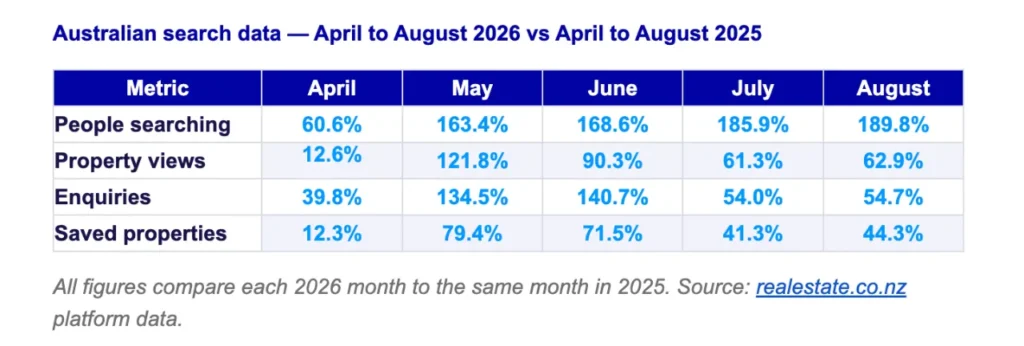
Platform data from realestate.co.nz shows the number of Australia-based property seekers was already 60.6 per cent higher year-on-year in April, before jumping 163.4 per cent in May, the month the Federal Government announced its tax reforms.
The increase continued in the following months, reaching 168.6 per cent in June, 185.9 per cent in July and 189.8 per cent in August compared with the corresponding months of 2025.
The timing is notable for Australian agents and investors because the reforms announced in the May Budget will change the tax treatment of residential property investment.
From 1 July 2027, negative gearing on residential property will generally be limited to new builds for properties acquired after 12 May 2026.
Existing investments held before the announcement are protected, while the 50 per cent capital gains tax discount is being replaced with inflation-based indexation and a minimum 30 per cent tax rate on real capital gains accruing from 1 July 2027.
New builds receive different treatment, including the ability for eligible investors to choose between the existing CGT discount and the new arrangements.
While the realestate.co.nz figures do not establish that the Australian tax changes caused the increase, realestate.co.nz describes the acceleration following the May announcement as significant.
Realestate.co.nz Chief Executive Sarah Wood said the behaviour being recorded on the platform suggested Australians were doing considerably more than casually checking New Zealand prices.
“We expected the announcement to have a flow-on effect to New Zealand, but the scale and speed of the shift have been striking. Australians aren’t just browsing – they’re searching, saving properties and making enquiries at levels well above what we were seeing a year ago.”
The increase extends beyond visitor numbers.
Compared with August 2025, Australian property views were up 62.9 per cent in August this year, enquiries were 54.7 per cent higher and saved properties had increased 44.3 per cent.
The biggest increases occurred closer to the May announcement. Property views jumped 121.8 per cent year-on-year in May, while enquiries climbed 134.5 per cent and saved properties rose 79.4 per cent.
In June, enquiries were 140.7 per cent above the same month last year.
Auckland, Central Otago and Canterbury draw attention
Auckland, Central Otago and Canterbury are attracting the greatest interest from Australian property hunters, with houses overwhelmingly the preferred property type.
Those buyers are also arriving at a time when parts of the New Zealand market are offering substantial choice.
Auckland’s available property stock was 11.5 per cent higher year-on-year in August, while new listings increased 1.9 per cent in Central Otago/Lakes District and 3.6 per cent in Canterbury.
The broader New Zealand market had 32,908 properties available for sale in August, with national stock 9.7 per cent higher than a year earlier.
The national average asking price was $NZ849,362, remaining relatively stable after several years of little overall movement.
“With a strong supply of available homes, relatively flat prices and a favourable exchange rate, the New Zealand market could hold real appeal for Australians considering investing or moving across the Tasman,” says Ms Wood.
“Growing interest from Australian buyers could bring additional competition to the NZ market, potentially creating welcome opportunities for vendors.”
Sydney has produced the biggest increase in users following the tax announcement, rising 121.3 per cent, compared with increases of 41.5 per cent from Brisbane and 40.8 per cent from Perth.
But the headline traffic figures tell only part of the story.
According to realestate.co.nz, users from Brisbane and Perth are recording more sessions and saved properties per person than their Sydney counterparts, suggesting a smaller but particularly engaged pool of potential buyers.
“Traffic numbers tell us we’ve caught their attention. What they do on-site tells us much more,” she said.
“When people are coming back, saving properties and making enquiries, we’re seeing behaviour that goes beyond a passing curiosity about what their money might buy across the Tasman.”