
Imagine this: A potential vendor meets you at an open home. You make a great impression. Later that evening, they ask ChatGPT or Google, “Is [Your Name] a good agent?”
What comes up?
Is it your own website telling your story – or a generic portal profile surrounded by ads for your competitors?
This scenario is playing out thousands of times a day across Australia across many industries including real estate.
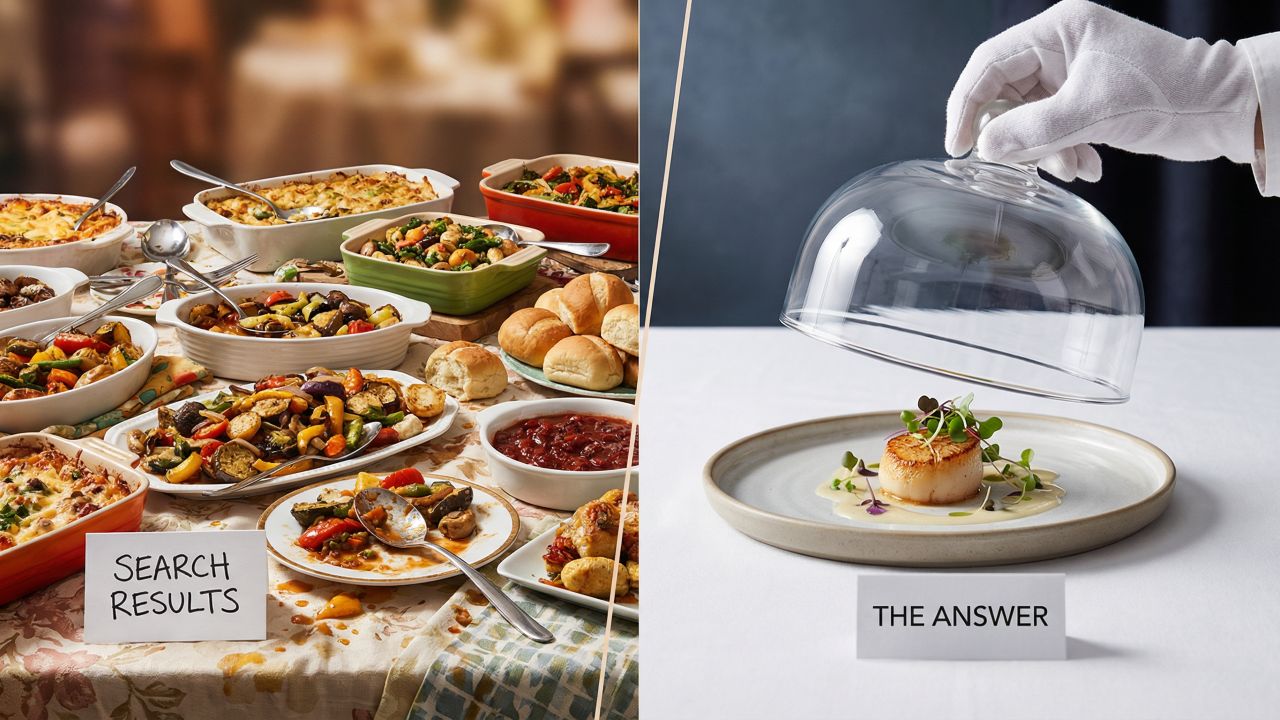
We’re moving from an era where ranking on Google meant getting clicks, to one where AI delivers the answer directly – and either cites you as the authority, or doesn’t mention you at all.
The good news? For agents willing to create genuinely useful, hyper-local content, this shift is less threat than opportunity.
The Shift: From SEO to AEO
For years, the SEO game was relatively simple. You targeted a broad keyword like “Real Estate Agent Broadbeach,” ranked for it, got a click to your website, and hopefully captured an email address.
But the goalposts have shifted.
Google and platforms like ChatGPT don’t just want to give users a list of links anymore – they want to give them the answer right there on the page. A “zero-click” result.
This is the era of Answer Engine Optimisation (AEO). And it’s not something to fear. In fact, for the hyper-local expert, it’s a massive opportunity to stand out.
How AI Overviews Actually Work
When Google or ChatGPT generates an answer, it doesn’t make things up from thin air.
It pulls information from sources it trusts – and crucially, it cites those sources with links.
These citations are your new battleground.
When someone asks, “What should I know about buying in [Suburb]?” and your content is cited as the source, you’ve just won the trust game without them ever having to click through.
Your goal is to become the source that AI trusts enough to cite.
The Rise of Brand Defence
In this environment, your first priority is Brand Defence.
Brand Defence is about ensuring you control the narrative. You want that citation – that link acting as proof of what the AI is saying – to point directly to you, confirming your authority without the user having to wade through a sea of other agents.
If you’re not actively publishing content that establishes your expertise, someone else’s content will speak for you. Or worse, no one will.
The Multimodal Advantage: Google is Watching
There’s another layer to Brand Defence that you can’t ignore: Google is now multimodal.
It doesn’t just read text anymore; it can “watch” and “listen” to video. Google’s algorithms can transcribe and understand the spoken words within your video content. This means every word you say in a market update or property tour contributes directly to your Answer Engine authority.
For buyers and sellers under 40, platforms like YouTube, Instagram, and TikTok have become primary search engines. They don’t just want to read about a suburb; they want to experience it.
If you’ve been hesitant about video, consider this your wake-up call: video is where the authority lives in 2026.
Why “Good Enough” Content No Longer Works
Real estate falls into a category Google calls YMYL: Your Money or Your Life. Because your advice affects people’s financial stability and happiness, the quality bar for your content is incredibly high.
Generic, faceless content won’t cut it. To rank in a zero-click world, you need to satisfy E-E-A-T: Experience, Expertise, Authority, and Trustworthiness.
Here’s the thing about Trustworthiness – it’s the lynchpin. Google doesn’t want to hear that a suburb is “perfect” if the locals know the parking at the shopping centre is a nightmare on Saturdays. It wants balance. It wants the truth.
Have you actually done the job? Do you know your stuff? Are you a known leader with consistent content? Are you real, transparent, and honest? These aren’t rhetorical questions – they’re what the algorithm is asking about you.
The Strategy: They Ask, You Answer
To become the “answer” the AI delivers, you must adopt the philosophy of “They Ask, You Answer,” pioneered by Marcus Sheridan.
Instead of generic “Just Sold” posts, you need to answer the specific, long-tail questions consumers are actually asking.
Cost: Instead of “free appraisal,” write a guide on “Hidden strata costs in [Suburb] for 2026.”
Problems: Be brave enough to discuss “5 things to check before buying a 1980s home in [Suburb]” – like asbestos or flood overlays.
Comparisons: Compare the lifestyle of two neighbouring suburbs honestly.
When your content directly answers a question within the first paragraph – providing a clear, concise definition or solution – you increase your chances of being the “featured snippet” or the cited source in an AI overview.
The Social Bridge: From Feed to Inbox
While search provides the answers, social media provides the reach. But remember: Facebook and Instagram are “pay to play” platforms where you’re effectively renting audience attention.
Your strategy must include boosting high-performing content – like your market updates or educational posts – to your specific target audience. But don’t just boost for likes. Boost to get people into your world, where you can talk to them directly.
The ultimate goal isn’t to be insta-famous; it’s to move people from a platform you don’t own (social media) to one you do (your database).
Defeating “AI Slop” with Local DNA
The Macquarie Dictionary’s Word of the Year for 2025 was “AI Slop” – low-quality, generative garbage that no one asked for.
AI slop is a human problem caused by bad prompts and laziness. As agents, you have the antidote: hyper-local knowledge.
You can use AI to build the structure of your content. You can use it to analyse census data and determine that your suburb is full of “active downsizers” who value “calm confidence.” But you must add the “Human in the Loop.”
The AI knows the median price. But only you know the secret spots the kids love, or which coffee shop has the best view. You need to know your suburb like it’s your lover – like it’s New York and you’re Carrie Bradshaw.
Creating content with the answers AI already knows is better than nothing, but creating content with answers only you know elevates everything.
Your Mission for 2026
We’re building hyper-local digital learning centres.
By creating content that is helpful, balanced, and deeply rooted in your local expertise, you effectively give the search engines reasons to recognise you as an authority. When you combine the efficiency of AI with your unique personality and local insight, you don’t just get traffic – you get trust.
And in a zero-click world, trust is the currency that matters most.

