
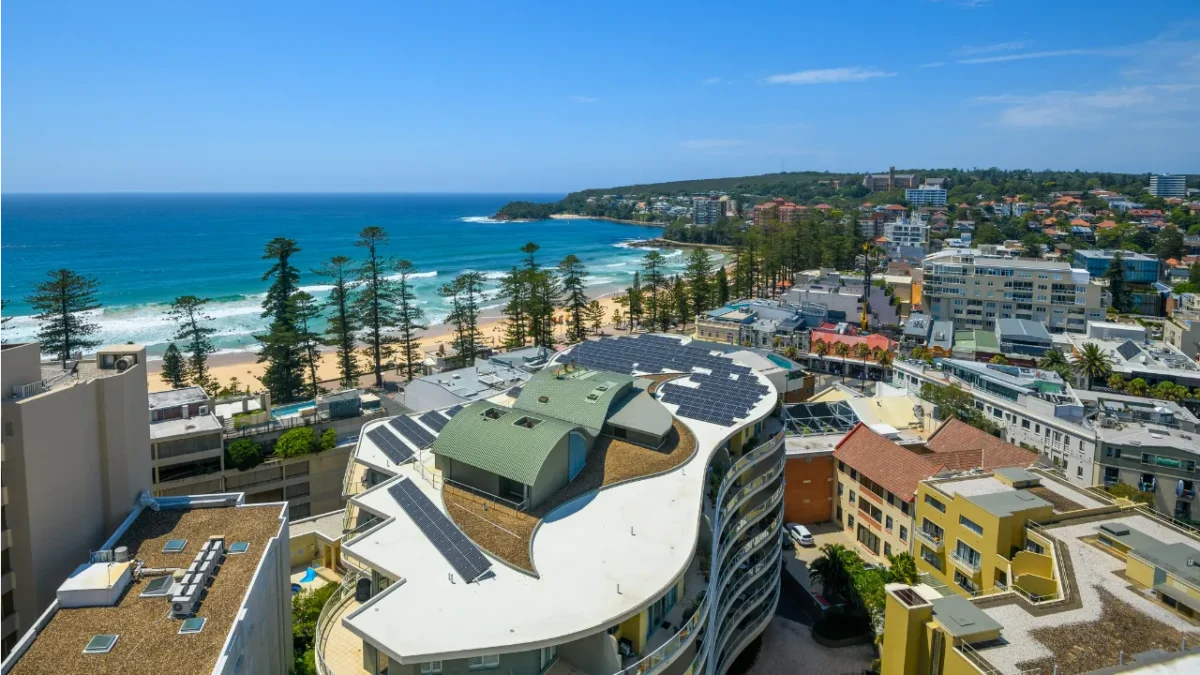
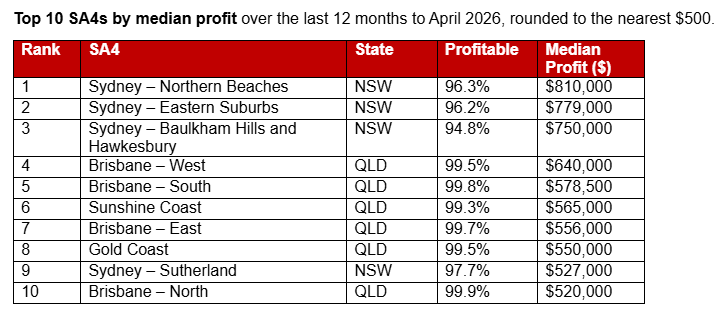
Homeowners in Sydney’s Northern Beaches pocketed a median profit of $810,000 on resales over the year to April 2026 – the highest of any region in Australia.
The data from realestate.com.au reveals that loss-making resales remain rare across most markets, with the vast majority of property owners continuing to sell for more than they paid.
Sydney’s Eastern Suburbs recorded the second-highest median profit at $779,000, with 96.2 per cent of resales profitable.
Baulkham Hills and Hawkesbury followed at $750,000.
Queensland dominated the remainder of the top 10, with Brisbane West ($640,000), Brisbane South ($578,500), and the Sunshine Coast ($565,000) all recording strong median gains.
Every region in the top 10 for median profit was located in either New South Wales or Queensland.
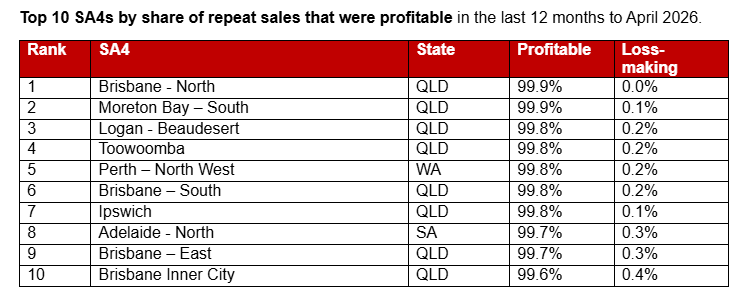
When measured by the share of profitable resales, Queensland regions swept the top positions.
Brisbane North and Moreton Bay South both recorded 99.9 per cent profitability – meaning virtually no sellers lost money.
“Analysis of properties resold with multiple prior sales shows that homeowners have made exceptionally large capital gains in the past year,” Megan Lieu, Senior Economic Analyst at REA Group said.
“Profits in many Brisbane regions, lifestyle hubs in regional Queensland and blue-chip areas within Sydney have risen substantially.”
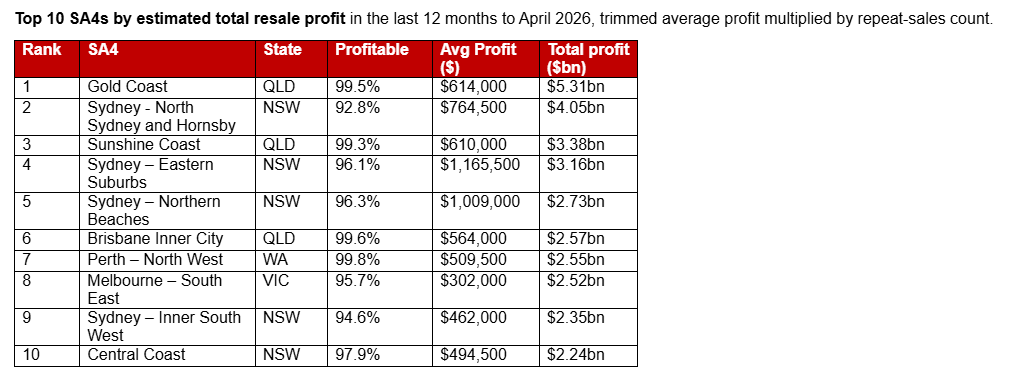
The Gold Coast generated the largest total resale profits of any region, with an estimated $5.31 billion in gains over the 12 months.
Sydney’s North Sydney and Hornsby followed at $4.05 billion, and the Sunshine Coast at $3.38 billion.
Ms Lieu said these strong equity positions would likely limit forced sales, even as higher interest rates affect buyer demand.
“Almost all property owners with a loan are currently in positive equity, meaning they have a buffer against an increase in mortgage repayments,” she said.
“This allows them to take actions such as lowering their expenses, refinancing their loans or depending more on their savings to offset these rising servicing costs.”
While price growth is expected to slow and decline in some regions, Ms Lieu said the widespread equity buffers would support a gradual easing rather than sharp falls.
“With a large proportion of owners in this position, the number of forced sales is likely to be low,” she said.
“These equity buffers will limit cases of distressed selling and support the gradual easing in prices, reducing the likelihood of abrupt and destabilising price falls.”