

Australia’s softer housing market has failed to deliver a meaningful improvement in affordability for house buyers, with a substantial gap remaining between the prices buyers are searching and the homes sellers are listing.
The latest Domain Matching Demand Report, which compares millions of buyer search prices with property listing prices across every capital city and dwelling type, found detached houses continue to record the largest disconnect between buyer budgets and available stock.
While affordability has traditionally pushed buyers further from CBDs in search of cheaper housing, Domain’s analysis shows dwelling type is becoming an increasingly important part of the equation, with townhouses and units generally recording much closer alignment between buyer search budgets and listing prices.
Domain Chief Residential Economist Dr Nicola Powell said the moderation in housing conditions had yet to provide sufficient relief for buyers seeking detached homes.
“The housing market has cooled, but affordability hasn’t improved enough to bring detached housing back within reach for many Australians,” Dr Powell said.
“What’s notable is that we’re still seeing a significant gap between buyer budgets and listing prices, despite softer market conditions. Historically, a market slowdown helps improve affordability, but that relief simply has yet to materialise for house buyers.”
The divide is most pronounced in inner-city house markets, where Canberra recorded the largest capital-city seller premium at about $538,000, followed by Melbourne at $440,000, Sydney at $400,000 and Brisbane at $350,000.
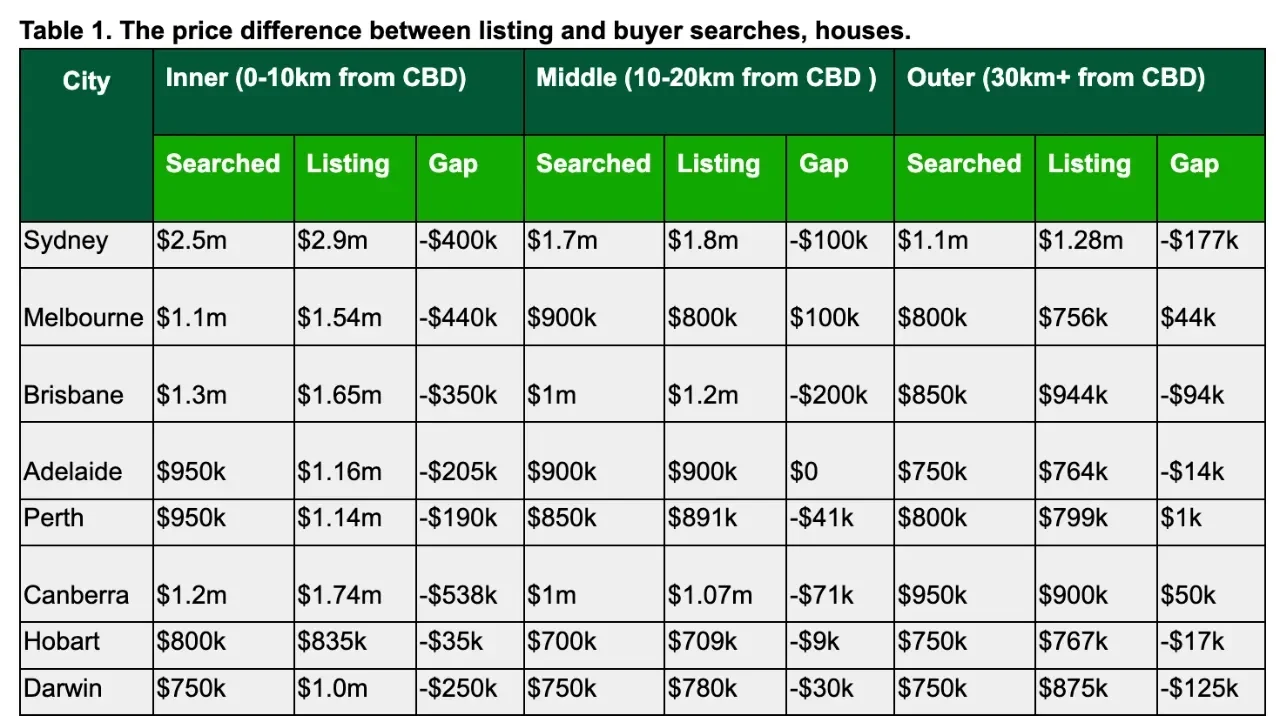
In Canberra’s inner ring, the median buyer search price was $1.2 million compared with a median listing price of about $1.74 million, while in Melbourne buyers were searching at a median $1.1 million against listings of $1.54 million.
Sydney’s corresponding figures were $2.5 million and $2.9 million.
Although affordability generally improves with distance from the CBD, Domain found the pattern has become increasingly varied across cities.
Sydney’s middle-ring house gap narrowed from $140,000 to $100,000 over the year, while Adelaide’s middle-ring market reached effective alignment between buyer searches and listings.
Brisbane moved in the opposite direction, with its middle-ring seller premium widening to roughly $200,000, while Perth shifted from buyer-led conditions to a seller premium.
Sydney also remains a clear outlier on the urban fringe, where house listings are still around $177,000 above buyer search budgets. While that gap narrowed over the year, Domain found it remained substantially larger than in any other capital.
At a more localised level, the greatest disconnect remains concentrated in some of Australia’s highest-value markets.
Sydney’s Eastern Suburbs – North recorded the nation’s largest house seller premium at $1.75 million, followed by Cottesloe – Claremont in Perth at $1.6 million and Brisbane Inner at $1.2 million.
North Sydney – Mosman recorded a $1 million seller premium, although its gap narrowed by $300,000 over the year, while Manly also recorded a $1 million gap after widening by $700,000.
Domain found some of the sharpest increases occurred in markets that were already recording substantial premiums, with Brisbane Inner widening by $500,000 year-on-year and Cottesloe – Claremont by $400,000.
Against that backdrop, townhouses are increasingly occupying the middle ground between detached houses and units, with Domain finding the segment offers closer alignment between buyer budgets and available supply in a number of markets.
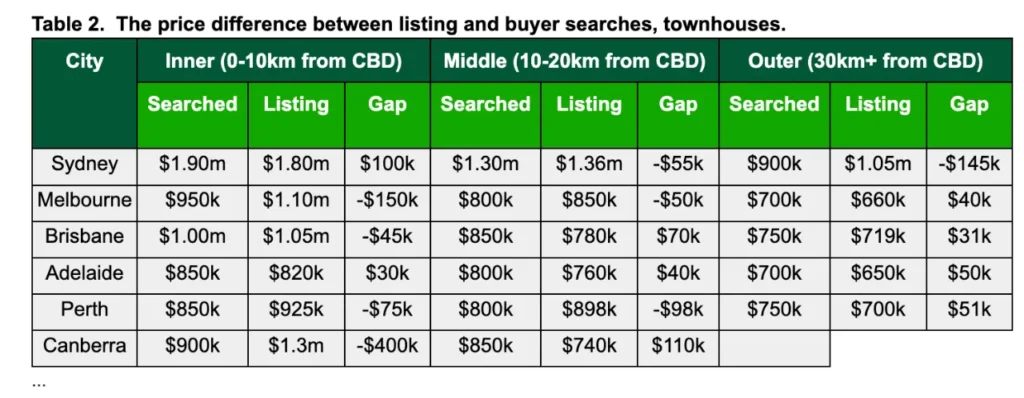
The past year produced significant changes in townhouse conditions, particularly in Sydney, where the inner-ring market moved from a $200,000 seller premium in 2025 to a $100,000 buyer premium in 2026.
Median buyer search prices in Sydney’s inner ring increased from $1.5 million to $1.9 million, while median townhouse listing prices rose from $1.7 million to $1.8 million, reversing the gap.
Sydney’s middle-ring townhouse market also moved closer to balance, with its seller premium narrowing from $150,000 to about $55,000 as growth in buyer search budgets outpaced the increase in listing prices.
Perth and Hobart, however, recorded the opposite pattern, moving from buyer premiums in 2025 to sizeable seller premiums this year.
Dr Powell said the findings showed affordability was increasingly influencing the type of housing that best aligned with buyer budgets.
“For decades, affordability pressures pushed buyers further from the CBD. Today, many are making a different trade-off, changing the type of home they buy rather than where they buy,” she said.
“In many cities, choosing a townhouse or unit can unlock greater affordability than moving to the urban fringe, allowing buyers to remain closer to jobs, transport and lifestyle amenities.
“The biggest divide in Australia’s housing market is no longer simply between inner and outer suburbs. It’s increasingly between detached houses and medium-density housing, with townhouses and apartments emerging as the point where buyer demand and available supply are most closely aligned.”
Units are now the most buyer-aligned housing segment in Domain’s analysis, with buyer search prices matching or exceeding listing prices across many markets and apartments generally showing a closer relationship between buyer budgets and available stock than detached houses.
The strongest buyer premiums are particularly evident outside premium inner-city markets. In Hobart’s middle ring, the median buyer search price of $700,000 was $166,000 above the median listing price of $534,000.
Canberra recorded a $120,000 middle-ring buyer premium, while Darwin’s was $75,000.
Domain cautioned that those premiums should not be interpreted simply as evidence that apartments are underpriced. They may instead reflect buyers searching with budgets above the prevailing listing median while looking for larger, higher-quality or better-located apartments than those represented in the available listing mix.
The findings ultimately point to a housing market in which affordability differs substantially according to both dwelling type and location.
Domain does not conclude that buyers are abandoning houses for townhouses or units. Rather, its analysis shows the stock most closely aligned with contemporary buyer budgets is increasingly concentrated in medium-density housing, while detached houses continue to record the largest gaps, particularly in prestige and inner-city markets.
The report covers the 24 months to July 2026 and, where regional markets are examined, uses SA3 areas with at least 50 listings of the relevant dwelling type. Price gaps are calculated by comparing the median upper bound of buyer-searched prices with median listing prices.