
Australia’s rental market may be responding to housing policy changes more than a year before they begin, with Domain data showing rents accelerating as investors rethink where and how they hold property.
The Federal Government’s changes to negative gearing and capital gains tax concessions for new investors will not take effect until July 2027, but Domain Chief Residential Economics, Dr Nicola Powell, believes the market may already be responding to the expectations surrounding those reforms.
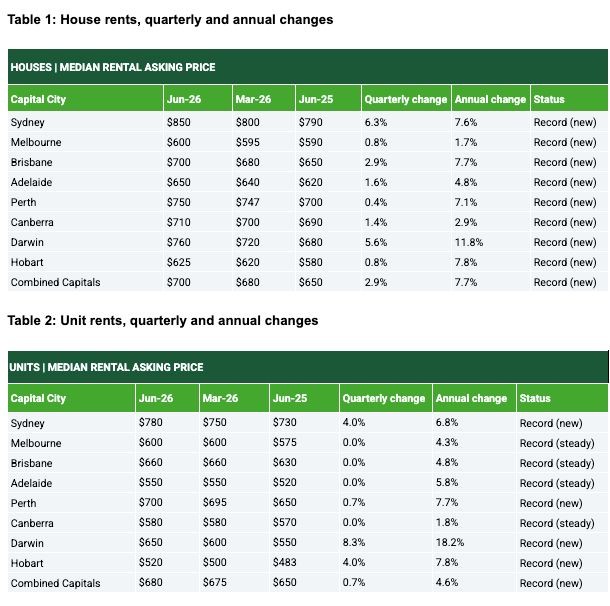
Domain’s latest Quarterly Rent Report found combined capital city house rents increased by $20 over the June quarter, marking the strongest quarterly rise in almost two years.
Sydney recorded its biggest quarterly house rent increase in four years, with rents jumping $50 to a record $850 per week, while Brisbane house rents reached a new high of $700 per week.
Darwin also continued its extraordinary run, overtaking Perth to become Australia’s second most expensive capital city for house rents, with house rents rising 11.8 per cent annually and unit rents increasing 18.2 per cent year on year.
But the latest figures point to a more complex story than another cycle of rent increases.
While supply shortages, low vacancy rates and strong tenant demand remain key drivers, Dr Powell believes investor expectations around future policy settings may now be influencing decisions in the present.
The timing is significant; the Federal Government’s proposed changes remain more than a year away from taking effect, yet property markets often respond well before legislation formally begins.
For investors, uncertainty around future returns may be enough to trigger a reassessment of strategies, even while current rules remain unchanged and Dr Powell said the speed of the latest rental acceleration suggested something more than normal seasonal movement was occurring.
“The acceleration we’ve seen this quarter was too sudden and concentrated to be explained by seasonal factors alone,” she said.
Rather than suggesting policy changes alone are driving rental increases, Dr Powell said the market is responding to several forces combining at once, including tight supply, higher holding costs and changing expectations around the future of property investment.
“I do think we’ve probably seen a behavioural response,” she said. “I think it’s just a change in sentiment, and I think it’s probably pre-empting, as well, the fact that they’re thinking that the rental market is going to get even tighter in certain locations.”
Investors are already reconsidering their next move
Australia’s rental market remains firmly tilted in favour of landlords, giving owners more ability to absorb rising costs through higher rents.
But the bigger question is not only what investors are charging today. It is how they respond to changing conditions over the coming years and Dr Powell said the current environment means landlords still have significant pricing power, particularly in markets where tenants are competing for limited supply.
“If we had a balanced market and we were seeing sentiment change, it’s harder to pass through rent increases,” she said.
“We’re still operating in a landlord’s market. If holding costs increase, if the outlook changes, market conditions allow for higher rents to be passed through.”
Beyond rental prices, the bigger concern is whether changing investment conditions influence the number of properties available for tenants in the future.
Dr Powell said conversations with agents suggest some investors are already reassessing whether residential property remains the right long-term wealth creation strategy.
“I do think part of that is going to happen, or is maybe already happening,” she said.
“We will be changing the way in which we tax investment property, and I think it makes property less attractive as a vehicle to build wealth … we will see strategies change, in fact it may already be starting to change.”
The investors bringing decisions forward
The potential impact may not simply be investors leaving the market. Some may shift towards other asset classes, while others could bring forward decisions they were already considering, including selling investment properties earlier than planned.
Dr Powell said uncertainty around future taxation settings could accelerate decisions among some mum and dad investors, particularly those approaching retirement.
“Some of the conversations I’ve been having are around, ‘Let’s bring forward our decision to sell that investment property’,” she said.
“Particularly if you’ve got a mum and dad investor that are perhaps close to retirement, and we are changing taxation, it’s becoming that little bit more confusing.
“That concept of let’s just sell before prices fall even further while the market supports it, and fast track that decision if they were going to be selling in a year or two anyway.”
Another emerging trend is investors changing how they use existing properties rather than selling them.
Some owners are exploring short-term leasing options to improve yields, potentially reducing the supply available to traditional long-term renters.

“My other feedback from agents is they’re seeing investors actually switch strategy,” Dr Powell said.
“They’re still retaining their investment property, but they’re wanting to shift it to short-term leasing in order to help get a better yield.
“If the concept is that you’re going to be paying more tax on your investment at the end of it when you sell it, that may mean people put greater focus on maximising the yield during the period of owning that investment property.”
A rental market hitting its limits
The latest Domain data also reveals a growing divide between capital cities, with some markets continuing to experience rapid rent increases while others show signs tenants are reaching affordability ceilings.
Sydney, Brisbane, Canberra and Darwin recorded accelerating rental growth, while Melbourne, Adelaide, Perth and Hobart showed signs that affordability constraints are beginning to limit further increases.
Dr Powell said renters respond to affordability pressure by making a series of compromises.
“When you have an affordability ceiling being reached, people can shift location much easier,” she said.
“They shift property types, they shift suburbs, they go somewhere cheaper, and when all else fails they actually shift into regional markets or they go into house shares.
“I do think that concept of consolidation of homes will be happening.”
The impact is particularly significant for families who are already struggling to secure housing that matches their needs.
“You have a big pool of our population that are young families who need that family home and want to be in suburbia renting a home because they’re just unable to purchase,” she said.
“This is when you do see scenarios where people are underhoused. They’re not living in a home that suits their needs.
“It may mean kids doubling up in a room, or shifting to a smaller townhouse, terrace home or apartment in order to find something that fits the needs.”
Sydney’s unexpected rental rebound
Sydney’s rental market has been one of the strongest stories in the latest data, recording a sharp rebound after a period where growth had begun to slow.
Both houses and units accelerated, with house rents increasing 6.3 per cent over the quarter and unit rents climbing 4 per cent to a record $780 per week.
Dr Powell said Sydney’s rebound reflects several factors combining at once.
“We had been very much seeing a slowing of rent growth and actually rents held over the first quarter of this year,” she said. “What’s interesting for Sydney is both houses and units have accelerated.
That pass-through might be higher holding costs as a result of three rate hikes; it might be policy change and therefore sentiment change.
“It’s also layered onto a tight rental market anyway where we don’t have a balanced rental market.”
The strongest growth has also appeared in a mix of markets, from prestige locations to family-focused middle-ring suburbs.
“When you drill down into suburb level, there are different dynamics going on,” she said.
“The pockets that seem to be seeing the stronger rates of rent growth are prestige, coastal, or those mid-tier family-orientated locations.”
The supply challenge ahead
Despite affordability beginning to limit rental growth in some locations, Domain expects conditions to remain challenging while vacancy rates stay well below balanced levels.
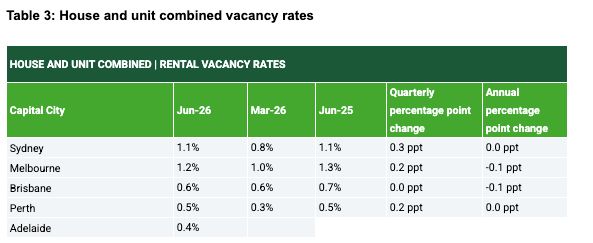
A balanced rental market generally has vacancy rates between 2 and 3 per cent, but many Australian cities remain significantly tighter.
Dr Powell said the long-term solution requires both more rental supply and more pathways for tenants to transition into ownership.
“We need more rental,” she said. “We need to shift the dial on both of those, more tenants transitioning to being homeowners, but also rental supply needs to increase.
“It’s been a rental crisis. We’ve been in a landlord’s market for many, many years now.”