

Expanding federal support for first-home buyers has shielded the vast majority of low-deposit borrowers from housing market downturns, with surging price growth in regional Australia driving double-digit equity gains.
Analysis of Housing Australia and PropTrack Home Price Index data reveals that out of approximately 48,000 households taking up the expanded 5% Deposit Scheme since income testing was removed last October, fewer than 0.2% – just 87 households – are in negative equity.
The findings challenge fears that government schemes encouraging low-deposit purchases would leave young buyers exposed to falling property values; instead, high demand at the entry level of the market has created a protective buffer for recent buyers.
“The main thing it tells us right now is that the current softening and decline in house prices in some areas hasn’t really impacted the more affordable end,” realestate.com.au Economist Luc Redman said.
“There was quite strong bring-forward demand when the scheme expanded in October, and that’s maintained a lot more upward pressure on prices than the downward pressure coming from interest rates and tax changes.”
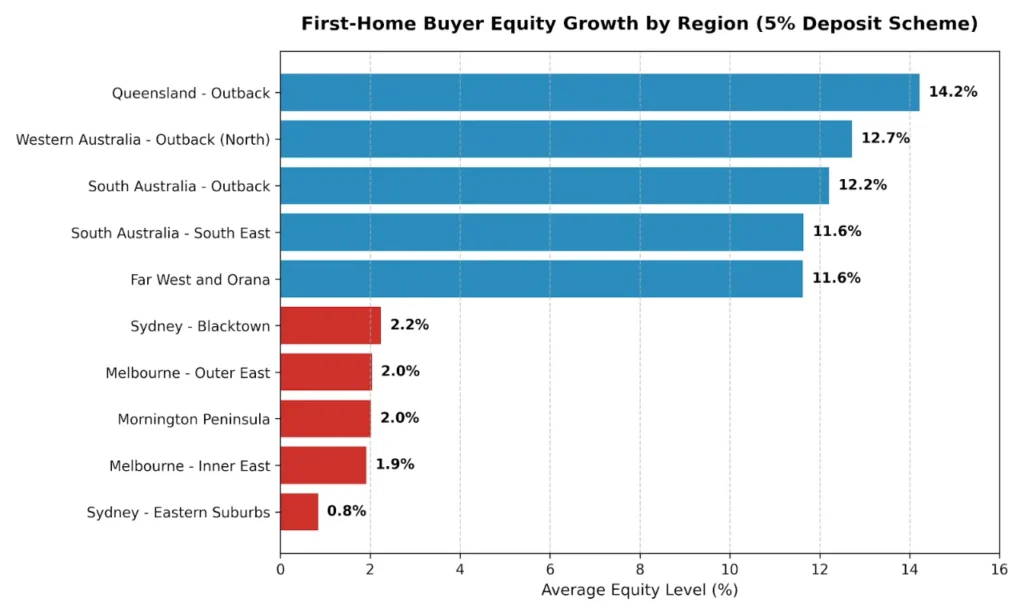
Regional locations recorded the strongest performance, led by Queensland – Outback, where first-home buyers under the scheme achieved average equity levels of 14.2%. Western Australia – Outback (North) followed at 12.7%, while South Australia – Outback reached 12.2%.
By contrast, buyers purchasing in premium capital city enclaves saw far thinner margins. Sydney – Eastern Suburbs recorded the lowest average equity in the nation at 0.8%, with Melbourne – Inner East at 1.9% and the Mornington Peninsula at 2.0%.
However, Mr Redman said that expensive inner-city hubs represent a tiny fraction of scheme users.
“The Eastern Suburbs of Sydney doesn’t have a heap of people taking it up – around 100 since October,” he said.
“Those tend to be the ones that experienced the most decline, but they are not where most people actually are on this scheme. The equity values of homes for most buyers have been quite buoyant, and in regional areas, they’ve actually grown.”
Nationally, 48% of households under the policy hold 5% or less equity at this point in time, meaning their current home value sits close to or slightly below their entry position after accounting for transaction costs — though this is likely to improve by the time they sell.
However, Mr Redman emphasised that the underlying financial health of these households remains solid, particularly because current estimates exclude funds held in offset accounts.
“There should be some level of concern given the potential increase in unemployment,” he said.
“Having said that, provided they’re not in negative equity and not in arrears, there’s not really too much concern. This analysis assumes no offset accounts, so you likely have people who have put money into offsets and have some sort of buffer on their repayments.”
Looking ahead, property agents expect entry-level outer suburban and regional markets to lead the broader real estate market once buyer activity accelerates.
“When the market starts to turn, it’s going to be these first-home buyer regions and price points that turn first.
“The 5% deposit scheme makes it essentially four times quicker to save for a deposit. When interest rates settle or start to be cut towards the end of this year or early next year, the more affordable end is going to be the one that moves first.”