

We know that Australia’s property market has entered a distinct cooling phase, but new data reveals the exact scale of the downturn: property investors are staging their most aggressive retreat in years, draining $5.4 billion in new lending volume from the financial system in a single quarter.
The sharp contraction highlights a rapid shift in market leverage, where shrinking borrowing capacity and rate uncertainty are fundamentally altering capital flows across the residential sector.
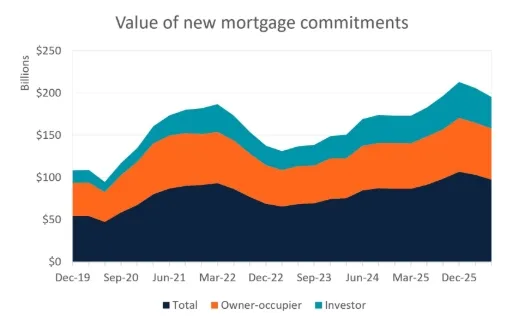
Data from the Australian Bureau of Statistics, analysed by financial comparison group Canstar, reveals total new residential lending dropped 5 per cent to $97.6 billion in the June quarter.
The decline marks the first back-to-back quarterly drop in new mortgage commitments in more than three years, signalling that successive interest rate hikes have finally breached the threshold of investor risk appetite.
For real estate agents, project marketers, and buyer representatives, the underlying mechanics of the downturn reveal an uneven battlefield; the contraction is almost exclusively an investor-driven exodus.
While owner-occupier commitments showed notable resilience with a modest 2 per cent decline to $60.5 billion, investor lending plummeted 10 per cent to $37.1 billion; in dollar terms, the $4.2 billion quarterly drop represents the sharpest single-quarter retreat in investor capital since 2015.
Industry analysts attribute the sudden pullback to a compounding array of headwinds, led by reduced borrowing power, elevated serviceability assessment hurdles, and lingering tax policy debate.
Canstar Data Insights Director Sally Tindall said that the structural shift in sentiment was immediate once financing costs escalated.
“The housing market has hit the brakes, with a $5.4 billion drop in new lending compared to the previous quarter. Investors led the retreat after three interest rate hikes and proposed tax changes took plenty of shine off the property market,” Ms Tindall said.
Sydney leads national decline in average purchasing power
The tightening credit environment is directly impacting transaction values at auction and private treaty. Average new owner-occupier loan sizes have contracted across major eastern seaboard markets, reflecting the hard ceiling imposed by bank serviceability calculations.
New South Wales registered the largest dollar drop in borrowing capacity, with the average new mortgage shrinking by $19,000 during the quarter to $842,000. Victoria experienced a similar easing, with average loan sizes falling to $664,000, bringing the national average mortgage down to $731,000.
While markets in Queensland, Western Australia, and South Australia have held near record highs due to tight stock levels, listing agents in those regions report mounting price resistance as buyer borrowing limits are tested.
The decline in purchasing power has also reached entry-level buyers as first home buyer commitments dropped 3 per cent over the quarter, representing 891 fewer settled transactions nationwide.
With both investors and first home buyers pulling back, transaction velocity is increasingly reliant on equity-rich upgraders and downsizing owner-occupiers.
The contraction in new buyer origination has sent shockwaves through the banking sector, forcing Australia’s largest lenders to report steep drops in application pipelines.
Commonwealth Bank recorded a 15 per cent drop in mortgage applications, while Westpac suffered a 20 per cent decline between mid-May and late July. National Australia Bank similarly logged a 15 per cent drop in application volumes for the quarter.
Faced with a shrinking pool of new buyers, major banks have aggressively pivoted toward existing mortgagors, sparking intense price wars across the refinancing landscape.
Refinancing volume reached $67.1 billion in the June quarter, the third-highest quarterly settlement total on record, as lenders fight to defend loan book scale.
Separately, the Daily Telegraph reported NSW stamp duty receipts fell 18% in June compared with a year earlier, as the number of property transactions dropped more than 17%.
The NSW budget is reportedly taking a $200 million hit as the post-budget property slowdown weighs on state revenues, with economists warning proposed changes to negative gearing and capital gains tax could have a significant flow-on effect.