

New realestate.com.au data has revealed a striking feature of Australia’s housing market: even within the country’s most exclusive suburbs, there are still significant “hidden” price gaps that can amount to millions of dollars depending on exactly where a property sits.
The analysis, which uses PropTrack’s automated valuation model (AVM), compares median home values across SA1 regions within each suburb over the 12 months to April 2026.
The results show that premium suburbs often thought of as uniformly expensive actually contain sharply different price tiers within their boundaries.
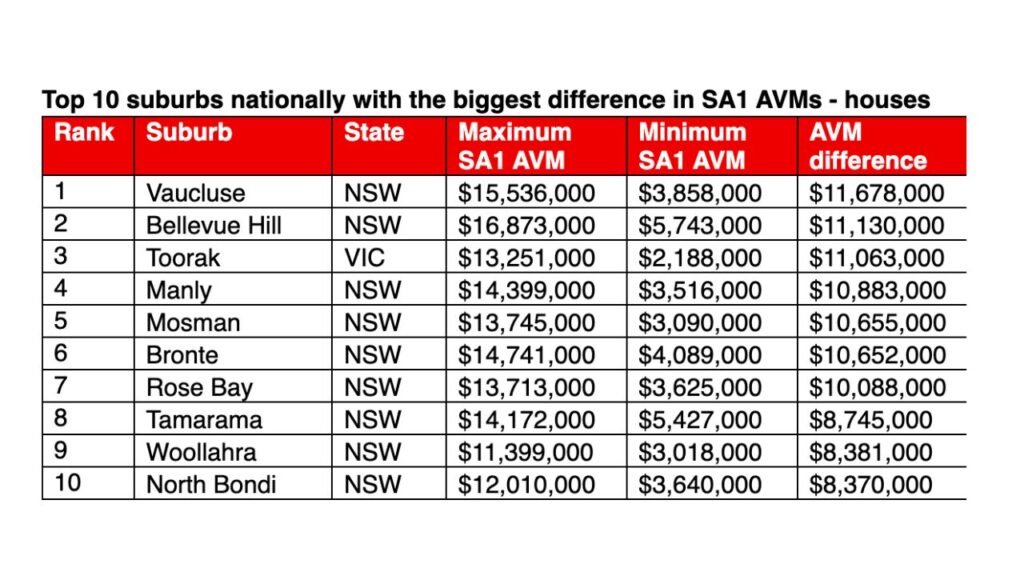
Nowhere is that more evident than Vaucluse in Sydney’s east, which recorded the largest house value gap in the country. The difference between its most expensive and cheapest pockets reached a staggering $11,678,000.
Toorak in Melbourne followed closely, with a variance of $11,063,000 between its highest and lowest-value areas, reinforcing how even Australia’s most elite postcodes can contain dramatically different market segments.
Across the national rankings, New South Wales dominates almost entirely. It accounts for the vast majority of suburbs with the biggest internal price differences and fills nine of the top 10 positions for houses, as well as all top 10 positions for units.
Only Toorak breaks that NSW dominance in the house category, ranking third overall.
For houses, the gaps across the top 10 suburbs range from $8,370,000 in North Bondi to the $11,678,000 peak in Vaucluse. For apartments, the differences remain substantial even at the lower end of the scale, starting at $2,827,000 in Millers Point and stretching to $5,963,000 in Hunters Hill.
These variations, according to REA Group Senior Economic Analyst Megan Lieu, reflect the way micro-location drives value even within tightly defined prestige suburbs.
Ms Lieu said the largest gaps are consistently found in blue-chip areas where lifestyle features and location premiums heavily influence pricing.
“The largest differences between pockets within suburbs are mainly seen in blue-chip, premium suburbs,” Ms Lieu said, pointing to the role of waterfront positions, quieter streets, and proximity to amenities in shaping value.
She explained that even within the same suburb, properties positioned closer to lifestyle drawcards such as beaches or harbour views can command significantly higher prices than those just a few streets away.
“If you’re looking at properties right beside the water, then they’re all obviously going to cost a lot more than one’s that are five streets away,” Ms Lieu said.
She also highlighted that supply constraints play a key role in sustaining these divides, particularly in heritage or tightly held suburbs where redevelopment is limited.
“There are limitations, especially in heritage suburbs or blue-chip suburbs in terms of rebuilding and knocking down and rebuilding,” she said.
“That does limit the amount of supply within these markets, so they’re always tighter than new development suburbs.”
The data ultimately points to a housing market that is far less uniform than suburb-level price tags suggest.