

To kick things off, Nerida Conisbee, Ray White Group Chief Economist, released new analysis drawn from more than 64,000 auction campaigns since the beginning of 2022, in which buyers and vendors are identified as either investors or owner-occupiers.
In the nine complete weeks following 12 May, there were 390 investor buyers at Ray White auctions, down from 564 over the preceding nine weeks – a 31 per cent decline. Over the same period, owner-occupier buyer numbers fell by 24.5 per cent, and total identified buyers fell by 26 per cent.
Measured as a share of all buyers, investors accounted for 24.3 per cent immediately before the Budget, fell to 20.7 per cent in the four weeks ending 27 June – the lowest four-week investor share recorded in 2026 – and recovered to 23.2 per cent in the four weeks ending 18 July. The equivalent four weeks last year recorded 29 per cent.
On the selling side, investor-vendor numbers fell by 31.4 per cent after the Budget, and their share of vendors edged down from 30.2 per cent to 28.7 per cent. There were 71 investor buyers for every 100 investor vendors before the Budget, and 72 afterwards.
“There is no evidence of a post-Budget investor sell-off,” Conisbee said.
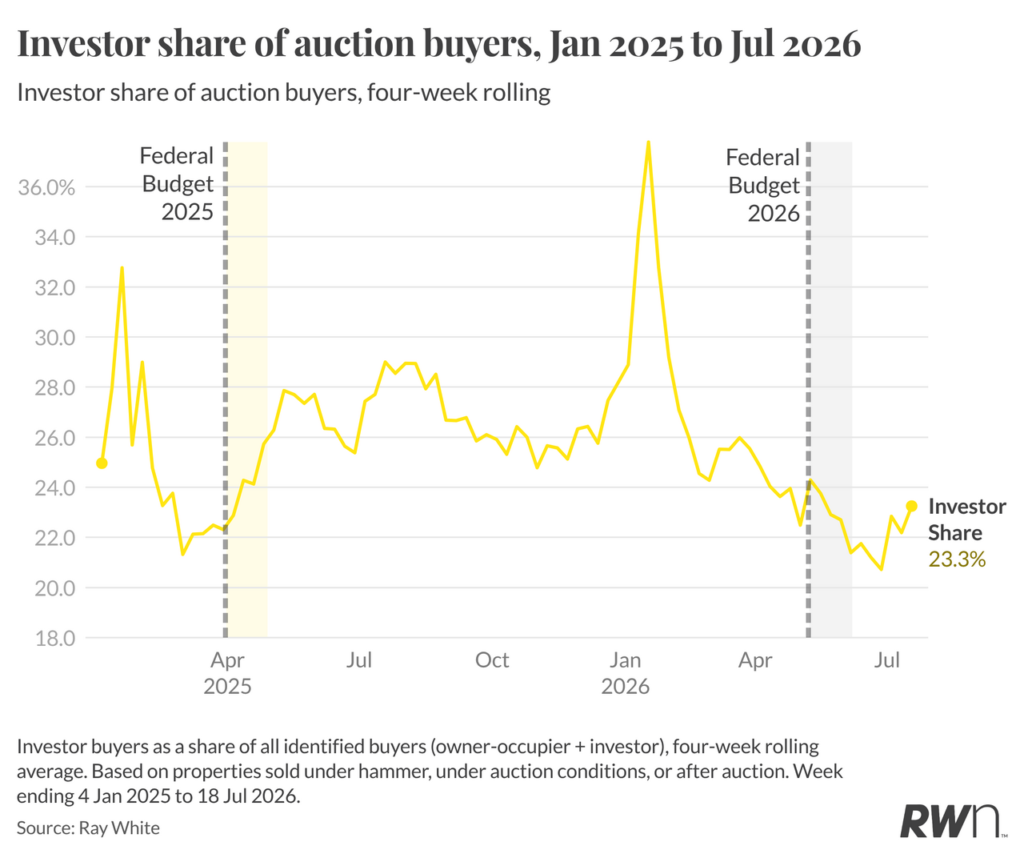
“The initial fall in investor participation suggests the Budget may have influenced buyer behaviour, at least temporarily. The subsequent recovery makes the longer-term impact less certain.
“We do not yet know whether investor participation will continue to rise as auction volumes recover, or whether the post-Budget decline will re-emerge.”
Macro Conditions: The Long Game
While auction clearance rates offer a micro-level view of buyer behaviour, the broader macroeconomic climate paints a stagnant picture for price growth.
Atom Go Tian, Ray White Group Economist, set out the wider conditions investors are buying into. The Reserve Bank lifted the cash rate 25 basis points to 2.50 per cent on 8 July, and annual inflation then came in at 4.1 per cent in the year to June, up from 3.1 per cent in March. Almost two-thirds of the quarterly rise came from petrol and diesel; stripping fuel out, inflation ran at 2.9 per cent.
Go Tian said national median prices have held within the $750,000 to $800,000 band for three years, but adjusting for inflation tells a different story, with the real national median down close to 31 per cent from its 2021 peak, compared with 17 per cent for the nominal price.
He noted that around seven in ten new listings are still finding a buyer, indicating the market is functioning. At the same time, net migration is running below its long‑run average and unemployment has risen, meaning the usual population and jobs tailwinds for price growth are much weaker than normal.
“We are nowhere near a crash, but nor are we approaching a period of growth,” Go Tian said.
“What has changed is simply how long the wait will be.”
Downward Budget Shifts: Investors Competing with First-Home Buyers
Against a backdrop of stagnant growth and tight budgets, are specific policy reforms creating unintended consequences for market competition?
Mortgage broker Alex Veljancevski put a different reading on the same policy. He said the negative gearing reforms, intended to make it easier for first home buyers to enter the market, may simply be shifting investor demand into the same price brackets as first home buyers.
As borrowing capacities tighten, Veljancevski said, many investors are not abandoning their plans but are lowering their budgets and targeting more affordable properties, potentially increasing competition for the very buyers the reforms were designed to help.
Strategic Shifts
Rather than abandoning the market due to tighter capacity, some industry data suggest investors are simply pivoting their strategies.
André Knott of Focus Property Group reported a 46 per cent increase in investor enquiries to his own firm since the Federal Budget. The figure is the company’s internal enquiry data and has not been independently verified.
“Rather than leaving the market, investors are becoming much more selective and are placing greater emphasis on cash flow, depreciation, supply and long-term fundamentals,” Knott said.
The New-Build Trap: Legal Risks in Off-the-Plan Contracts
This pivot toward new strategies – particularly the rush toward new-builds driven by tax changes can carry significant, often overlooked legal risks.
Ian Perkins, Managing Director of Lawlab, said a post-Budget rush into new-build properties might lure investors into some of the most complex sales contracts in the market, with many mistakenly believing off-the-plan and house-and-land agreements are safer or simpler than buying established homes.
He believes the tax changes will trigger a wave of inexperienced investors entering new-build projects at speed, driven by polished marketing, turnkey sales packages, and the perception that “new” automatically means low-risk.
“Investors are walking blind into new-build contracts because the whole sales environment is designed to feel safe,” Perkins said.
“The brochures look glossy, the process feels guided, and buyers assume the contract must be straightforward, but none of that reflects the legal reality.
“These contracts are long, complex, and often heavily weighted in favour of the developer or builder.”
Perkins said many investors wrongly believe new-builds are simpler because there is no auction pressure, no immediate repairs and no physical inspection required, while others assume government building regulations imply broader protection.
“There’s a big difference between consumer protections and contract protections,” he said.
“Building standards don’t protect you from sunset clauses, variation rights, valuation gaps, or the developer’s ability to change materials, specifications, or timelines.”
He said investors have often signed without legal review, only to discover later that key safeguards were missing or that the developer had broad powers to alter the build or extend delivery dates.
“Every developer writes their own contract, so there is no standard version,” Perkins said.
“Investors are comparing it to buying an established home, where the risks are visible and the contract is familiar.
“However, with new-builds, the risks are buried in the fine print, and too many people are signing blind.”
He said the combination of tax-driven urgency, polished project marketing, and limited supply is creating conditions in which inexperienced investors are particularly vulnerable.
“When policy changes rapidly, behaviour changes quickly, too, but contract understanding does not,” he said.
“If investors don’t slow down and get proper advice, they risk locking themselves into agreements that expose them to delays, cost blowouts, valuation shortfalls, or even contract termination under sunset clauses.”
Chasing yield
The danger of investors ‘signing blind’ could be compounded by the temptation to chase immediate returns over stable wealth creation.
Cate Bakos, Chair of the Property Investment Professionals of Australia, warned that the changes to negative gearing and CGT are fuelling some risky behaviour, with many investors chasing high-yield properties at the expense of long-term capital growth.
Bakos said the reforms were likely to trigger a surge in interest in regional locations, small units and apartments, challenging title types, commercial assets, and other cash-flow-focused investments.
“Positive cash flow may appear more valuable now that first-time investors no longer have access to negative gearing tax offsets unless they purchase brand-new property,” Bakos said.
“It helps service debt, provides resilience against rising interest rates, and offers liquidity.
“But cash flow alone does not build wealth, because capital growth remains the cornerstone of successful property investment over the long-term.”
She said the taxation changes had created a more complex landscape, where some inexperienced advisers may start recommending asset classes outside their expertise.
“Consumers must ask their advisers for their experience in recommending regional or commercial assets,” Bakos said.
“Do they understand the growth fundamentals of these markets, or are they simply chasing yield?
“Without proven expertise, investors could be steered into properties that look good on paper but fail to deliver capital appreciation.”
Bakos said spruikers often emerge in times of policy change, promoting properties that may not withstand professional scrutiny.
“Some of these higher risk properties may include internal floor areas that fall short of lending policy, or unusual title types that may require a significantly higher deposit than traditional residential options,” she said.
She said the Budget may have changed the rules, but it had not changed the principles.
“Cash flow is important for sustainability, but capital growth is what compounds returns and builds wealth over time,” she said.
“Investors must ensure their advisers are qualified, experienced, and aligned with their long-term goals.”
Legislative distortion and shrinking supply
Ultimately, this turbulence in investor behaviour and policy reform has downstream effects on the most vulnerable segment of the housing market: renters.
The Real Estate Institute of New South Wales released figures on the state’s rental pool. REINSW data shows 271,618 residential tenancy agreements were signed in NSW in the 2024-25 financial year – which the institute equates to the number of properties a tenant either signed a lease to move into or remain in – falling to 245,249 in 2025-26, a decline of more than 25,000. About 800 fewer agreements were signed between May and June this year alone.
REINSW’s count of exclusive management agreements signed, which it equates to the number of properties for which a property manager has been appointed, was 77,641 in 2023-24, 74,339 in 2024-25 and 72,296 in 2025-26.
The institute also pointed to NSW Fair Trading’s Rental Bonds Data Insights Pack for June 2026, which it said shows the number of rental bonds currently held declined over the previous quarter with a significant drop from May to June, and that the length of rental tenures has declined 0.9 per cent over the past year.
REINSW CEO Tim McKibbin said the growing disconnect between the number of people looking for a home to rent and those who have found one is deeply concerning.
“The situation for renters is worsening. When demand among renters is as strong as it currently is, a natural market response would be the increased absorption of rental supply,” McKibbin said.
“But legislative changes have distorted the market’s ability to respond. What we’re left with is a spiralling societal disaster.”
“It’s not just where all these hopeful renters are living, but how are they living?
“And for those who did have a home to rent and no longer do, where did they go? After all, only a small percentage have moved into the first home buyer category. Consistently rising rents are making it harder than ever for tenants to save a deposit.
“Recent changes to residential tenancy laws are clearly having the opposite effect and with more changes on the horizon as a consequence of the Federal Budget, the rental reversal could become even worse.
“A moratorium on new residential tenancy legislation is needed now, alongside an independent review of the real-world implications of recent legislative changes.
“There is no short-term fix to this dire situation, but we can, at the very least, stop continuing down this destructive path.”
Editor’s Note:
So, is the rental market collapsing, pivoting, or holding firm? The answer, of course, depends on where you sit.
For renters, the pressure is intensifying, with shrinking supply and policy changes constraining the market’s ability to respond.
For property values, the broader picture remains one of stagnation rather than decline, with prices holding steady while real growth goes backwards.
For investors, however, the story is not retreat – it’s a pivot, a recalibration.
It’s early days, but investors aren’t exiting the market; they’re adjusting to it. Lower budgets, new-build incentives, and a growing focus on yield are reshaping how and where they buy.
The immediate risk isn’t a mass investor sell-off, but perhaps more the consequences of rapid behavioural shifts. From complex off-the-plan contracts to increased competition in lower price brackets, these adjustments are creating new pressure points across the system.
In a market reshaped by policy, the fundamentals haven’t changed, but the margin for error has. Caution, informed advice and long‑term thinking are now more important than ever.
The shift to trusted advisor
In line with the ongoing trend of agents and property managers becoming trusted advisors rather than purely transactional operators, here are three practical ways to show up as a strategic partner for your clients right now.
Make ‘asset performance’ your core offering
Investors are absorbing higher costs and tighter borrowing limits while reworking their property strategies; they’re not just asking “what’s my rent?” but “is this asset still performing the way it should in this market?” That’s where you come in.
The action: Turn routine touchpoints into strategic conversations about the property itself. Offer simple cash‑flow and rental yield reviews on the specific asset, highlight practical tax and depreciation questions they can discuss with their accountant or financial adviser, and overlay hyper‑local insights on vacancies, rent movements and buyer demand. When you consistently connect day‑to‑day decisions (pricing, lease terms, minor improvements) to the property’s long‑term performance, you become the person they call before they change property strategy – not after.
Guide clients through complexity, not just inventory
A transactional agent points to a glossy brochure; a trusted advisor translates what’s buried in the fine print into practical risk and process.
The action: Build a clear advisory playbook for new‑build clients across sales, buyers’ agency and property management. That means flagging contract red flags early, setting realistic completion and leasing expectations, and designing handover and defect processes that you can explain confidently. When you’re the one helping clients understand where the traps are—not just where the opportunities are—you’re operating firmly in advisory territory.
Treat tenant stability as part of the investment plan
In a rental environment marked by tight supply and shorter tenures, “finding a tenant” is no longer enough; the quality and longevity of that tenancy sits at the heart of the investor’s risk profile. A transactional mindset focuses on the next lease; an advisory mindset focuses on the next five years.
The action: Reframe conversations with landlords around stability and total return, not just headline rent. Help them weigh up modest, sustainable increases versus vacancy risk, coach them on the value of retaining good tenants, and make maintenance and communication standards part of an agreed strategy rather than an afterthought. By positioning tenancy management as a deliberate investment choice, you’re no longer just managing properties – you’re actively stewarding your clients’ wealth creation plans. In other words, the Budget hasn’t broken the market so much as it has reshaped the rules of engagement.
While volumes are down and confidence has clearly been shaken, the data suggest investors have paused and pivoted rather than disappeared, prices are stuck rather than plunging, and the real crunch is showing up in rental supply and in the quality of decisions being made under pressure.
With that as a backdrop, the real differentiator for agents and property managers isn’t who can shout the loudest about listings – it’s who can calmly interpret the signals, flag the risks and help clients make decisions that still make sense five or ten years from now.