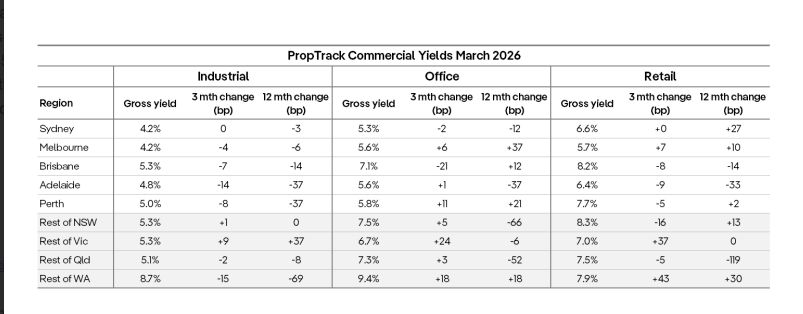
Brisbane has emerged as Australia’s most attractive commercial property market for income-focused investors, delivering the strongest yields across industrial, office, and retail assets in the March 2026 quarter, according to the first realcommercial.com.au Commercial Yield Report.
REA Group Senior Economist and report author Anne Flaherty said Brisbane’s standout performance reflects both opportunity and evolving fundamentals.
“Across the three asset types, Brisbane yields were the highest. So for a commercial investor hunting yield, Brisbane really looks like there’s a lot of opportunity,” she said.
Ms Flaherty explained why Brisbane’s commercial yields have traditionally been higher than other major capitals.
“Historically, Brisbane has been seen as a riskier market compared to Melbourne and Sydney. The reason being that its economy is not as diverse as those two other cities. It’s more government focused, more mining focused,” she said.
She also suggested the city’s economic and demographic trends are changing the picture.
“Brisbane is evolving, and I think Brisbane is becoming more diverse… especially given the strong population growth that we’ve been seeing across Southeast Queensland, that’s supporting a growing need for goods and services, which supports business growth. Of course that drives demand for commercial real estate,” she said.
Ms Flaherty also highlighted Brisbane’s relative strength compared with other capitals.
“The yields are higher in Brisbane than they are in Perth and Adelaide because, arguably, the fundamentals of Brisbane are actually a lot stronger than both of those cities,” she said.
Industrial yields remain tight
Industrial property saw the sharpest yield compression nationally, with every capital city recording declines over the past year. Perth and Adelaide were the hardest hit, each falling 37 basis points.
Ms Flaherty said industrial yields could tighten further as businesses adjust to rising transport costs and growing logistical needs.
“I think there’s a good chance we could see further compression with industrial yields. Industrial real estate is going to remain very in demand… and that could support the performance of those assets,” she said, citing rising fuel costs and growing demand for warehouse and storage space.
Melbourne and Sydney office markets
Office yields were more varied. Melbourne, grappling with the highest CBD vacancy rate, recorded a 37-basis-point rise, while Sydney’s office yields fell 12 basis points.
Ms Flaherty attributed Melbourne’s vacancy surge to supply pressures.
“Melbourne back in January 2020… had the lowest CBD vacancy rate in the country. And then now it’s sitting at 19% as of January 2026,” she said.
“That growth in tenant demand wasn’t enough to offset the growth in new supply,” she added, noting it could take years for landlords to see improved conditions.
Retail yields show variability
Retail yields, traditionally the most variable commercial asset type, also differed across markets. Sydney and Melbourne saw rises of 27 and 10 basis points respectively, while Brisbane and Adelaide improved, declining 14 and 33 basis points. Perth’s retail yields remained steady.
Ms Flaherty emphasised that not all retail properties carry the same level of risk and that investor interest depends on the type of tenants leasing the space.
“It depends what kind of retail you’re looking at; retailers that operate in that discretionary space… those will be perceived as riskier assets.
“We’re still going see strong investor demand for retail assets that are in that non-discretionary space like grocery stores, food stores, places that are more recession-proof,” she said.
Key takeaway
Commercial property sales bounced back in 2025 following three interest rate cuts and improved investor sentiment, though two of those cuts have already been reversed in 2026. Rising rates and persistent inflation could influence yields in the months ahead.
Ms Flaherty said commercial real estate agents should steer their buyers to weigh yields against asset-specific risk.
“It’s really important to look at what different yields can be achieved… and then do those yields actually reflect the risk in the market?” she said.
“On the whole, industrial is low risk and still attractive. Retail depends on the fundamentals of the specific asset – lease in place, quality tenant, ability to pay rent – but it’s definitely possible to get some very attractive returns in commercial.”