
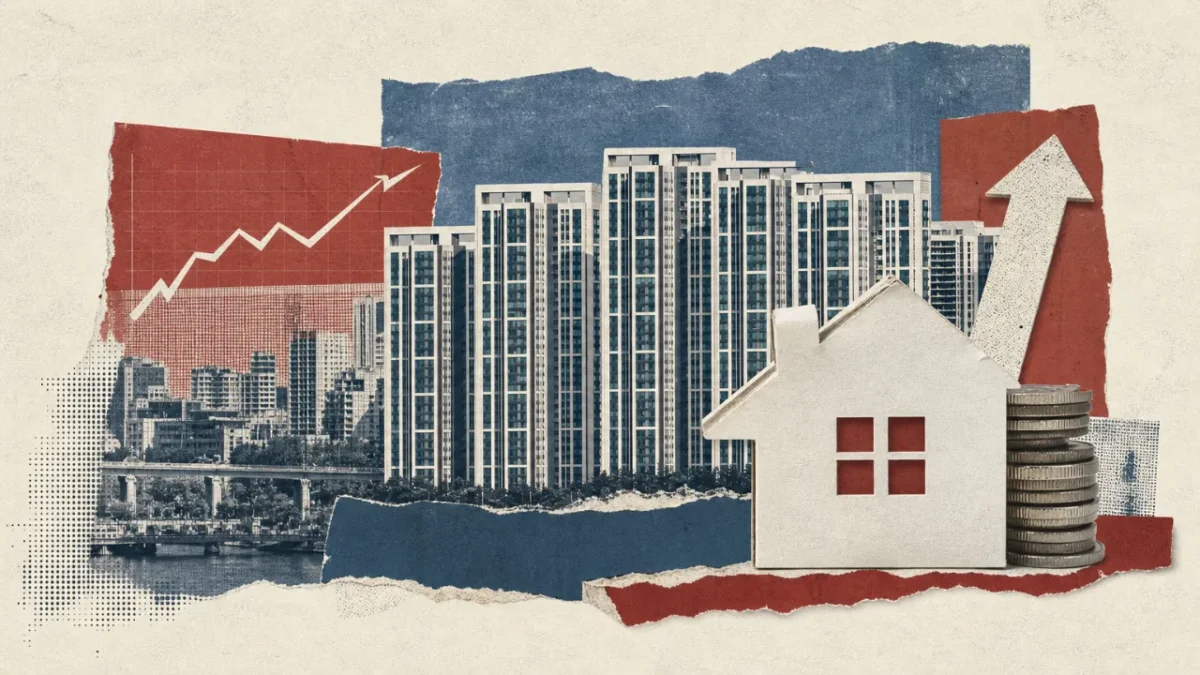
South Korea is moving to increase taxes on wealthy homeowners and property investors as the government attempts to cool a red-hot housing market and shift property ownership away from speculation.
The proposed tax changes, announced by the country’s Finance Ministry, would increase the burden on multiple homeowners and owners of high-value properties while providing relief for some owner-occupiers.
The move follows mounting public anger over housing affordability, with South Korean house prices rising for 13 consecutive months through June and recording their strongest growth since November 2021.
South Korean Finance Minister Koo Yun-cheol said the government wanted to create a “residence-oriented housing market”, where homes are viewed primarily as places to live rather than investment assets.
“We will reform real estate taxes in a reasonable manner to establish a residence-oriented housing market under the principle that a home is a place for living, not buying,” Mr Koo told Reuters.
Under the proposed reforms, single-home owners living in their properties would receive higher tax exemptions, while tax settings would become less favourable for multiple homeowners and owners of expensive homes.
Holding tax rates could rise by up to 2.3 percentage points depending on property value, with properties valued above certain thresholds facing increased costs.
The reforms are expected to be submitted to South Korea’s parliament by September 3.
Australia faces its own property tax debate
South Korea’s move comes as governments globally look at taxation settings as a way to address housing affordability, including Australia, where the Federal Government announced major changes targeting property investment settings.
As part of its 2026 Budget measures, the Albanese Government announced changes to negative gearing, limiting the tax treatment for future residential property investments.
From 1 July 2027, investors purchasing existing residential properties after the 12 May 2026 Budget announcement will no longer be able to offset rental losses against other income. The restriction will apply to established dwellings, while investors purchasing new builds will retain access to negative gearing arrangements.
The Government said the reform was designed to encourage investment into new housing supply rather than competition for established homes.
The Budget also announced changes to capital gains tax, replacing the current 50 per cent CGT discount on assets held longer than 12 months with an inflation-adjusted approach from 1 July 2027. A 30 per cent minimum tax rate on relevant capital gains will also apply under the new settings.
Investor confidence and supply remain key concerns
While the policy approaches differ, both South Korea and Australia are grappling with the same challenge: how to improve housing affordability without reducing investment needed to support future supply.
South Korea’s government is attempting to reduce speculative demand by increasing costs for wealthier property owners, while Australia’s reforms are aimed at shifting investor activity towards new construction.
However, some property industry commentators have warned that changes targeting investors need to be carefully managed, given the role investors play in rental supply.
The developments highlight a broader global trend: governments are increasingly using tax policy to influence property markets, buyer behaviour and investment decisions.
The challenge remains balancing affordability goals with maintaining confidence among homeowners, investors and developers.