

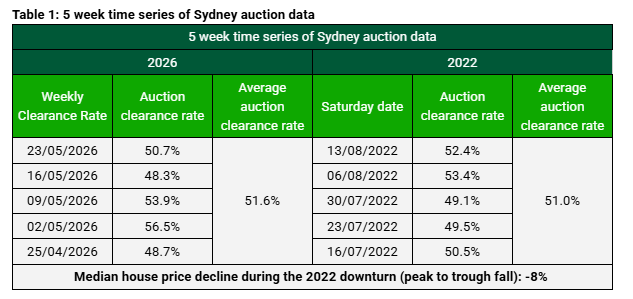
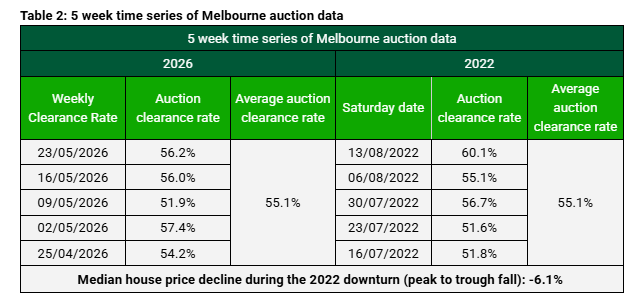
Australia’s auction markets are flashing warning signs, with clearance rates over the past five weeks tracking at or below the levels that preceded an 8 per cent fall in east coast house values during the 2022 downturn.
Sydney’s five-week average clearance rate sits at 51.6 per cent, compared to 51 per cent at the equivalent point in 2022, according to Domain.
Melbourne is matching its 2022 average at 55.1 per cent, while Brisbane has dropped to 37.2 per cent – marginally below its 37.7 per cent average four years ago.
During that earlier correction, median house prices fell 8 per cent in Sydney, 6.1 per cent in Melbourne, and 9.8 per cent in Brisbane.
Domain’s preliminary May data suggests buyer demand has eased faster than it did at the onset of the last correction, with higher interest rates and policy uncertainty weighing on confidence.
“Auction markets are often the first place we see turning points, and recent results are signalling a clear moderation in demand,” Domain Chief Residential Economist Dr Nicola Powell said.
“The fact that clearance rates are tracking below 2022 downturn levels highlights just how quickly conditions have softened through May, particularly at the top end.”
The softening reflects reduced borrowing capacity after sustained rate increases, which has widened the gap between what buyers can afford and what sellers expect.
Rising listings are also adding supply, helping to rebalance conditions after a prolonged period of vendor strength.
Policy changes targeting investors appear to be dampening participation further, reducing competition just as stock levels climb.
However, Dr Powell noted that recent inflation data came in better than expected, which should reinforce expectations that interest rate pressures are beginning to ease.
“Combined with strong underlying fundamentals, this points to a more balanced market ahead,” Dr Powell said.
“For committed buyers, there’s growing opportunity as choice improves and competition becomes less intense.”
Strong population growth and a resilient labour market continue to support underlying demand, particularly at more affordable price points.