

New York architect Matthias Hollwich has spent decades designing buildings that shape how people live. He says AI has already changed how developers decide what to build and where — and most real estate agents don’t know it yet.
If you think AI is just for writing property descriptions or scheduling social posts, think again. The technology is now influencing which projects get approved, what they look like, and where they get built — before a single brick is laid.
Matthias Hollwich, founder and principal of New York-based HWKN Architecture, works at the cutting edge of how technology is reshaping cities.
He’s not talking about AI as something coming down the track. He says it’s already here — and the real estate industry hasn’t caught up.
He puts it plainly: AI isn’t just another efficiency tool. It’s the biggest shift in how buildings get conceived and created in a generation.
“I believe that AI is one of the most radical changes that has been happening in the world for decades, and it touches many industries, and it touches the real estate industry in many ways.”
“It touches the way we search, the way we research, and also how we design, and it’s a very exciting time.”
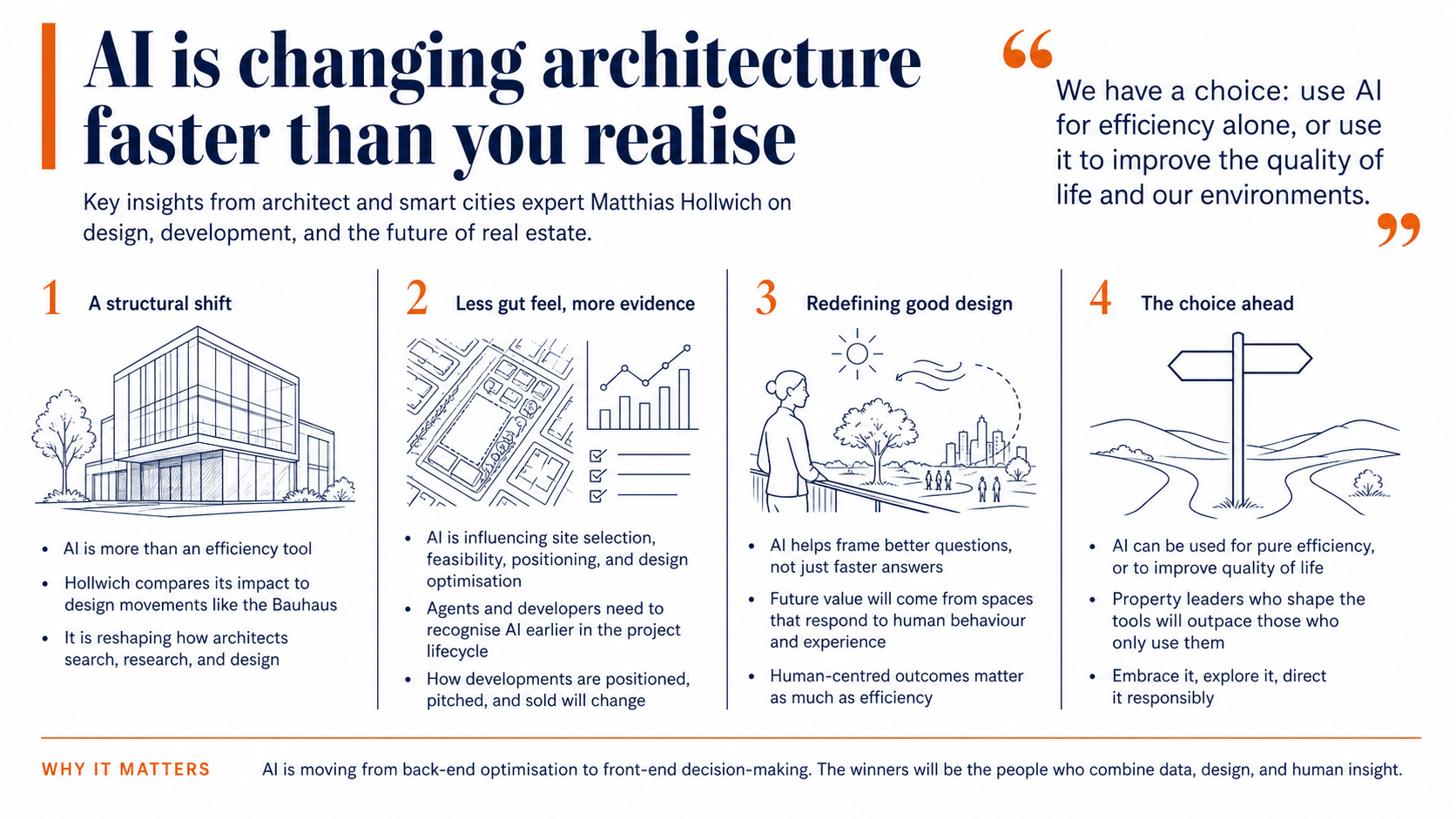
For agents, the implication is direct. AI is no longer just changing how architects draw — it’s also changing what developers choose to build and where.
This isn’t a new app. It’s a whole new way of thinking about what gets built.
Hollwich says the change goes deeper than speeding things up. AI is altering the creative process itself — the questions architects ask, the options they explore, and the decisions developers make.
“It’s really the question, how do we apply it, right?”
What this means for agents on the ground: the properties coming to market in the next few years will increasingly reflect AI-driven design choices — layouts optimised by data, locations chosen by algorithm. Understanding that shift puts you ahead of the conversation with buyers and developers alike.
Developers are increasingly using AI to decide what to build, and where. Here’s what that means for you.
One of the most immediate changes is happening at the very start of a project – before design even begins.
Site selection, market positioning, and project feasibility can now be run through AI tools and increasingly process far more data, far faster, than any human team.
Hollwich says this is already changing how architects and developers operate in practice.
“We can look differently at markets, we can look differently at positioning, we can also look differently at the design itself.”
In plain terms, the gut-feel decisions that used to define development are being replaced by data. And that data is shaping the future supply of property across major markets.
Who’s in charge of what AI builds? That’s actually the most important question right now.
Beyond speed and efficiency, Hollwich says AI is raising a deeper question — one that’s as relevant to agents as it is to architects. If technology can generate designs and crunch development data, who decides whether the outcome is actually good for the people who’ll live and work there?
“The novel thing about AI-driven design is asking the right questions, and we as designers have the opportunity to steer the ship.”
“So what I would take away from us designers in the use of AI, to use a little bit more the experience that we have, because AI learns from the past, and we can bring the future.”
His point is a useful one for agents to take into client conversations: AI doesn’t have values. The humans using it do.
“What I hope the audience takes away is that we have a choice to make. That one choice is AI to be used in a responsible way that creates a better world.”
“And that is something where we are now part of the process. It’s not just happening to us. We are actually active participants.”
“We have to maybe come up with our own AI applications to make sure that it goes in the right direction.”
This exclusive interview with Matthias Hollwich for Elite Agent was conducted by Tabish Ali of the Motivational Speakers Agency.