
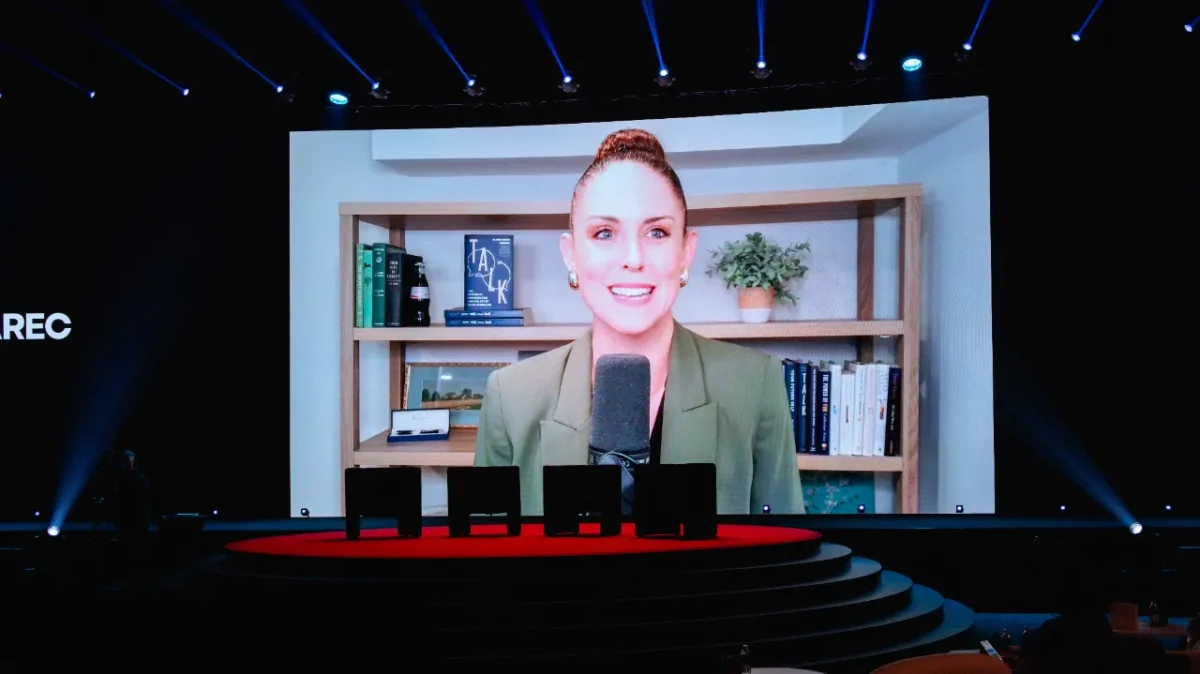
Alison Wood Brooks has studied hundreds of thousands of conversations. Her conclusion for the AREC audience, delivered via Zoom from Boston: agents who treat conversation as a learnable skill will outperform those who rely on charisma or market conditions.
“You’re not really in the property business,” Alison said.
“You’re in the human relationship business, and that unfolds one conversation at a time.”
The Harvard Business School professor – whose book TALK examines the science of conversation – told the room that when markets tighten, conversational skill matters more, not less.
Building trust, following up, being emotionally steady, expressing integrity and genuinely caring about people become competitive advantages.
“The number one mistake people make in conversation is focusing too much on yourself,” she said.
The rest of her session was a practical framework for pushing attention outward.
The TALK framework
Alison gave the audience a four-part acronym: Topics, Asking, Levity, Kindness.
Topics are the building blocks of every conversation.
Alison urged agents to prep topics before meetings – even ten seconds of forethought makes conversations measurably better.
She also shared a finding from her research: when people feel a conversation covered the wrong number of topics, they are three times more likely to say they didn’t cover enough than too many.
Conversations fail more often from stagnation than from moving too quickly.
Asking means asking more questions, especially follow-up questions.
Alison cited research showing that asking just one additional question on a first date converts one in twenty into a second date.
The same principle applies in listing presentations, negotiations and client meetings. Follow-up questions show you’ve listened and want to know more.
“When in doubt, ask the next question,” she said.
“It’s where the richest information lives.”
Levity is the antidote to the quieter killer of conversation – not hostility, but boredom and disengagement.
Alison drew a distinction between trying to be funny and trying to make it fun. Her research found the people rated funniest in conversations aren’t the ones making the most jokes – they’re the ones spending the most time laughing.
“Stop trying to be funny,” she said.
“Try to make it fun.”
Kindness sits at the base of the framework.
Alison said the most important skill within kindness is listening – not just active listening (smiling and nodding) but using your words to show someone you’ve heard them.
Follow-up questions, paraphrasing, and what she calls “callbacks” – referencing something someone said earlier in the relationship – are how trust compounds over time.
Validate before you redirect
Alison gave a specific tactic for difficult vendor conversations.
When a property has dropped in value, and you need to deliver that news, start by naming the feeling.
“It makes sense that you feel nervous about buying this house. It makes sense that you feel angry that we didn’t get a higher price. It makes sense that you feel sad about selling your home,” she said.
“Whatever your clients are feeling, we have to say out loud that they’re allowed to feel that way.”
Validation is not agreement, she stressed.
You can validate a vendor’s frustration and still hold firm on price. But validating first changes how the rest of the conversation lands.
Alison added that new agents who feel like imposters often perform confidence and certainty as a response. That reads as inexperience, not strength.
“Admitting uncertainty can be quite powerful and make you look a lot more seasoned,” she said.
“Very experienced people in any domain know that you have to admit what you know and what you don’t know.”
She closed with a message about what won’t be commoditised.
AI and information are becoming commoditised: Human trust and human connection will not.
“Conversation isn’t just a skill,” she said.
“It is the skill.”
Your morning to-do list
- Before your next listing appointment, spend sixty seconds prepping three topics you want to raise – not a script, just three things worth covering. Notice how much less anxious you feel walking in.
- In your next client call, try ending more of your speaking turns with a follow-up question. See how quickly you learn something you wouldn’t have otherwise.
- The next time a vendor pushes back on price or timing, validate before you redirect. Say “It makes sense that you feel that way” before you say anything else. Watch what happens to the temperature in the room.
- Think of one long-term client. Find something they told you months ago – a renovation they were planning, a school their kids started, a trip they mentioned. Call them and reference it. That’s a callback, and it’s how trust compounds.
- In your next team meeting, try to make it fun rather than trying to be funny. Ask a surprising question, share something unexpected, laugh more. See if the energy shifts.