

Australia’s regional luxury property market is often talked about as one market. It isn’t, according to new analysis from Ray White Group Chief Economist Nerida Conisbee, who has broken the sector into seven separate precincts and found tropical resort markets have pulled well clear of every other prestige category over the past decade.
Ms Conisbee’s analysis uses the 90th percentile automated valuation model for each SA2 area, rather than median prices or individual sales, giving a consistent read on the top end of each market. The figures are averaged into a three-month rolling trend, with each market weighted equally so the comparison isn’t skewed by transaction volumes.
The seven precincts range from temperate coastal prestige – established markets such as Byron Bay, Portsea and Lorne-Anglesea – through to tropical resort luxury, which covers tourism-driven markets including Port Douglas, Palm Cove, Hamilton Island, Noosa Heads and the Gold Coast’s Mermaid Beach-Broadbeach precinct.
Other categories include coastal commuter prestige (Mount Martha, Torquay, Kiama), rural lifestyle prestige (Bowral-Mittagong, Daylesford, Macedon), wine region prestige (Tanunda, McLaren Vale, Pokolbin), alpine luxury (Thredbo-Perisher, Falls Creek, Mount Buller) and broadacre agricultural prestige (Scone, Orange, Mudgee).
Tropical resort luxury has been the standout, with values accelerating sharply during the pandemic as buyers chased resort-style properties and holiday homes.
She said the segment has been more volatile than most but has continued setting new highs, now sitting comfortably above every other regional luxury category – a trend she linked to the exceptional growth recorded across Queensland’s coastline over the past decade.
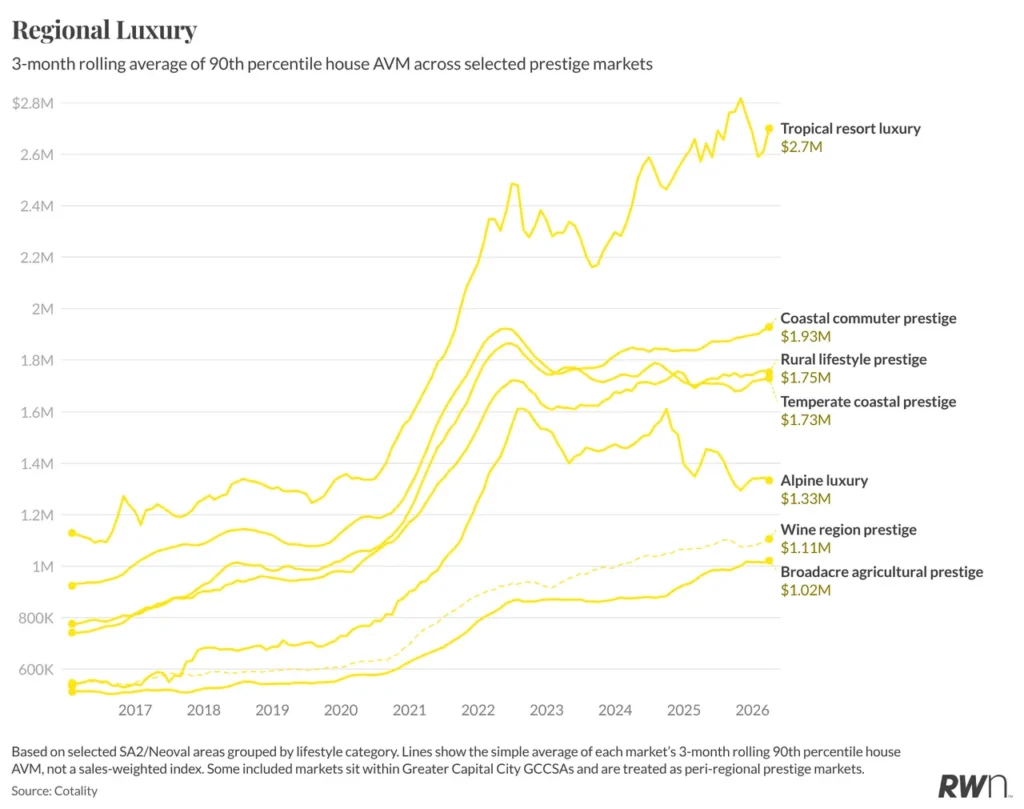
Temperate coastal and coastal commuter prestige markets tracked each other closely for years, both surging through 2020 and 2021 as remote work and lifestyle demand pushed up prices.
Neither has since experienced a significant reversal. More recently, coastal commuter markets have edged ahead of the traditional coastal favourites, a shift Ms Conisbee said suggests buyers continue to place a premium on locations combining coastal lifestyle with convenient access to major cities.
Alpine markets remain the most cyclical of the seven, climbing rapidly through 2021 and early 2022 before correcting more sharply than any other precinct as borrowing costs rose.
Values are still well above pre-pandemic levels, but she said the combination of small markets, limited transaction volumes and discretionary demand makes alpine precincts particularly sensitive to shifts in buyer confidence.
Rural lifestyle prestige markets also grew strongly during the pandemic and have retained most of those gains. Wine region prestige markets took a different path, delivering steadier appreciation with more modest corrections – behaviour she said looks more like an established prestige market than a high-growth lifestyle one.
Broadacre agricultural prestige has been steadier again, with growth reflecting the influence of agricultural land values alongside residential demand.