

Sydney’s housing downturn is exposing a vulnerability more than a decade in the making, with the nation’s most stretched property market recording the sharpest annual price falls despite being comprehensively outpaced by Brisbane and Perth during the recent boom.
Sydney house prices have fallen 5 per cent over the past year, the largest annual decline among Australia’s major capitals, according to Ray White Group economist Atom Go Tian.
For agents, the more important question is not simply why prices are falling, but why Sydney is taking a bigger hit than markets that recorded substantially stronger growth on the way up.
Mr Tian said the answer lay in the amount buyers were paying relative to what they earned, with Sydney carrying the legacy of more than a decade of accumulated price growth.
“Sydney is falling faster than anywhere else, and that’s the puzzle,” Mr Tian said.
“Because unlike past downturns, Sydney didn’t run the hardest on the way up. Over the past three years its growth was modest next to Brisbane and Perth. So why is it now falling further than both?”
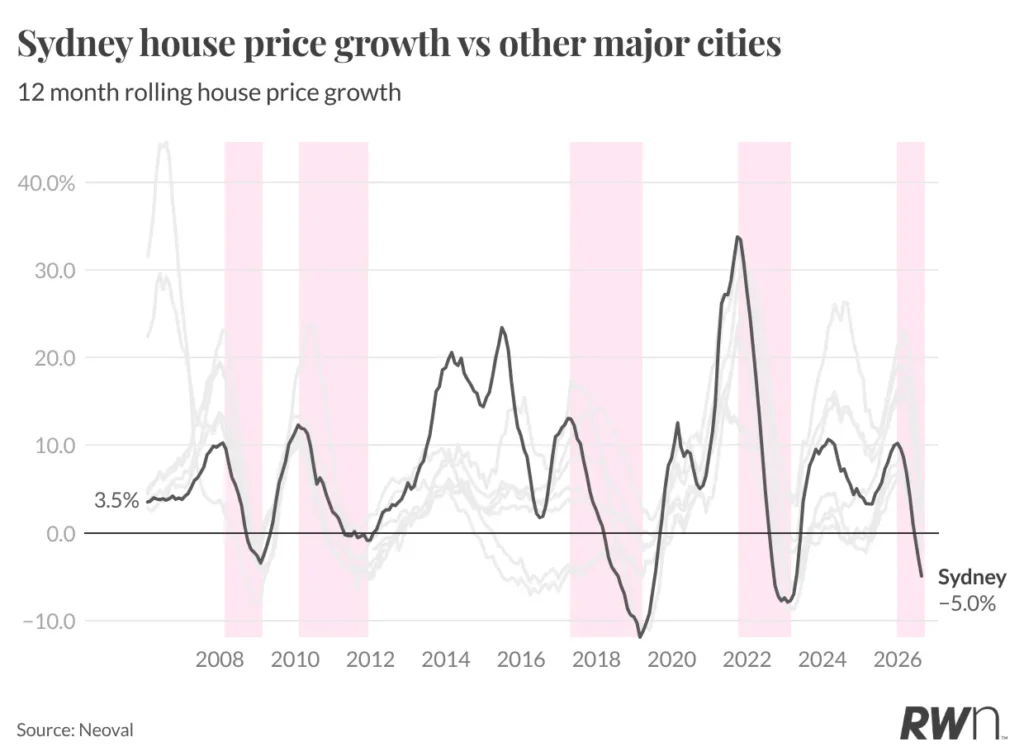
The answer, he said, was leverage.
Sydney’s price-to-income ratio now sits at 12.9 times average earnings, the highest of any major Australian market and substantially above Brisbane at 10.2 and Melbourne at 8.8.
That means changes to borrowing conditions can have an outsized effect on Sydney buyers, with affordability already stretched before rates, credit conditions or investor policies shift.
“At the heart of every one of these downturns is a sudden and significant change to lending, whether tighter credit or higher rates,” Mr Tian said.
“A lending shock translates into larger swings for an outstretched market, where buyers have borrowed most against what they earn.”
A decade in the making
The distinction is particularly important for agents trying to explain the current market to vendors who may be comparing today’s prices with the extraordinary gains recorded in other capitals.
Historically, Sydney has not always been the market most vulnerable to a downturn.
During the Global Financial Crisis in 2008, Perth prices fell 8 per cent while Sydney declined just 3 per cent.
When post-GFC stimulus was unwound in 2011 and 2012, Sydney remained broadly flat while other major capitals recorded falls of between 3 and 7 per cent.
At the time, Sydney’s price-to-income ratio was between six and eight times earnings and remained relatively close to other major markets.
That changed during the 2013-15 boom, when Sydney outperformed every other major capital, including Melbourne.
Over just two years, its price-to-income ratio climbed from about seven to 10.
Sydney has remained Australia’s most stretched major housing market since.
“So, in a sense, yes, Sydney is falling furthest because it grew the most,” Mr Tian said.
“It’s just that the last three years alone can’t explain it. Instead, it’s a decade of accumulated growth that left Sydney the most leveraged market in the country.”
That helps explain why the current correction looks unusual when viewed only through the most recent property cycle.
Brisbane and Perth delivered much stronger gains during the latest upswing, but their households did not enter the downturn carrying the same relationship between property prices and incomes as Sydney.
What it means at the listing table
For Sydney agents, the shift increases the importance of vendor education and realistic pricing.
A market in which borrowing capacity is under pressure can create a widening gap between what owners believe their property is worth and what finance-constrained buyers are actually able or prepared to pay.
Properties that are priced according to yesterday’s conditions therefore risk sitting on the market longer, particularly where comparable sales begin reflecting the downturn.
But the same conditions could also create opportunities for agents working with buyers who had previously been priced out, particularly if vendors become more willing to negotiate.
The bigger question is what happens when conditions eventually improve.
Mr Tian said the recovery may not simply be a reversal of the downturn.
“This downturn also differs from the rest in that it comes paired with permanent policy changes that reprice investor demand for good,” he said.
“So just as this downturn has hit Sydney harder than anywhere, its recovery is likely to look different too.”
Some of that recovery will depend on greater certainty around the direction of interest rates, but Mr Tian said investor behaviour would be another major variable.
“Part of it will come when the outlook on rates stabilises,” he said.“But another, less predictable part will depend on how investors choose to show up in the years ahead.”
For agents, that means the next Sydney upswing may not arrive simply because rates turn favourable.
The market’s high price-to-income ratio, changing investor demand and altered policy environment will all shape how quickly buyers return and how much they can afford to pay.
Sydney’s 5 per cent fall may be the immediate headline, but the bigger story is what sits underneath it: the country’s most expensive market relative to earnings is being forced to adjust to a new borrowing and investment environment.
And after more than a decade of becoming increasingly stretched, that adjustment could take a very different path from the recoveries agents have seen before.