

Three years after New Zealanders last took to the polls, a sharp debate has emerged over the true state of the country’s housing market, revealing a stark divide between listing portal figures and the ground-level reality of completed sales.
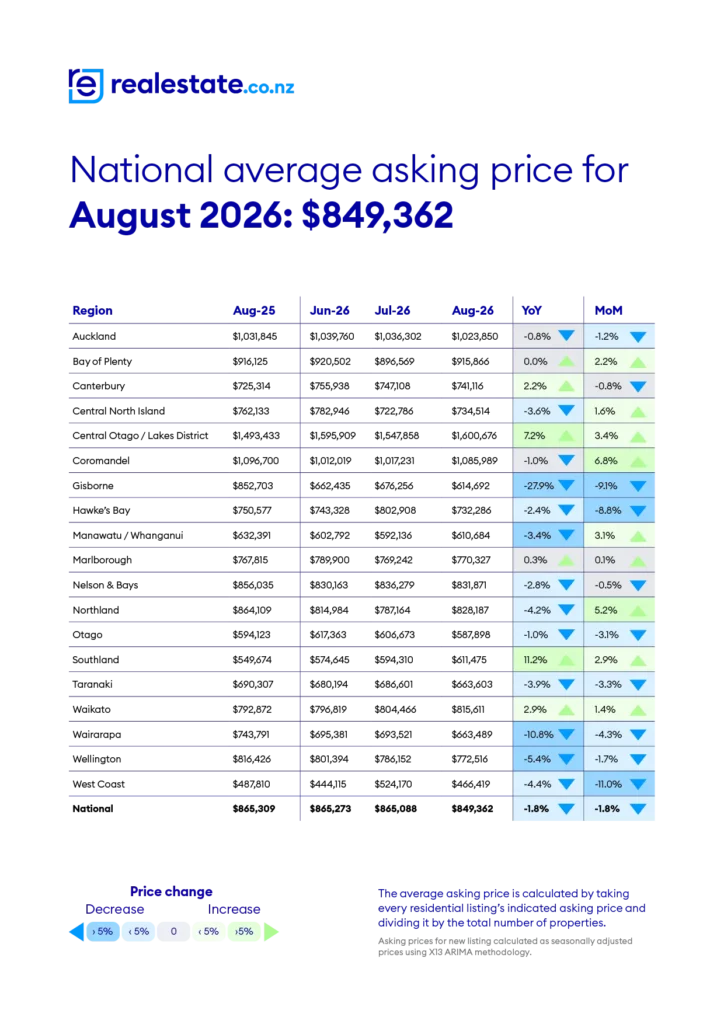
According to the latest New Zealand Property Report from realestate.co.nz, national asking prices have remained relatively unchanged over a three-year period. Data released by the portal shows a national average asking price of $849,362 for August 2026, sitting just 3.2 per cent below the August 2023 average of $877,158.
Sarah Wood, Chief Executive Officer of realestate.co.nz, characterised the current environment as a steady, stable market that has settled into a new equilibrium following years of policy changes and economic shifts.
“The striking thing about today’s market isn’t how much prices have changed, but how little they have,” Ms Wood said.
“Three years is a long time in property, and yet the national average asking price has changed by less than $28,000 since August 2023. What has changed significantly is choice.
“There are almost 45 percent more properties available for sale than there were three years ago, while new listings for the month are also nearly 12 percent higher. Buyers have considerably more options, but we haven’t seen that translate into a dramatic shift in asking prices.”
Ms Wood added that this prolonged period of stability suggests the market may have reached a sustainable plateau.
“For buyers and sellers, this is a very different market from the rapid swings we saw earlier this decade. It’s steadier. Three years of relatively flat asking prices suggest we may be looking less at a market waiting for the next big correction, and more at one that has found its new normal,” she said.
However, leading Wellington real estate consultant William Yip of Team YIP at Collective, First National, strongly rejects the suggestion that property values have simply moved sideways, arguing that portal figures reflect seller expectations rather than completed transactions.
“Asking prices have got nothing to do with sale prices.”
He emphasised that relying on listing metrics gives the public an inaccurate view of what homes are actually selling for across the country.
“I’m not saying that that data is incorrect, but I think that is an angle to look at the market that’s probably inaccurate,” Mr Yip explained.
“I think sales data is probably a bit more reliable because that’s actually what’s transacting. I mean, if the farm wants to sell to 50,000,000, well, then that could drag the averages of the sale price up. But, ultimately, we would prefer to look at average sale prices, and we know the country has dropped by just under 20 percent from the peaks.”
He added that anyone actively working in the industry recognises that prices have fallen significantly.
“There’s no way you would talk to anyone in New Zealand, and they would say, ‘Yeah, okay, the house prices have just moved sideways for the last three years,’ unless you’re in Canterbury, possibly Marlborough, and bits of the South Island.
“There may be some pockets where some suburbs have held up better than others, but as a whole, there’s just no way that is a representation of the market being sideways,” he said.
While realestate.co.nz reported regional variation in asking prices – including Gisborne dropping 27.9 percent year-on-year to $587,898 and Southland rising 11.2 percent to $611,475 – Mr Yip argued that actual completed sales in major urban centres show far deeper price contractions than asking price trends suggest.
Ms Wood noted that local dynamics are driving regional outcomes across the country.
“After several years of significant economic and policy change, local market fundamentals are increasingly coming to the fore,” she said.
“Employment, population movement, affordability, buyer confidence, and the balance between supply and demand are all playing a greater role in determining what happens to prices in individual regions. The contrast between Southland and regions such as Gisborne and Wairarapa is particularly telling, and for buyers and sellers, that makes understanding what is happening in their own backyard more important than ever.”
In the Wellington region, where total stock has expanded by 12.9 percent year-on-year according to portal figures, Mr Yip said actual completed sales prices in Wellington have fallen by an average of over 25 percent from their peak, according to his own market observations, with certain outer suburbs suffering even steeper declines.
“In Wellington, the drop has been as high as 40 percent in some categories,” Mr Yip said. “So we had a house where we sold it for 1,200,000 in the peak, and it just sold, I believe, around $800,000.
“So there has been some cases where the drops have been a lot more pronounced in certain categories. But the average in Wellington, the drop was just over 25 percent.”
He attributed Wellington’s severe downturn directly to government policy changes, public sector job cuts, and subsequent population loss.
Both realestate.co.nz and Mr Yip note that available inventory has expanded dramatically across the country. The report shows national stock rose 9.7 percent year-on-year in August 2026 to 32,908 properties – up 45 percent compared to three years ago – led by major inventory gains in Gisborne (up 26.4 percent), Taranaki (up 22.3 percent), Coromandel (up 17.2 percent), and Wellington (up 12.9 percent).
Ms Wood framed this stock buildup as a benefit for prospective buyers.
“For buyers, one of the defining features of the current market is choice,” she said. “With more than 32,000 properties available nationally, buyers have greater scope to compare homes, locations, and price points, and to be more considered about what represents value for them. That changes the dynamic of the market, because when choice is plentiful, buyers can afford to be more discerning, and properties are competing harder for attention. It puts greater emphasis on vendors understanding their local market and being realistic about where their property sits within it.”
Conversely, Yip explained that the spike in listings is driven by severe financial pressure on property owners, coupled with widespread buyer hesitation.
“Landlords are all losing money, so the cost of ownership is higher than the rental yields. So landlords want to sell,” he said.
“A lot of people who bought in the peak and now interest rates have gone up, they can’t afford it, so they’ve got to sell. And in general, the market forecast is not great.
“So a lot of people aren’t buying, because they don’t want to catch the falling knife, as such. So a lot of people are waiting to buy.”
Despite new listings dropping 5.1 percent year-on-year nationally – with significant dips in Wairarapa (down 30.7 percent), Coromandel (down 28.1 percent), and Marlborough (down 20.4 percent) – Mr Yip stressed that buyer demand has not disappeared entirely, but is simply waiting for borrowing costs to stabilise.
“Markets move on sentiment, and it only needs a sentiment to change,” he said.
“The sale volume has dropped, and that tells me that the number that’s dropped by were people that would have normally bought a house, but have chosen not to for various reasons – monetary, fiscally, politically, market trend, whatever. And when the market condition favors buying, i.e., the bottom of the market, then I would expect those people who had planned to upsize, downsize, buy an investment, whatever, they would then look to purchase at that point in time.”
Looking ahead to a potential market turnaround, Ms Wood advised that vendors entering the market in spring must be mindful of presentation and realistic pricing amid high competition. Mr Yip, meanwhile, pointed to interest rates as the ultimate catalyst for recovery, while noting Wellington’s unique path ahead.
“When interest rates stay stable or start coming down, we will see that reversal as a country,” he said. “For Wellington, our issue is we’ve lost our demand because the jobs have gone. And then the on-flow effect of that to subsequent industries … we won’t probably see a reversal until the public sector has a boom.”