
Mortgage stress is no longer confined to Australia’s traditional outer-suburban “mortgage belt”, with new data showing financial pressure is now spreading into some of Sydney’s most affluent postcodes as sweeping federal tax changes and weakening auction conditions ripple through the housing market.
According to the latest report from Digital Finance Analytics (DFA), mortgage stress is rising across both middle-income and high-income suburbs, marking a structural shift in where financial pressure is emerging.
Research adviser Mansour Soltani said stress levels are now “notably higher than this time last year”, driven by a combination of higher mortgage repayments, cost-of-living pressures, shrinking savings buffers and policy uncertainty.
He said the federal budget’s changes to negative gearing and capital gains tax discounts have fundamentally altered the investment equation.
“For many years, investors were prepared to carry short-term losses because the expectation was that long-term capital growth, combined with tax incentives, would outweigh the holding costs,” Mr Soltani told The Australian.
With those incentives now reduced, investors may be less willing to absorb ongoing cashflow losses, potentially increasing selling pressure in leveraged markets.
The DFA analysis shows mortgage stress is no longer concentrated in lower-income areas, but is now entrenched across “dual-income middle-ring suburbs” that expanded debt loads during the low-rate era. Recent commentary also points to Sydney recording the highest concentration of rising stress across capital cities, with multiple postcodes showing worsening conditions in early 2026.
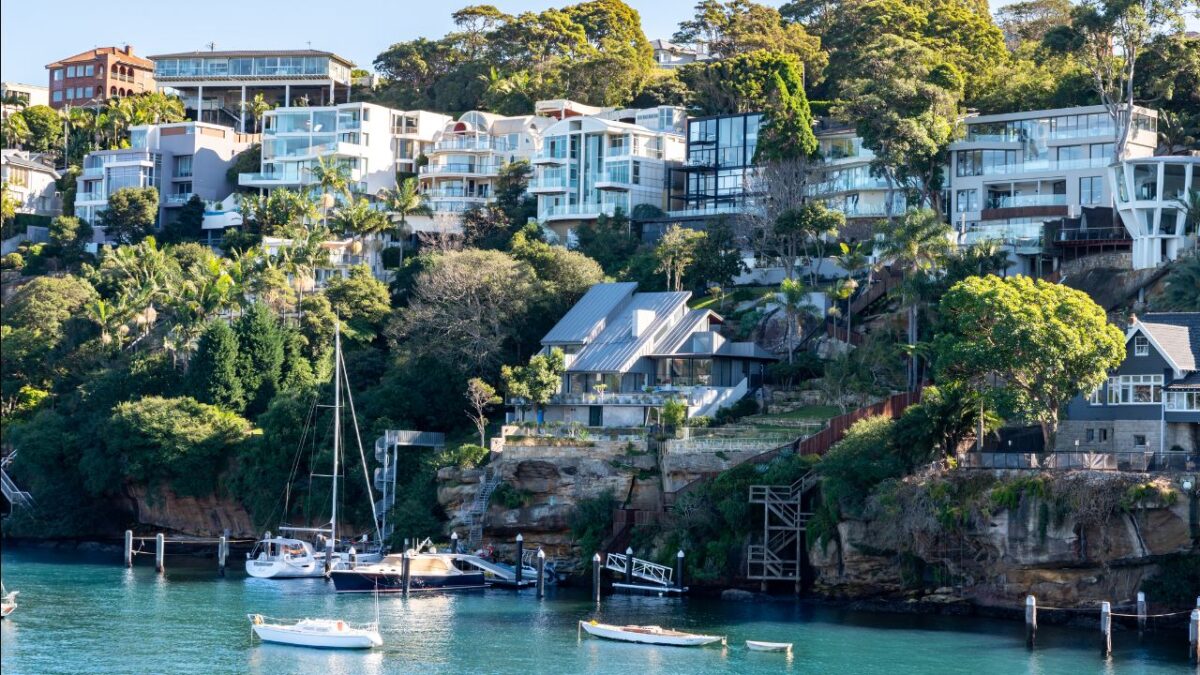
Sydney’s affluent Lower North Shore postcode 2066, covering suburbs including Lane Cove, Northwood, Riverview, Longueville and Linley Point, has emerged as Australia’s biggest severe mortgage stress hotspot in the first quarter. The number of severely stressed households in the area surged from 749 to 2,306, highlighting how financial pressure is now extending well beyond traditionally vulnerable outer suburban markets and into high-income, established areas.
At a national level, the Digital Finance Analytics (DFA) report shows mortgage stress is increasingly entrenched across “middle Australia” rather than being concentrated in lower-income postcodes. Brisbane and southeast Queensland recorded the fastest growth in default risk, with eight of the top-10 ranked postcodes increasing over the quarter, including a 73.3% spike in postcode 4207 across the Gold Coast–Logan corridor.
Melbourne’s outer growth suburbs also weakened, with 3030 (Point Cook, Werribee, Wyndham) rising 51.4%, and 3199 (Frankston, Karingal) increasing 28%, underscoring widespread deterioration across growth corridors.
The strain is now intersecting with a softer housing market.
Across the combined capital cities, Cotality economist Annabelle Mezieres reported that the preliminary auction clearance rate edged up slightly to 58.2%, but remains below the key 60% benchmark for six of the past eight weeks following the budget changes.
The prior week recorded a low of 57.5%, highlighting ongoing volatility in buyer demand.
Sydney’s market has been particularly affected. While clearance rates lifted to 56.9% from a recent low of 49.2%, activity remains fragile. Melbourne recorded a steadier 60.2%, but volumes and sentiment remain uneven across cities. Brisbane, meanwhile, recorded a weak 45.7% clearance rate, its softest result since 2023, underscoring widening divergence across capital cities.
Nationally, auction volumes rose to 2,339 listings, up 19% week-on-week, but still down 4.9% compared to the same period last year, suggesting sellers are returning to market cautiously even as demand remains patchy.
In Sydney, 823 homes went to auction last week, a sharp increase on the prior week’s 619 listings, while Melbourne hosted 1,043 auctions, up 13.6% week-on-week.
Despite higher volumes, both cities are showing signs of absorption stress, with clearance rates failing to consistently hold above 60%.