

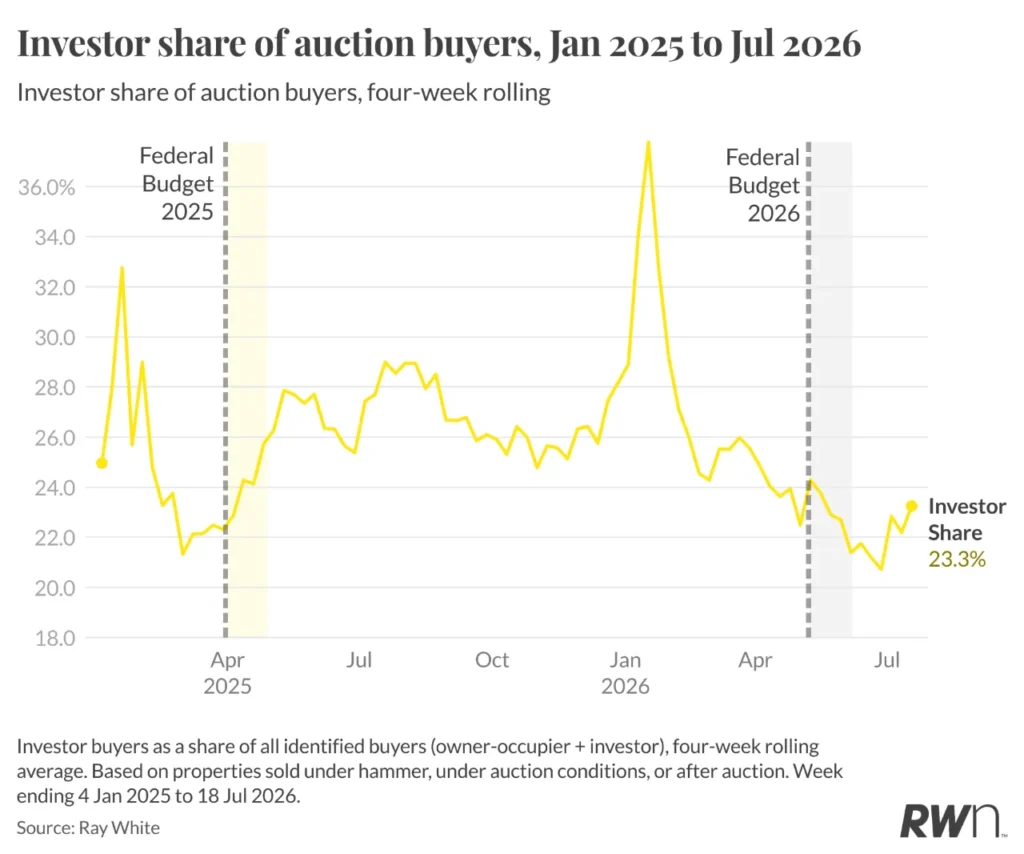
Investor participation at auction is creeping back up after falling sharply in the weeks following May’s federal Budget, according to Ray White Group Chief Economist Nerida Conisbee, though it remains below where it stood before the Budget landed.
The housing measures announced on 12 May were designed to reduce the number of investors buying established properties. In the immediate aftermath, the data suggested it was working: investor buying fell and investors made up their lowest share of auction buyers recorded this year.
Ms Conisbee’s analysis, drawn from more than 64,000 auction campaigns since the start of 2022 across a network that conducts around one in four auctions held in Australia, shows investor buyer numbers fell 31 per cent in the nine weeks after the Budget, from 564 to 390.
But the whole market slowed over the same period, with owner-occupier numbers down 24.5 per cent and total buyers down 26 per cent, making the investor share of buyers a clearer signal than raw numbers.
That share tells the real story. Investors accounted for 24.3 per cent of buyers immediately before the Budget.
It dropped to 20.7 per cent in the four weeks to 27 June, the lowest four-week reading of the year, before climbing back to 23.2 per cent in the four weeks to 18 July.
She cautioned against reading too much into the rebound; the latest four-week period recorded 166 investor buyers, more than the 149 in the previous period but still fewer than the 181 counted in the first four weeks after the Budget.
Some of the lift in investor share also reflects continued softness among owner-occupiers rather than a genuine surge in investor demand, and the current 23.2 per cent share remains well short of the 29 per cent recorded over the same weeks last year.
On the selling side, there has been little change. Investor vendor numbers fell 31.4 per cent after the Budget – broadly in line with the drop in investor buyers – while their share of vendors slipped from 30.2 per cent to 28.7 per cent.
The ratio of investor buyers to investor vendors held steady, at 71 per 100 before the Budget and 72 per 100 after.
“There is no evidence of a post-Budget investor sell-off,” Ms Conisbee’s analysis states, adding that the initial fall in participation suggests the Budget may have influenced buyer behaviour, at least temporarily, but that the subsequent recovery makes the longer-term impact “less certain”.
Separate commentary from Ray White CEO of Performance and Value Thomas McGlynn points to who is filling the gap investors have left.
Post-Budget buyer-intent data cited by Ray White shows the share of first home buyers at its auctions has lifted from 40.6 per cent to 46.5 per cent as the investor pool shrinks and the renovate-and-flip segment largely exits the market.
“We can see first home buyers are stepping into the space investors are leaving,” he said.
Ray White figures also show 62 per cent of investors who have bought at its auctions since the Budget say they still intend to rent the property out.
“The investors still buying are doing it for the same reason they always have – to hold and rent – so the exits we’re seeing are about caution on new purchases, not a wholesale retreat from the asset class,” Mr McGlynn said.
Whether investor participation keeps recovering as auction volumes lift, or the post-Budget pullback re-emerges, is not yet clear.
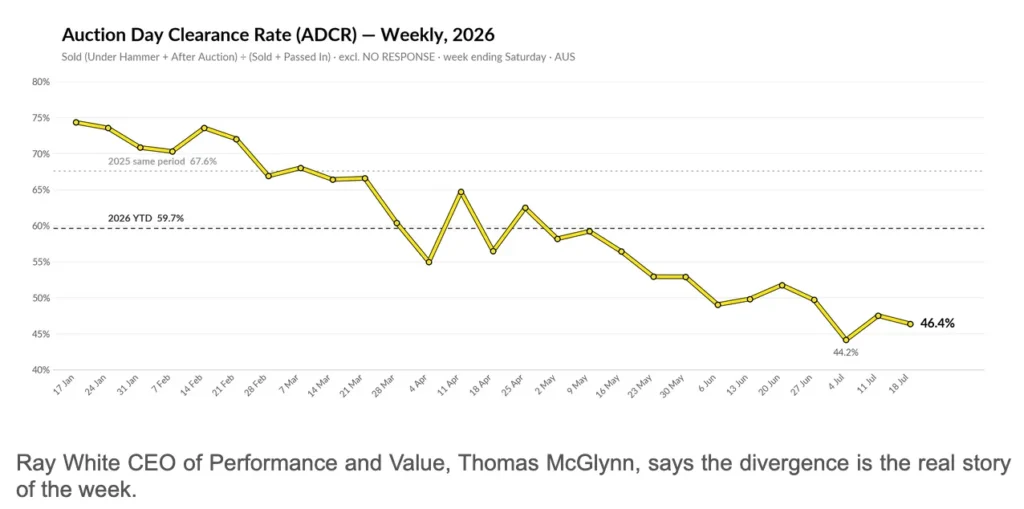
“Week to week, the clearance rate will move around, that’s normal,” Mr McGlynn said.
“What we’re watching closely is engagement: how many people register, how many actually bid, how far passed-in properties travel after the hammer doesn’t fall. On every one of those measures, this market is moving in the right direction, even while the headline number eases. That’s the story sellers should be paying attention to.”