
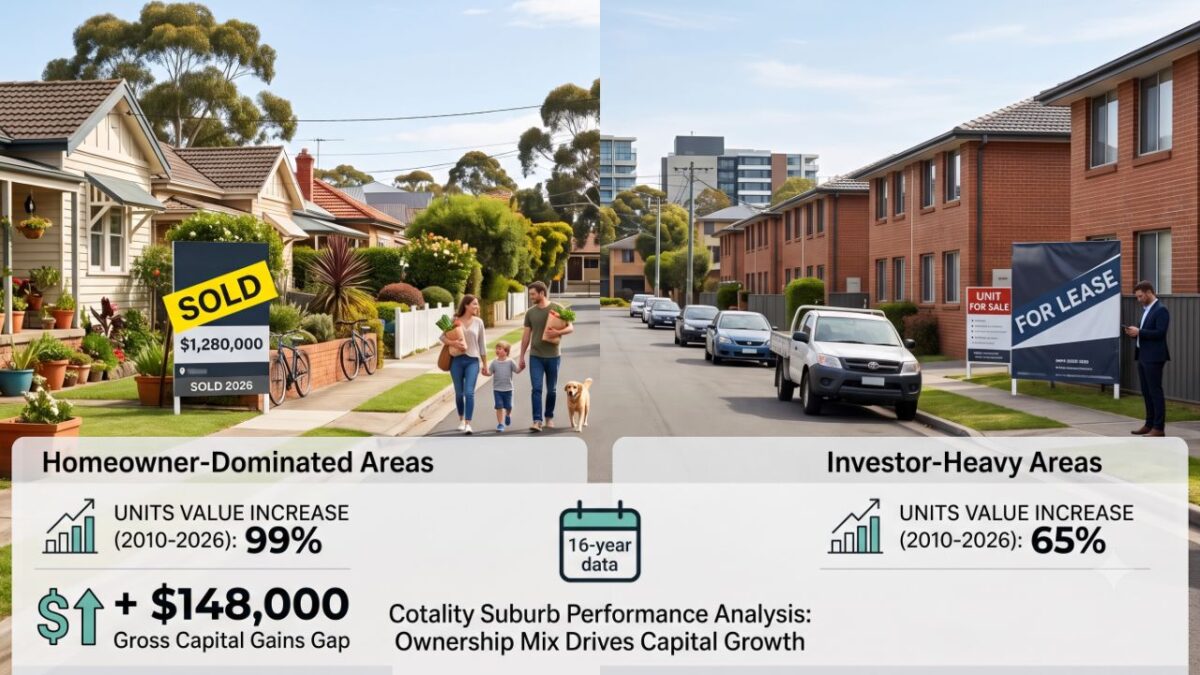
Suburbs dominated by everyday homeowners are systematically outperforming investor-heavy rental hubs, exposing a massive $148,000 equity gap that is reshaping how property professionals assess long-term market growth.
A 16-year data analysis from Cotality has exposed a stark performance divide across 3,000 Australian suburbs.
Between January 2010 and March 2026, neighbourhoods with a high concentration of owner-occupiers delivered significantly stronger capital gains, fueled by an astonishing 34-percentage point performance gap in the apartment sector.
The findings completely flip the traditional investment playbook, proving that a suburb’s demographic mix is a critical driver of capital growth.
The $148,000 unit market divide
While units in investor-heavy suburbs managed a 65% gain over the 16-year period, units in owner-occupier-dominated suburbs surged by 99%.
When applied to the January 2010 national median unit value of $436,000, that percentage gap hands homeowners an additional $148,000 in gross capital gains.
The data shows a similar, though less aggressive, trend for detached housing. Low-investor suburbs saw house values jump 136%, outstripping the 117% growth seen in investor-heavy areas, leaving an estimated $83,000 gap on the table relative to the 2010 median house price of $435,000.
“The results are consistent with the idea that owner-occupier heavy suburbs have tended to see stronger capital growth, particularly across the unit segment,” said Cotality Economist Annabelle Mezieres.
“Units in investor-heavy suburbs have historically underperformed because they can be more exposed to sudden supply spikes, changes in market sentiment, and shifts in credit conditions.
“Owner-occupiers typically buy with a focus on liveability and lifestyle, often inject capital via renovations, and hold assets longer, which supports value over time.”
The “Amenity Premium”
According to Ms Mezieres, this performance gap is deeply tied to an “owner-occupier amenity premium.”
While investors price properties logically based on achievable rental yields, everyday buyers purchase with emotion and daily utility.
Homeowners are consistently willing to pay a premium for premium school zones, walkability, and strong transport links because they live with that value daily, allowing owner-occupier suburbs to capture more growth during market upswings.
The data also exposed a distinct geographic pattern. The highest concentrations of investor-heavy markets are heavily clustered in inner-city, high-density hubs and outer-fringe new builds. In the data set, this was led by Perth pockets like Northbridge and East Perth, alongside famous high-density rental hubs like Sydney’s Newtown, Petersham, and Paddington, and Melbourne’s South Yarra, St Kilda, and the CBD.
This concentration triggers what Ms Mezieres terms “supply asymmetry.”
Because developers procyclically build exactly where investors are already buying, a single new apartment tower can instantly inject hundreds of units into an investor-heavy suburb, diluting scarcity and dampening capital growth.
Detached housing, by contrast, retains an underlying land value and a natural barrier to sudden supply spikes, keeping the performance gap much narrower for houses than units.
Cash-flow squeeze and Budget tax cuts threaten rental hubs
This newly uncovered data arrives at a critical turning point for real estate professionals and their clients. Investors captured 40% of all housing lending by value in the March quarter of 2026, but the financial ground is rapidly shifting.
The Reserve Bank has completely reversed its 2025 interest rate cuts, driving investor mortgage rates into the mid-6% range.
With capital city rental yields averaging just 3.5%, highly leveraged landlords are facing immediate, severe cash-flow pressures.
Compounding the risk is a major regulatory shakeup from the Federal Budget, which will grandfather negative gearing for existing properties from 1 July 2027, redirecting tax incentives exclusively toward new builds.
For real estate agents, property managers, and buyers’ advocates, this shifting landscape means the “investor-pack” suburban model faces an uphill battle.
“Future buyers of established stock may not have access to the same tax benefits or borrowing capacity, which could narrow the buyer pool in locations previously attractive to investors,” said Thomas Clarkson, Cotality’s Senior Manager of Analytics & Data Science.
“While new builds will benefit from tax incentives, a high rental ratio could have implications for long-term capital gains.
“Additionally, investors are likely to weigh higher entry costs, the potential for a shallower resale market, and reduced scarcity against the appeal of tax benefits derived from new housing options.”