
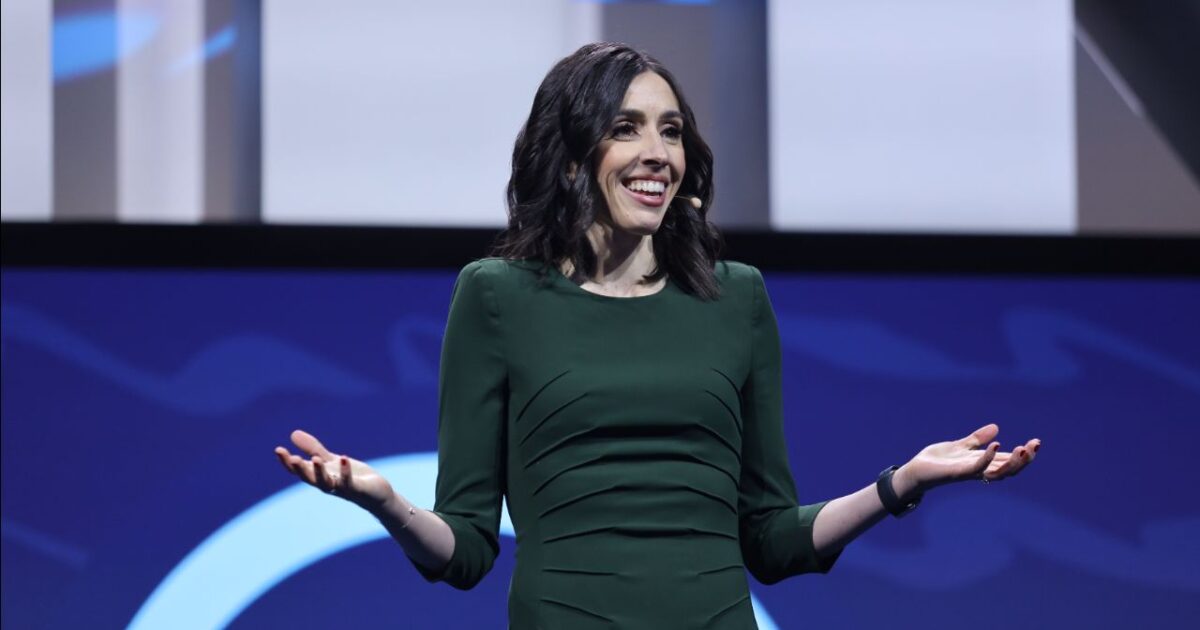
When Holly Ransom takes the stage at AREC, she is not just bringing a resume that includes sharing stages with Barack Obama and Richard Branson. She is bringing a blueprint for a profession she believes is standing at a critical crossroads.
As automation reshapes how the industry works, Holly, a Fulbright Scholar and CEO of Emergent Global, argues the real winners will not be those with the best technology, but those who build strong psychological armour and commit to continuous experimentation.
She calls this a “to-test” mindset and says it is becoming essential for staying relevant.
The myth of the leadership key
For most agents who operate independently rather than as agency owners, leadership can feel like something reserved for someone else, but Holly challenges that idea.
“We are all leaders, whether we have a title or not, because we are all impacting the decisions of the colleagues around us,” she says.
She outright rejects the idea that leadership is something you are handed at a certain point in your career.
“I think there is a thinking that there is a magical moment in your career where someone hands you the leadership keys and says, cool, now have a run at it. You can grab those keys any way that you want.”
For Holly, leadership is built through what she calls a body of evidence. It comes from small, consistent actions that accumulate over time rather than one defining moment.
That might mean experimenting with new ways of telling stories on social media, changing how clients are communicated with, or rethinking how past relationships are reactivated.
“Nothing motivates people like evidence,” she says.
What the world’s most influential leaders have in common
Across global figures including Barack Obama and Richard Branson, Holly says a consistent leadership pattern emerges that is less about status or visibility and more about discipline behind the scenes.
She describes a consistent focus on “leading self” before “leading others”, where high-performing leaders continue doing personal work long after they have reached senior levels.
“There is a constant introspectiveness,” she says, pointing to leaders who remain deliberate about how they think, operate and structure their lives, rather than relying on experience alone.
Across the leaders she has worked with, and there have been many, Holly says there is also a shared willingness to stay curious and open to challenge, rather than becoming fixed in their ways.
Ultimately, she argues leadership only becomes real when it moves beyond the individual.
“If it doesn’t move beyond us, it’s not leadership.”
Trust as the real competitive advantage
Real estate has long struggled with trust, but Holly says that gap matters more now than ever. As more of the work becomes standardised and automated, she believes trust is becoming the key point of difference.
Her view is that when AI handles speed and efficiency, the advantage shifts to human judgment, intent, and relationship quality; she breaks trust down into a simple equation:
Reliability plus credibility plus intimacy divided by self orientation equals your trust score.
While many agents focus heavily on credibility, such as awards and sales performance, she says the real differentiators are reliability and intimacy.
Reliability is about consistency, doing what you say you will do every time, without exception.
Intimacy is about whether clients feel safe enough to be honest and open, and whether the relationship feels genuine rather than transactional.
“The more consistently I follow through on my word, and the more honest and open our interactions are, the stronger the trust becomes,” she says.
Clients have a strong BS radar and can quickly detect when interactions feel performative.
“I don’t have to put up a facade with you. We don’t have this kind of showmanship where you have to show up a certain way or deliver a certain impression. We’ve got a real ability to be honest with one another.”
Holly reflects on her own experience as a buyer to bring this to life; the agents she remembers most clearly were not the loudest or most visible, but the ones who demonstrated genuine care and attention.
“The questions they asked, the fact they remembered my 16-year-old’s name, the way they would reach out and not pitch me the thing that clearly was on their books, they clearly understood what we were after.”
Those moments of attentiveness, she says, are what build lasting trust and long-term referral power.
Killing complacency with a ‘to-test’ mindset
“The better we get at things, the scarier being a beginner is,” Holly says, warning that complacency is often what quietly shortens careers.
Rather than pushing for reinvention, she encourages agents to focus on small habits that keep them curious and adaptable.
“Don’t tell me about the ambition; tell me about the habit, the infrastructure you’ve got in the way you work.”
She argues many people want to evolve and stay relevant, but fail to build the simple systems that support that in everyday practice.
Instead of trying to change everything at once, she recommends putting together a list.
“Start a ‘to-test’ list. What’s the one thing I’m having a go at this week.”
That might mean listening to a different podcast on the commute, trialling a new tool, experimenting with marketing approaches, or speaking to people outside their usual real estate networks.
“We need to find small ways to keep the aperture open.”
Holly says curiosity has become a genuine competitive advantage as AI reshapes the industry, but only when it is turned into action.
“If you think you can come to a conference like AREC and go back and spend 80 per cent of your week doing everything you’ve heard about, you’ve got another thing coming.”
Instead, she advocates for micro habits, small deliberate actions repeated over time.
“We seek to optimise before we seek to establish,” she says. “So think about the smallest unit of work and build reps.”
For agents trying to stand out in an inevitably crowded market, Holly says the key is balancing clear direction with flexibility in how you get there.
“Always think about a strong sense of direction, but a loose hold of the reins.”
She believes progress does not come from rigidly sticking to one model, but from being willing to adapt and reinterpret what good looks like over time.
“You do not need to be anchored to the way that is immediately put in front of you. Part of the opportunity is to take it and reinvent it.
“That is progress.”
Holly Ransom will be appearing at AREC on Sunday, 24th May, from 9:30 am to 10:15 am.
AREC26 nears sell-out as Boris Becker joins keynote lineup
AREC26 is tracking toward a near sell-out, with just 1,000 tickets remaining as momentum builds ahead of the Australasian Real Estate Conference at the Gold Coast Convention and Exhibition Centre on Sunday 24 and Monday 25 May 2026.
The program has been bolstered with the addition of global tennis icon Boris Becker, who will appear as a virtual keynote speaker. The six-time Grand Slam champion and former world No. 1 will speak on resilience, discipline and performing under pressure, with lessons tailored to operating in high-performance, high-stakes environments such as real estate.
Ticket demand is being led by Queensland at 33%, followed by New South Wales at 26% and Victoria at 23%. Diamond tickets have sold out, while only 25 Platinum seats remain available.
Izzy Savva, Head of Total Real Estate Training and organiser of AREC, said the 2026 program has been designed to reflect the shifting expectations facing the industry, with a focus on practical tools, insight and performance.
The Property Management Hall will also return in 2026 as a dedicated stream for property managers, curated and hosted by Nick Georges. The format will allow attendees to move between the PM Hall and the main AREC Arena, ensuring access to both tailored content and headline keynote sessions.