

I woke up this morning and did what I suspect you did: scrolled through the socials to see how agents were reacting to last night’s budget.
It was… a lot.
Long posts that need their own table of contents. Hot takes from people who maybe haven’t read past the headline. Doom and gloom from agents whose clients are probably watching them post it in real time.
But here’s what I actually see when I look at last night: an opportunity.
This might be one of the first big moments where you get to prove that you’re an agent who is valuable beyond the tech.
Your clients can Google the budget changes. They can ask ChatGPT. They can read a hundred hot takes before lunch. What they can’t get from any of that is someone who knows their property and situation and picks up the phone to walk them through it.
AI just made it possible to understand complex tax reform in an afternoon. The question is what you do with that understanding… and how valuable can you make yourself in this moment?
So here are five things you can do right now with the actual budget documents that will put you ahead of every other agent in your market by tomorrow morning.
1. Build an interactive tool for your website
We built an interactive flowchart that walks investors through the decision tree: Do they already own? Are they buying? New build or established? Each path leads to a clear outcome – what’s grandfathered, what’s in the grace period, what’s restricted.
Here’s mine if you want some inspo.
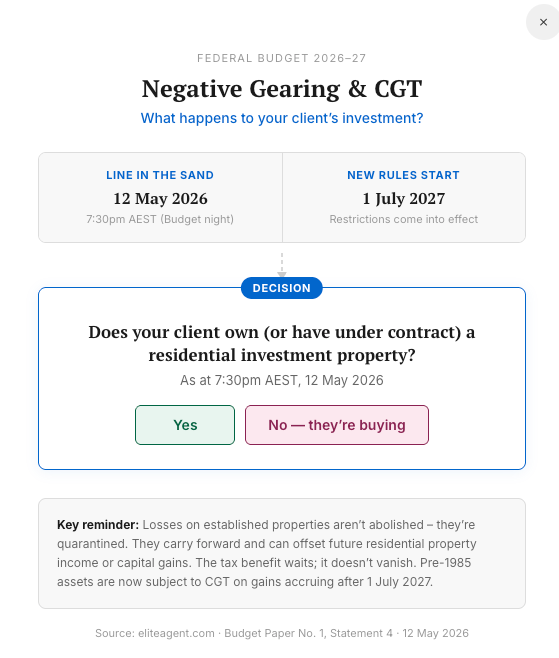
You can build your own version. Take the budget paper (specifically Section 4 from the Treasury website), open up a Claude project or ChatGPT, paste it in, and ask it to create an interactive tool that helps your clients figure out where they sit.
Yes, that’s it, there is no punchline.
Then, put the tool on your website. Not as a PDF download behind an email gate. Not as a 47-slide carousel. As something useful that people can actually tap through and get an answer.
Share that on the socials. So, while everyone else is posting walls of text, you’ll be the agent who built something a client can actually use.
2. Create a project and really understand the detail
There is a lot of nuance in the actual budget documents that isn’t making it into the coverage you’re reading this morning. Not because the coverage is bad, but because 1,200-word articles can only hold so much.
Go to the Treasury website. Download Budget Paper No. 1, Statement 4. It’s the section on tax reform for workers, businesses, and future generations.
Then throw it into a Claude project or a custom GPT. Ask it questions. Stress-test the scenarios your clients will call you about today.
- “What happens if my client bought in March 2026 but doesn’t settle until August?”
- “How does the CGT split work for a property held since 2015?”
- “What does cost base indexation actually mean in dollar terms on a property purchased for $600,000 in 2019?”
Our Budget Night breakdown is the TLDR – and we’ve got more coming this week.
But there’s no substitute for sitting with the source document and building your own understanding. The agents who do this will hear it in their own voice when they explain it to clients. The ones who don’t will sound like they’re reading someone else’s summary.
3. Build an interactive CGT calculator
This one’s for the agents who want to go a step further.
The new CGT model is the part most investors will struggle with. The 50 per cent discount is simple – halve it, done. Cost base indexation? A split at 1 July 2027? A 30 per cent minimum tax on real gains? That’s three moving parts, and most people’s eyes will glaze over by the second one.
So here’s an idea: Take the budget papers, CPI detail and load them into a Claude project or custom GPT, and ask it to create an interactive tool where a client can plug in their purchase price, purchase year, and estimated sale price, and see the difference between the old CGT rules and the new ones side by side.
It doesn’t need to be tax-advice-grade accurate. It needs to be accurate enough to show the shape of the change. Add a disclaimer. Point them to their accountant for the real numbers.
But the agent who can sit across from an investor, pull up a calculator on their phone, and say “let me show you what this actually looks like for your property” – that’s a different conversation from the macro conversation in the mainstream media.
4. Build a rent roll impact calculator
This one’s for the principals who might want to think about this early.
If the negative gearing changes push some investor clients to sell established properties rather than hold, that’s not just a sales conversation. It’s a rent roll conversation.
Every property that leaves a rent roll has a dollar value attached to it and that’s usually a number that deserves attention.
So build a calculator. Load the budget papers into your AI project and ask it to create a simple tool where you can input your current rent roll size, average management fee, and a scenario for how many properties might sell over the next two to three years. Show the impact on annual revenue and on the capital value of the rent roll.
It doesn’t need to predict the future. It needs to make the risk visible – so you can plan for it, have the conversation with your team, and start thinking about where the replacement properties come from.
According to the Treasury’s own historical analysis, more than half of negatively geared properties are sold or become positively geared within four to five years, and over three‑quarters do so within ten.
In other words, the ‘churn’ you see in your rent roll is exactly what the budget is assuming will happen – this is the baseline, not a doomsday scenario.
5. Pick up the phone
You’ve done the work. You understand the detail. You’ve built the tools. Now use them; one conversation at a time.
Call your investor clients. Not to broadcast. To check in. Ask how they’re feeling about the changes. Ask if there’s anything they’d like explained. Then pull up the flowchart, walk them through the calculator, and show them where they actually stand.
Here’s the thing about an AI world: the tools are incredible. You can build a flowchart, a calculator, and a custom GPT in an afternoon. But none of that replaces the moment where a human being picks up the phone and says, “I’ve been thinking about you — how are you going?”
I say this from experience. I’m still waiting for a call from my investment property manager after the cyclone in February 2025.
It’s the little human touches in an AI world that will really make the difference. The agents and property managers who get this, (who use AI to do the heavy lifting so they can spend more time on the human stuff), they’re the ones who’ll keep their clients.
And while you’re on the phone, listen. Are they thinking about holding? Selling? Buying something new? Make a note in the CRM. One round of calls this week will tell you more about your pipeline for the next 12 months than any market report.
Then, do some team building. PMs know which investors are getting nervous about holding. Sales needs to know who might be about to list. That intel flows both ways – and right now, in most agencies, it doesn’t. The budget just gave every office a reason to have a group brainstorm session.
The bottom line
This is what using AI well actually looks like.
Not replacing the human element. Clearing the path to it. Use AI to understand the information quickly – the budget papers, the tax models, the scenarios your clients will ask about – so you can spend your time on the thing that actually matters: being there for the people who need you.
Build the tools. Do the work. Then pick up the phone.
The budget papers are right there. Your clients are right there. Use both.
Usefulness will be in short supply for the next few weeks. Opinions won’t be.
So, complain to your partner. Your friends. Your dog. Your cat. Whoever will lend a sympathetic ear. Get it out of your system.
Then get back to work. Your clients need you today more than they needed you yesterday. That’s not a bad place to be.
Read our full Budget Night breakdown: What Just Landed: The Budget Night Negative Gearing Breakdown