
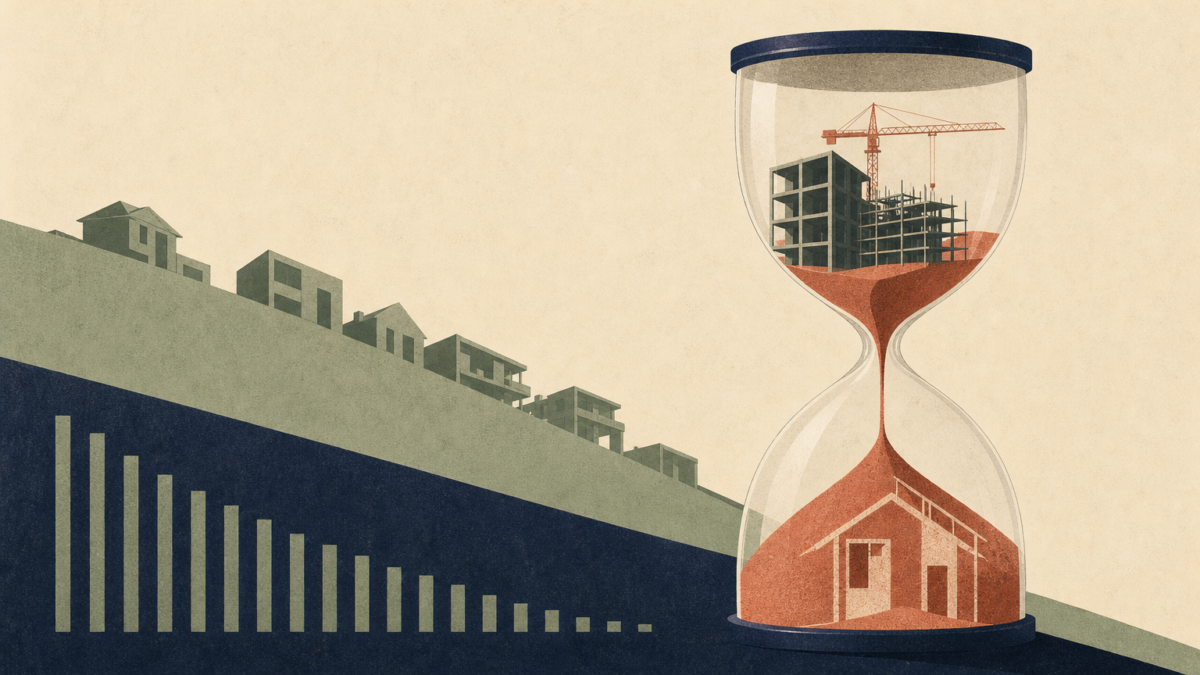
Australia is completing roughly half as many homes per hour worked as it did three decades ago, raising concerns that even a prolonged property downturn may do little to resolve the nation’s underlying housing shortage.
A new report from Optiwise Market Intelligence, The Clarity Report: The Housing Case File, argues that the industry’s declining capacity to build homes has become a more persistent problem than fluctuations in interest rates or property prices.
The warning comes as the Reserve Bank’s cash rate sits at 4.85 per cent and national property values continue to fall, with the report suggesting the housing market could face another supply squeeze when buyer confidence eventually returns.
Property intelligence analyst and report lead Mal Cayley said the industry’s loss of construction capacity would not be quickly reversed.
“Rates and prices move in cycles, and they always turn. The building industry doesn’t bounce back on a cycle. When we lose builders, we lose them for years, and that’s what keeps the pain going long after the headlines change.”
Building more slowly despite decades of progress
The report draws on Productivity Commission research showing that the number of dwellings completed per hour worked fell 53 per cent between 1994-95 and 2022-23.
Even after adjusting for improvements in housing quality and increases in dwelling size, construction labour productivity declined 12 per cent over the same period.
By comparison, productivity across the broader Australian economy increased 49 per cent.
Construction times have also lengthened considerably, with detached houses taking an average of 10.4 months to complete, compared with 6.4 months previously.
For apartments, average construction times have increased from 18.5 months to 27.8 months.
The findings point to a significant challenge for developers and residential agents operating in growth markets, where new housing supply increasingly depends on projects that take longer and cost more to deliver.
The report also highlights the financial pressure experienced by builders following the pandemic-era HomeBuilder program.
According to figures cited from the Australian Securities and Investments Commission, construction insolvencies increased from 1,284 in 2021-22 to 3,596 in 2024-25.
Mr Cayley said the combination of fixed-price contracts and rising material costs had left lasting damage across the sector.
“Builders signed contracts in good faith, then watched steel, timber and concrete blow out.
“They kept building at a loss until they couldn’t. You can’t announce your way out of that, and you can’t rebuild an industry in one budget cycle.”
Why approvals aren’t translating into homes
The research also raises questions about how much new housing will ultimately be delivered from the existing development pipeline.
Australian Bureau of Statistics figures show approvals for private sector dwellings excluding houses fell 21.2 per cent in August, while detached house approvals increased 3.7 per cent.
However, the subsequent September figures showed a reversal, with approvals for private sector dwellings excluding houses rising 16.6 per cent and detached house approvals falling 5.3 per cent.
Despite those monthly movements, Optiwise argues that the more significant issue is the proportion of approved developments that ultimately become completed homes.
Its analysis estimates that approximately 95 per cent of detached houses progress from approval to completion, compared with around 60 per cent of apartments and townhouses.
Those conversion rates are Optiwise estimates rather than figures independently established by the ABS.
For agents working in apartment markets and emerging residential precincts, the distinction matters because approved projects do not necessarily translate into new properties available for sale or rent.
Higher construction costs, financing difficulties and project feasibility can all influence whether developments proceed.
The report argues that this creates a risk of future supply shortages even when headline approval numbers suggest new housing is on the way.
Falling prices may not deliver lasting relief
Mr Cayley also questioned whether the current decline in property values would provide meaningful relief for buyers.
With borrowing capacity under pressure from higher interest rates and lenders continuing to assess borrowers against a three-percentage-point serviceability buffer, lower advertised prices do not necessarily translate into improved purchasing power.
The buffer was increased to three percentage points by the Australian Prudential Regulation Authority in October 2021 and remains a significant consideration in mortgage assessments.
He said national price movements could also disguise considerable differences between local property markets.
“Everyone will read lower prices as relief.
“There’s no such thing as one Australian property market. There are more than 2,000 local markets, and the headline figure mostly reflects the fact that cheaper homes are the ones selling.
“Most owners don’t need to sell, so they don’t. Meanwhile we still don’t have enough homes, and rents are still rising.”
The report argues that construction costs tend to remain elevated after major price increases, even when property values soften.
That can leave developers facing a difficult equation, with lower potential selling prices making projects less financially viable at the same time as construction and borrowing costs remain high.
For the real estate industry, the concern is that weaker buyer demand could temporarily reduce pressure on prices without addressing the longer-term shortage of housing.
Mr Cayley warned that the consequences would become more apparent when market conditions improved.
“When confidence returns, it returns to a market with even fewer homes than today. Renters will feel that first.”
Read the full report here.