
The real estate game has always been one of high stakes and high adrenaline, but in 2026, the adrenaline is starting to feel more like a permanent state of emergency.
Between the whiplash of interest rate pivots and the loud, intrusive arrival of generative AI, the industry’s elite are facing a choice: keep their heads down and hope the storm passes, or start building the weather.
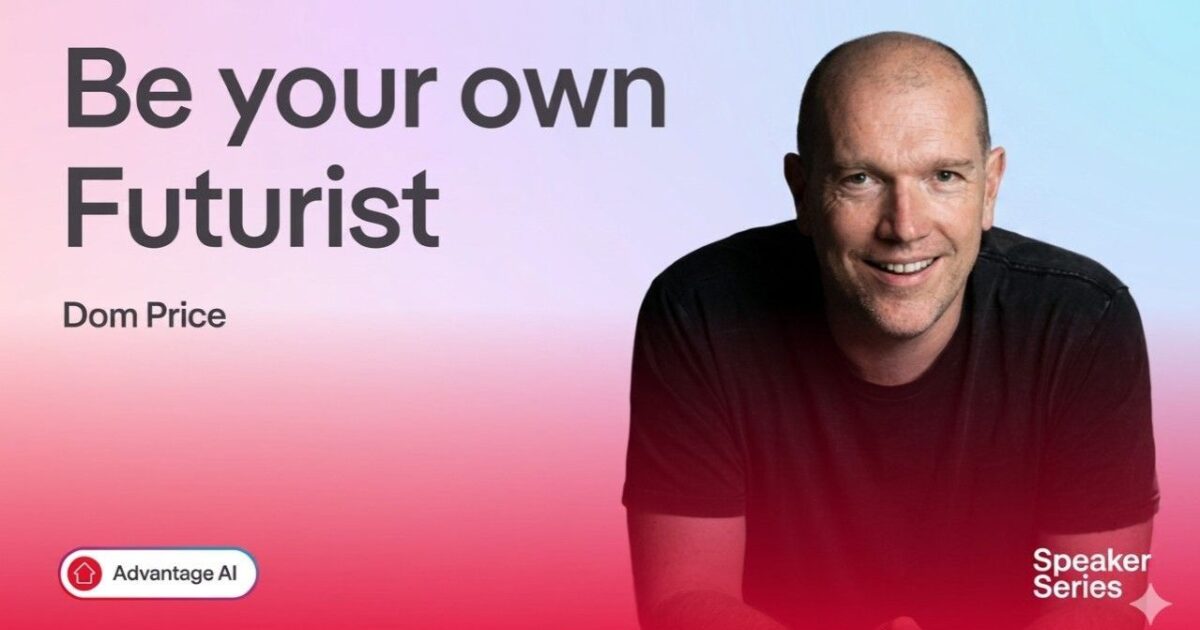
According to Dom Price, a work futurist who has spent 25 years at the intersection of people and technology, the biggest threat to the modern agency isn’t the economy – it’s “blinkers”: the tendency to stay narrowly focused and miss what’s changing around us.
In an REA Advantage AI Speaker Series, Dom speaks directly to principals who are actively shaping the future of the industry.
Why does it matter? Because the agencies making the biggest moves right now aren’t just reacting to change – they’re leading it.
In this YouTube session, Dom unpacks a practical framework for navigating AI-era uncertainty, building a futurist mindset, and positioning yourself as the person others look to for direction.
“When life gets a bit stressful, we start to look down,” Dom says.
“The blinkers come in and we stop thinking broadly about our businesses. We just get busy solving this week’s problem, and we kick the future down the road.”
Dom, who has consulted for everyone from boutique firms to global enterprises, isn’t interested in the usual crystal-ball gazing.
He believes that the title of futurist shouldn’t belong to a select few consultants, but should be the mandatory job description for every principal and agency leader in the country.
The ‘Rule of Three’
The modern real estate leader is often a specialist by nature, someone who has mastered the art of the deal or the grit of property management, but Dom argues that the singular focus is now a liability.
He advocates for a Rule of Three, a mental model designed to prevent leaders from betting the farm on a single outcome.
Take the current obsession with AI; for many, it’s viewed purely as a technical upgrade, but Dom says this is a path to failure.
“If you were in an organisation right now that had poor practices and you layered in technology, you’re going to do those poor things faster.”
Instead, Dom suggests that every major decision must balance technology, people, and practices. It is a portfolio approach to leadership.
If you are looking at a new CRM, you must simultaneously look at the skills your people need to thrive alongside it and the antiquated rituals you need to kill off to make it work.
Seeing around corners
In a market defined by its legacy, where what we did last year is usually the benchmark for next year’s goals, Dom’s method for innovation is a radical departure. He calls it seeing around corners, and it requires a healthy dose of imagination.
The process doesn’t start with a spreadsheet; it starts with a dream. Dom encourages leaders to look three years into the future and paint a low-fidelity picture of their market. This isn’t about data, it is about beliefs.
“I don’t know what’s going to happen in three years,” Dom admits. “But I do have a belief. I believe we’ll still be buying houses… but maybe the way we go about buying and selling houses will be different.”
The magic, however, happens in the return to earth. Step two requires the leader to come “hurtling back to reality” to confront the messy, lived experience of the present.
It is only by acknowledging the gap between that three-year dream and today’s “brutal reality” that a leader can identify the three small, pragmatic experiments needed to bridge it.
“It’s about seeking, not knowing,” he says. “Every experiment that’s ever been run in history, half of them fail. But you are going to learn one degree faster than your competition.”
The Art of the Subtraction
Perhaps the most confronting element of Dom’s philosophy is the idea of subtraction. In an industry where busyness is often worn as a badge of honour, Dom suggests that the best thing a leader can do is stop doing things.
He proposes a 90 day “Five L’s” audit: Loved, Loathed, Longed For, Learned, and Laughed. It is a tool for radical relevance. The most critical, and often the most painful, is identifying the loathed, those tasks a leader does out of habit that no longer add value.
“I have a belief that every one of you is full,” Dom says. “You’re either full hours-wise or you’re full cognitively. To break that cycle, you have to look at the loathed. What do I do as a leader that no longer adds value? You delete it. You remove it.”
By clearing the deck of these legacy habits, leaders find the space for the longed-for, the coaching, the strategy, and the creative play that actually moves the needle.
Taking the Driver’s Seat
This is essentially a message of tough love. Dom isn’t interested in helping leaders predict the future; he wants to help them take agency over it. In a world of total chaos, the temptation is to be a passenger, reacting to every market ripple as it arrives.
But the futurist’s path is different. It is about accepting that you have more control over your destiny than the headlines suggest.
“You aren’t stuck in traffic. You are traffic,” Dom concludes.
His challenge is this: stop imagining the future as a distant destination and start treating it as a series of experiments you run on Monday morning.
View the full YouTube video below: