

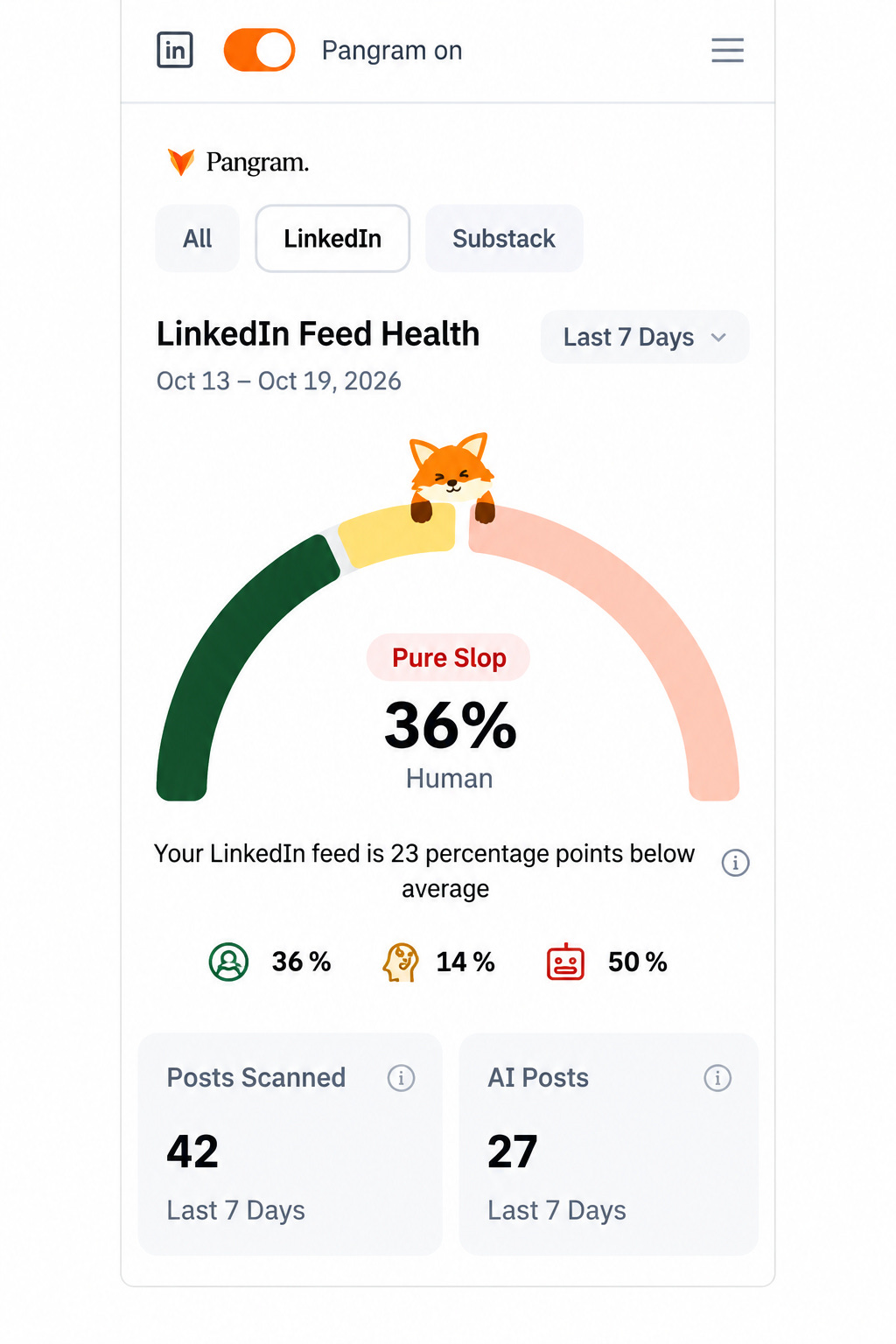
I did a test this morning and it turns out my LinkedIn feed is 36% human.
That’s Pangram’s assessment of the 42 posts it scanned. It gave my feed the label “Pure Slop”.
I ended up there through Jessi Hempel’s essay, “Can You Even Be Authentic On The Internet Anymore?”, which linked to Pangram’s research.
Across more than a million scanned posts, Pangram flagged:
-
About one in four posts over 250 words as fully AI-generated.
-
More than 40% of long LinkedIn posts as fully AI-generated.
Those figures come from people who opted in to share scans from Pangram’s browser extension, so they’re an estimate, not a census. Still!
But Jessi’s essay asks a bigger question than who typed the words, and it’s a big one for those of us in real estate.
As AI gets better at sounding like us, how do people decide whether to trust us?
Her answer is that they’ll have to get to know us over time. How we show up, what we stand behind, whether what we do matches what we say.
For agents, your posts are the introduction.
Then someone meets you. And over the following weeks, they find out whether or not you are who you say you are.
You can get AI to write a lovely post about how much you care about your clients.
But everyone says that. People find out what your version of “care” actually feels like when the campaign isn’t going well, when the feedback is uncomfortable, or when you have to admit you got something wrong.
That’s when they get to know you.
I’m obviously comfortable using AI to help me draft and proof. But I do wonder how much effort we’re putting into making our words sound authentic, compared with giving people something real to know about us.
So here’s an exercise we did in Transform, my 30-day AI program for agents. Fair warning: it’s not an AI exercise. That’s the point.
Ask the people who know you
Email at least seven people who’ve known you for three years or more. Mix it up – people you’ve worked with, family, friends, friendly clients, neighbours, your footy club.
Ask them two questions:
Would you take a few minutes and tell me:
• What do you see as my Unique Capability?
• What do I naturally do better than most other people?
Thank you!
I first did this years ago with Perry Marshall, who learned it from Dan Sullivan at Strategic Coach. We’ve run it in Transform since 2020, and people are always floored by what comes back.
When the replies arrive, read them properly. Take them in. They’re special.
Then put them next to your last three posts. Do they describe the same person?
If your friends say you’re the one who tells it straight, and your posts are all “dream home” and “thrilled to announce”, that’s a gap.
If three of them mention how you still check in after settlement and you’ve never written about it, that’s a post.
AI can help you sort the replies into themes later. That’s what we did in Transform a few days after. But the asking and the reading are all you.
Then, next time you write about your work, explain a real decision you helped someone make. What mattered to them? What did you recommend, and why? Keep their private details out and get permission where needed.
Over time, those explanations help people understand your judgement. Their interactions with you tell them whether you follow through.
And when they eventually sit down with you to talk about their own home, hopefully they’ll recognise the person they’ve been reading as the one their trusted colleagues described.
This column first appeared on Samantha McLean’s Substack, samanthamclean.substack.com.