
Updated 20 September 2026: first published on Elite Agent in September 2026. The article has been refreshed with practical guidance on relevant follow-up and responsible use of contact information.
I have had an AI answering service, Lucy by Curious Thing, for quite some time now.
People often tell me how good she is. But on one recent occasion, her caller was too busy talking to notice.
Lucy began her introduction, explaining that she was an AI assistant working for me and that I wasn’t available.
She calls it out because I believe you shouldn’t have to work out for yourself that you’re speaking with AI.
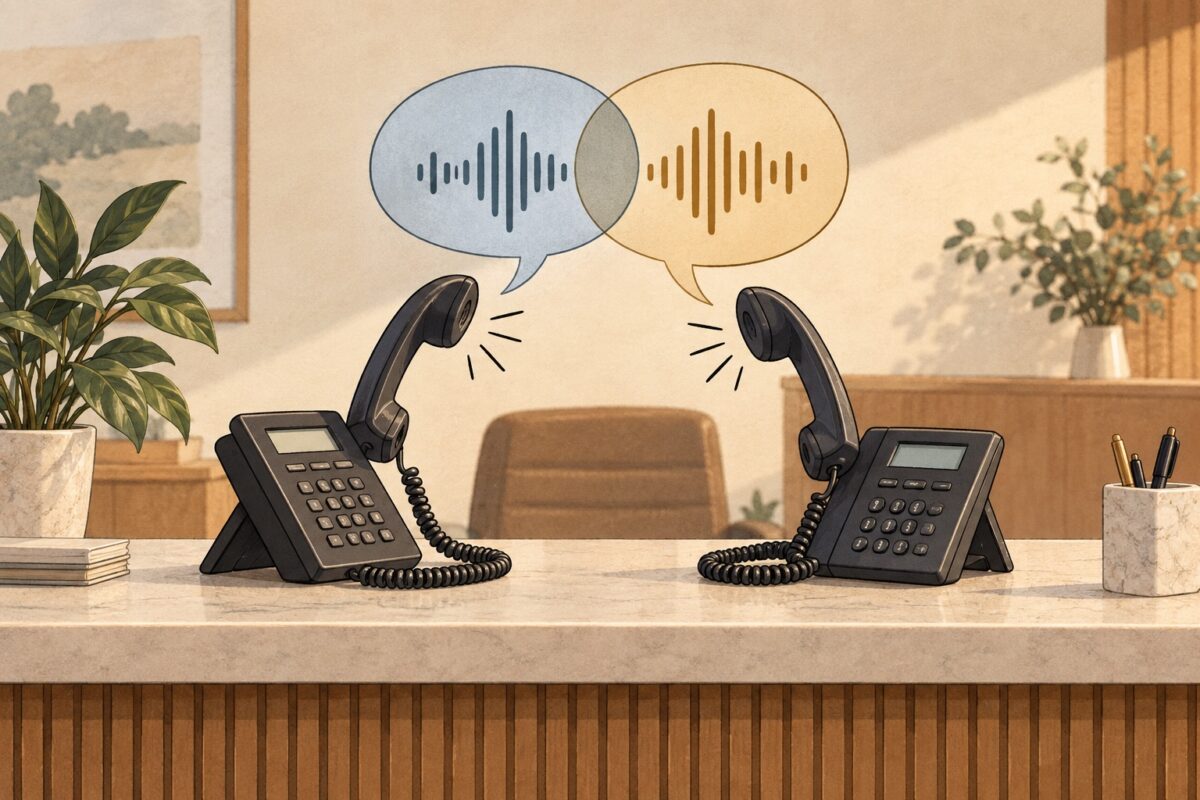
Meanwhile, the AI caller on the other side was getting busy trying to sell me a ticket to an industry event without identifying itself as AI.
On this occasion, both AIs had something to say. Neither was particularly inclined to give up the floor.
Have a listen to the two of them on my Substack – it runs 20 seconds.
Despite the weird cross talk, Lucy took the message and delivered it correctly.
But it left me wondering: if agents are buying AI to make more calls, while the people they’re calling are using AI to screen them, where does that leave prospecting?
I totally get why
I get why an agent (or a conference organiser) might want a bot to tear through an old database like a Ford Mustang down Conrod Straight at Bathurst.
I’ve never liked the idea of an AI outbound dialler – asking for someone’s time while saving my own feels like a super efficient way to make another human feel completely unimportant.
Ellen Fanning was right to question “Daniel”. Tell people they’re speaking with AI, and give them a choice about continuing.
(Here’s that one if you missed it)
Still, I use Lucy because she provides a friendly option when I can’t answer. I might be speaking at an event, with a client or in a meeting.
She does protect me from quite a lot of robocalls and at times wildly irrelevant press release pitches (the publishing industry’s equivalent of a cold call).
She takes messages accurately and fast – what you want from an answering service.
This got me thinking: If your AI is calling my AI, we’ve certainly automated something.
But if all our AIs are doing is talking to one another, how much of an advantage is there now in simply making more calls?
Could AI be the final nail in the cold-calling coffin?
But Sam, I have this big list of names…
I don’t know whether AI will finish off cold calling. After all, it’s been around since the dark ages. I’m expecting a Chloe vs History episode on it very soon.
But I wouldn’t build my entire prospecting strategy around being able to interrupt more people.
I’d start with who might actually welcome the conversation.
If you have a database, there are better ways of finding the people who need and want your help.
Start with people you have a valid basis to contact, and honour their communication preferences and opt-outs. A name in an old database is not permission on its own. For marketing emails and messages, ACMA’s guidance explains consent, sender identification and an easy way to unsubscribe. Sending a marketing email to ask for consent does not fix missing consent.
Use an approved tool and only information you are authorised to use. Look for needs people have actually told you about, rather than asking AI to infer age, health, finances or life circumstances from unrelated data. Check the proposed list yourself before contacting anyone.
For example, look through your data or get AI’s help to find a list of people who have previously mentioned downsizing.
AI could help you organise those existing notes and prepare a useful local guide: suitable properties, likely costs and the practicalities of buying before selling. Check the details, then offer it to the people it’s relevant to.
“You mentioned downsizing when we last spoke. Would our most recent guide to the local options be useful?”
You could make that offer in a short personal email, giving them room to reply when it suits them.
If they’d like to keep hearing from you, follow up with useful information about the move they’re considering. You can automate parts of that and still make it relevant to their situation.
When someone asks for a callback, make it yourself and make it promptly. AI can help you prepare, organise the notes and keep track of what you promised.
I’d much rather spend time with a smaller group where I can offer a personal service rather than having a large group feel like I don’t value them.
The takeaway
My AI can take your message. Yours can take mine. Somewhere in there, surely two people can find a reason to talk.
At PM/ONE on the weekend, Chris Hanley put it this way: “I will till the day I die believe we all want to talk to human beings.”
I’m with Chris. Lucy is staying, but I’m making a slightly late mid-year resolution: call people back faster.
She’s doing her bit. Time for me to get better at mine.
This column first appeared on Samantha McLean’s Substack, AI Powered Real Estate by Samantha McLean.