

The 21st Century ROAD to Housing Act has became US law after President Donald Trump let a 10-day constitutional deadline expire rather than sign or veto it.
According to Inman, the bill is the broadest federal housing package since the Cranston-Gonzalez National Affordable Housing Act of 1990, touching everything from institutional investors to manufactured home builders to local zoning incentives.
Both chambers of Congress passed the bill in June with strong bipartisan support. House Speaker Mike Johnson sent it to the White House on 29 June, starting the constitutional clock.
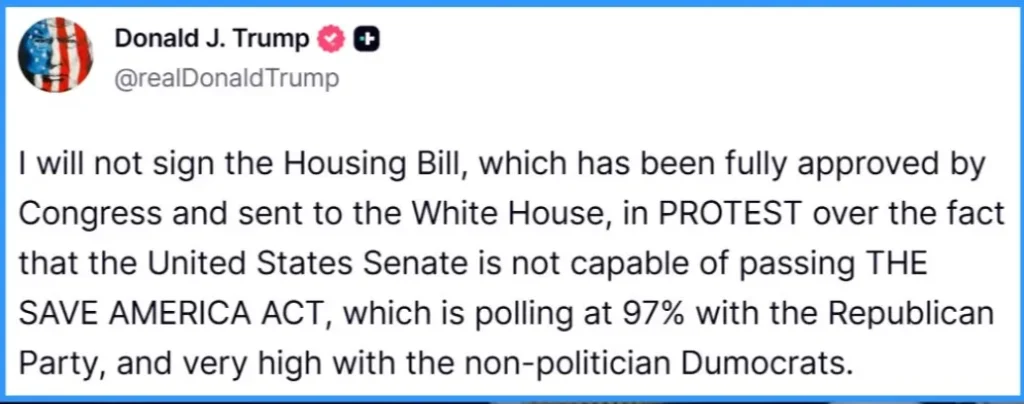
Trump used the delay to press an unrelated demand, telling Congress on Truth Social he would not sign the bill “in protest” of the Senate’s failure to pass the SAVE America Act, a voter ID measure with no connection to housing policy.
“I will not sign the Housing Bill, which has been fully approved by Congress and sent to the White House, in PROTEST over the fact that the United States Senate is not capable of passing THE SAVE AMERICA ACT,” Trump wrote on Truth Social.
Without a signature or a veto, the bill became law automatically. White House press secretary Karoline Leavitt had previously called it “one of the most significant pieces of housing affordability legislation in American History”, according to CNN.
The law bundles more than 40 provisions, according to Inman, or 47 according to CNN, aimed at supply, financing and oversight.
For the first time, it caps how many single-family homes large institutional investors can buy, barring companies that own 350 or more from adding to their portfolios, with carve-outs for some build-to-rent projects. Large investors currently hold about 3 per cent of the single-family rental market nationally, though their share is far higher in some individual metro areas.
Manufactured housing gets a boost too. The law scraps the long-standing federal requirement that these homes sit on a permanent steel chassis, a change housing policy experts say could cut construction costs by $5,000 to $10,000 per home.
A new $200 million annual grant programme will reward local governments that streamline permitting and zoning, and the law expands exclusions from environmental review for smaller infill projects. On the finance side, it raises FHA multifamily loan limits for the first time in more than two decades, directs the Consumer Financial Protection Bureau to study small-dollar mortgages under $100,000, and lifts the cap on bank community development investment from 15 per cent to 20 per cent.
None of it comes with new appropriated funding.
What the law leaves untouched matters just as much. Local zoning remains entirely under council control, and mortgage rates sit outside its reach – a 30-year fixed loan was running near 6.5 per cent in early July, according to Inman. The median existing US home sold for $440,600 in June, per National Association of Realtors figures.
Yonah Freemark, a housing research associate at the Urban Institute, told CNN that any relief will take years to show up, given the layers of change required.
“We’re talking about a situation where not only will the federal government have to make changes, but then state and local governments also will have to make changes and then businesses, developers, etcetera will have to make investments, which itself takes time,” Yonah said.
He added that the legislation “can play an important role in encouraging states and localities to make changes to expand housing supply, but it doesn’t require them to make those changes.”
Not everyone is convinced the bill will help. The Wall Street Journal editorial board panned an earlier version in a piece titled “A Bipartisan Housing Fiasco”, arguing it would “raise costs and give more power to regulators.”
A 2025 Goldman Sachs report cited by CNN estimated that relaxed land-use regulation alone could add 2.5 million housing units in the US over the next decade – but only if local governments choose to act.
This story draws on reporting from Inman and CNN. Read the original Inman explainer here and CNN’s coverage here.