
Australia’s housing market has slowed following three interest rate hikes, with national home prices holding steady in May while Sydney and Melbourne recorded their third consecutive month of price declines, according to the latest realestate.com.au Market Snapshot.
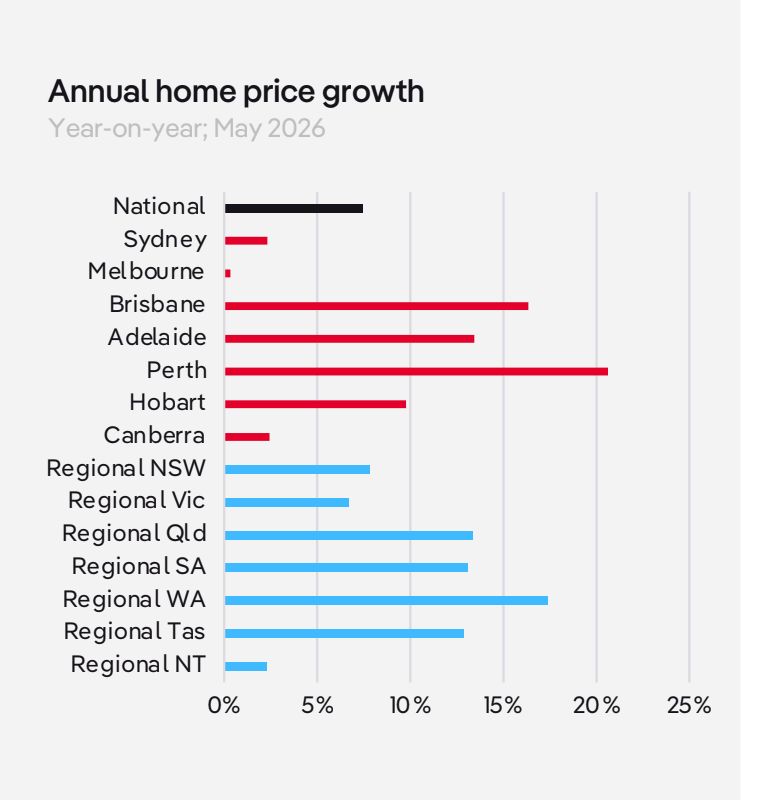
The report found national home prices were unchanged over the month, although values remain 7.5 per cent higher than a year ago.
Perth continues to lead the nation with annual growth of 20.6 per cent, while Melbourne recorded the smallest annual increase among the capital cities at just 0.3 per cent.
REA Group Senior Economist Angus Moore said higher interest rates were now clearly influencing market conditions across the country.
“Housing market conditions have slowed following three rate hikes; remains too early to see full impact of the Budget in the data.”
Mr Moore said the slowdown was no longer confined to Australia’s largest cities.
“Home prices held flat nationally in May, with falls recorded in Sydney and Melbourne for the third consecutive month. Even the fast-growing markets of Brisbane, Perth and Adelaide have seen conditions slowing.”
Despite the monthly slowdown, the strongest-performing capital cities since January 2022 remain Perth, where home prices have increased around 80 per cent, Adelaide, up around 60 per cent, and Brisbane, which has recorded growth of approximately 55 per cent.
The report also highlights growing differences in housing supply across the country.
National new listings increased 2 per cent compared with May last year, with Darwin recording the largest annual increase in new listings at 26.7 per cent. Brisbane also posted a 10.1 per cent annual increase in new listings.
Stock levels remain elevated in Sydney and Melbourne, with total listings sitting around 10 to 15 per cent above typical levels for this time of year, providing buyers with more choice.
By contrast, Brisbane, Perth and Adelaide continue to experience constrained supply, with total listings remaining around 40 per cent below pre-pandemic levels.

Auction markets have also softened in Australia’s two largest cities.
The report shows Sydney’s auction clearance rate has remained below 50 per cent since mid-March. However, homes are still selling relatively quickly, with the typical property taking around 30 days to sell.
Mr Moore said the softer auction results reflected both higher borrowing costs and increased housing supply.
“Auction clearance rates have softened over the past couple months as rates have risen, but days on market remain low in both cities, with the typical home selling in 30 days.”
He added that current market conditions in Sydney and Melbourne differed from those in other capital cities.
“Soft clearance rates in Melbourne and Sydney reflects price declines in both cities following successive rate hikes and relatively solid volumes and stock on market, giving buyers more choice and easing the competitiveness of markets.”
While the Federal Budget included a range of housing measures, he said it was still too early to assess any impact.
“With the Budget changes announced only a month ago, and not yet legislated, it is still too early for those effects to have meaningfully showed up in prices or market outcomes.”