

“You and I could MacGyver anything.”
Mark said it to me the other night – the way you say something you’ve always known but never bothered to put words around.
For anyone under 35 who just read that and thought it was a surname and not a verb: It’s actually both: MacGyver was a TV show that ran from 1985 to 1992.
The hero – mullet, leather jacket, zero weapons – could defuse a bomb with a paperclip and a stick of chewing gum.
He became so iconic that his name turned into a verb. To “MacGyver” something means to make it work with whatever you’ve got lying around.
My actual response to Mark?
“No. We’re the Beth and Rip of publishing.”
If you haven’t watched Yellowstone – first of all, fix that. But the short version: Beth Dutton and Rip Wheeler are the two people on that ranch who just handle whatever gets thrown at them, however sideways it goes, before anyone’s had to call a meeting about it.
I was flattering us a bit. (OK, a lot!). But stay with me, because I’m about to land the plane.
Mark and I are nothing alike – different brains, different instincts, different ways of working. But we share the same reflex: see a problem, move on it.
We bootstrapped Elite Agent from our laundry. We’re now bootstrapping LOIS, our content intelligence engine. We bootstrapped Ailsa. This weekend, we rebuilt our entire podcast studio with stuff we already had lying around.
Regularly, I even challenge myself to invention tests in the kitchen when I’ve forgotten to do the online grocery order (which is regularly!).
We make things work with what’s in front of us. And the longer I sat with that conversation, the more I realised Mark hadn’t described just our weirdness as business owners.
He’d described the single most valuable trait in business right now – and almost nobody names it, because it doesn’t come with a certificate and you can’t buy it in a tech stack.
So let me try to name it.
Silicon Valley has a word for it. You don’t have to use it.
The tech world calls it “high agency.” The tech bros are always talking about it.
But… you don’t need their vocabulary to recognise exactly what it is, because you’ve almost certainly seen it in your office – or noticed its absence.
Strip out the jargon, and high agency is simply this: the instinct to take ownership of a problem and move it forward without being asked.
Not a job description per se, but a disposition.
The five levels of agency
When onboarding new hires, Morning Brew co-founder Alex Lieberman relies on a five-level workplace framework developed by Steph Smith, who was a prominent tech writer and builder whose resume includes NVIDIA, the a16z podcast, and The Hustle. He designed the model to define how employees show up to their jobs.
Lieberman now tells every new hire:
“You will live at Level 4 from day one, and as we build trust, you will move to Level 5.”
Here’s how it works.
- Level 1 – “There’s a problem.” Then you walk away and leave it for someone else.
- Level 2 – “There’s a problem, and I’ve found some causes.”
- Level 3 – “Here’s the problem, here are some possible causes, and here are some possible solutions.”
- Level 4 – “Here’s the problem, here’s what I think caused it, here are some possible solutions, and here’s the one I think we should pick.”
- Level 5 – “I found the problem, worked out the cause, sorted the fix, and it’s handled. Just keeping you in the loop.”
I’ve read this ladder several times since I saw it on X.
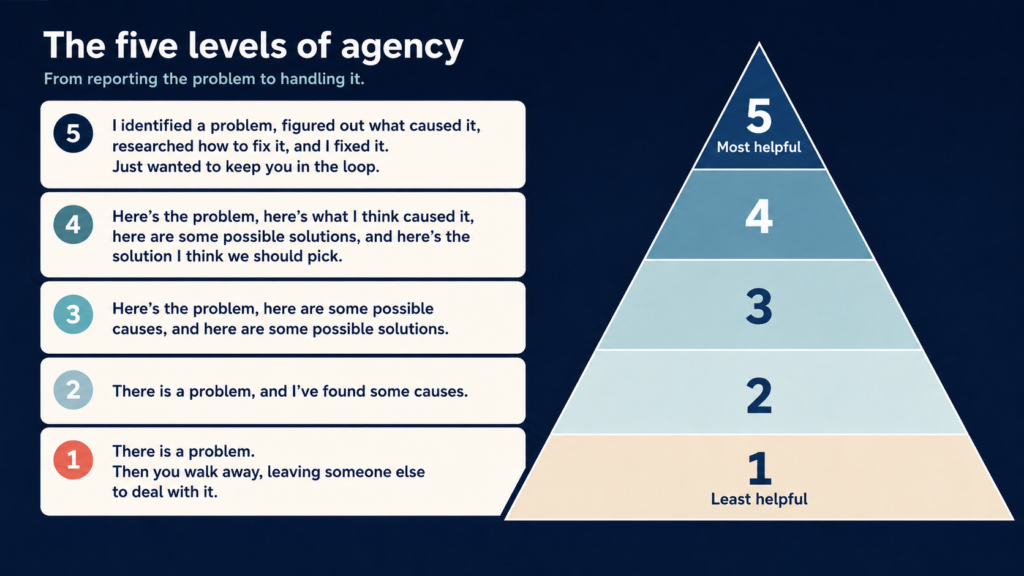
But I feel like what it does is take a thing you’ve only ever been able to feel in your gut about a person and turn it into something you can see, name, and – if you lead a team – coach.
So, just like that, “be more proactive” – possibly the most wishy-washy feedback in the history of management – becomes “that was a Level 2 email. What would Level 4 have looked like?”
AI just made this the whole game
Here’s why this matters more in 2026 than it did five years ago.
Back then, the gap between a good agent and a great one looked like a skill gap. Learn the sharper script. Buy the better CRM. Master the new platform. Close the distance.
That story is over.
AI can do a lot for you – pull your comparable sales, draft buyer follow-up sequences, summarise inspection feedback, build market reports. Things that used to take years to master can now take minutes to generate, if you’ve got the agency to ask the right questions and take the next step.
When everyone has access to the same capability floor, the only differentiator left is what someone decides to do with it – without being told.
Now – I’ve been banging on about Adaptability Quotient since 2023, well before it became everyone’s favourite acronym. AQ matters. It measures how well you respond when conditions change, and it’s genuinely valuable. But it’s reactive. The market shifts, and you adjust. Agency is different. Agency doesn’t wait for the shift. It’s already moving.
So adaptability, yes, hire for that.
But agency might be your real differentiator if you want to free your self up. So, hire for that too.
You already know this. You watch it every week.
If you’ve ever watched MasterChef, you’ve seen agency in real time – you just didn’t call it that.
Nobody survives a pressure test by saying “there’s a problem with my soufflé.” You’ve got limited time, limited ingredients, and exactly one question that matters: what are you going to do with what’s in front of you, right now? That’s Level 5 in an apron.
Traitors is even better. The Faithfuls who last aren’t sitting in the roundtable waiting for someone else to call it. They’re reading the room, forming a theory, making a move. The ones who get murdered off first? The ones who report the problem and wait. Level 1 in a castle.
Survivor. Same deal. You don’t win by adapting to tribal council. You win by building alliances, finding idols, making moves before you need to.
Every elimination show, every prestige drama – underneath the entertainment, it’s a sorting mechanism for agency. The people who last are the people who act. Start watching for it, and you won’t be able to unsee it.
What it actually looks like in your office
Here’s where this gets practical. Because agency isn’t abstract once you map it to the roles sitting ten metres from your desk.
Your property manager
A tenant reports a leak.
Level 1 PM logs it. Waits. Level 3 gives the landlord three options at the next catch-up. Level 5 has already assessed the issue, called the landlord with a recommendation, got the go-ahead, and found a tradie with availability, while keeping one eye on the management agreement and the legislation. As a leader, you never heard about it because there was nothing left to hear about.
Your sales agent
A listing hits week four with no offers.
Level 1 tells the vendor “it’s quiet out there.” Level 3 presents repricing options at the next vendor meeting. Level 5 spotted the stall before the campaign officially ended, pulled the buyer feedback, identified the pricing gap, booked the vendor in with a repricing recommendation and a relaunch plan, and sent a two-line message: here’s where we are, and here’s what I’ve done about it. Delivered new listing copy, social advertising, and a marketing plan informed by buyer personas.
Your admin or EA
Salespeople aren’t updating the CRM.
Level 1 walks into the principal’s office and says, “The salespeople aren’t updating the CRM.” Problem reported, responsibility transferred. Level 3 identifies which agents are behind and why, and presents three options – reminders, simplified fields, or a training session. Level 5 has already identified the friction (too many fields; agents don’t see the point), streamlined the input process, sent the team a two-minute walkthrough, and set up a Friday audit.
You got a Slack message that said “I’ve fixed our sales reporting.”
Your BDM
You’ve lost a few managements lately.
Level 1 says “we lost it on price.” End of analysis. Level 3 reviews what happened and suggests adjustments for next time. Level 5 has already gathered the proposal, the pitch materials, and the conversation notes, run them through AI to pinpoint where the presentation lost momentum, reworked the approach for tonight’s appraisal, and practised the new version with a colleague over lunch.
Same roles. Same market. Same tools. Completely different outcomes.
How to spot it before you hire
There’s a talent shortage in real estate right now – everyone knows it.
Finding anyone is hard, let alone the right person. When the pool is shallow and you’re already short-staffed, it’s tempting to back the first candidate who walks in with energy and a good handshake.
Three months later, every problem still ends up on your desk – and the shortage just got worse.
The five levels give you a filter.
Here are some example questions that reveal which level a candidate naturally sits at.
“Tell me about a time you fixed something before anyone asked you to.” This is a Level 5 detector. If they can’t think of an example, that’s your answer.
“Walk me through how you’d handle a listing that stalled at week four.” Don’t mention the framework. Just listen. Do they describe the problem? Present options? Recommend one? Or have they already mentally solved it and moved to the next step?
“What’s the last thing you improved in a role that wasn’t in your job description?” Agency doesn’t live inside position descriptions. It lives in the gap between what’s expected and what’s possible. This question finds it.
“Tell me about a time you didn’t have what you needed to get something done. What happened?” This is your MacGyver question. The answer tells you whether they see a missing resource as a wall or a detour.
“When was the last time you told your boss about a problem – and when was the last time you told them about a solution?” Ask it exactly like that. The gap between those two answers is the gap between their current level and their ceiling.
You’re not looking for perfect answers. You’re listening for agency. Does this person face problems or face solutions? Do they describe what happened to them, or what they did about it?
One caveat. Agency without judgement is just chaos in a good suit. A new PM who “handles” a maintenance issue before they understand the Residential Tenancies Act isn’t showing initiative – they’re a compliance risk. The levels are a ladder you climb with someone, not a trapdoor you drop them through on day one. Lieberman’s line does a lot of heavy lifting here: Level 4 from day one, Level 5 as trust builds. That last part matters as much as the rest.
Now flip it. Are you worth working for?
Here’s the uncomfortable part.
High-agency people don’t stay in offices that punish initiative. They leave. Quietly, without drama. And you’re left wondering why your best people keep disappearing while the ones who bring you every problem are still very much at their desks.
If every decision has to go through you, you’ve capped your entire team at Level 4. Maximum. Nobody can operate at Level 5 if they’re not trusted to act without permission.
If you micromanage a Level 5, they won’t fight you on it. They’ll find an office that doesn’t.
If you give the most attention and energy to the people who bring you problems – instead of the people who quietly solve them – you’re training your whole team down. You’re rewarding Level 1 behaviour with the one thing everyone wants: your time.
And if the only people who get praised are the ones who make the sale, but the PM who handled forty tenant issues before they ever reached your inbox goes completely unnoticed – you’re teaching everyone that agency only counts when it comes with a commission.
So the question isn’t just “how do I hire more Level 5 people?”
It’s “am I building an office that a Level 5 person would choose?”
Where do you live on the ladder?
If you’re reading this and wondering how to become a person of high agency, none of this asks you to learn a new skill.
It asks you to make a decision – before the next problem lands – about which version of yourself shows up. The one who reports it, or the one who’s already handled it.
If you lead people, give them the roadmap. Name the levels out loud. The next time someone sends you a Level 4 email, tell them. The next time someone hits Level 5, say so – properly, by name – and watch how fast it spreads.
If you’re hiring, use the questions. Listen for orientation, not polish.
And if you’re the one doing the work – whether you’ve got a team around you or you are the team – the top of that ladder is the much-fabled ‘extra mile’ on which there is no traffic. Agency can’t be copied, and AI can’t fake it.
That’s what Mark actually meant, I think. Not that we can fix anything. That we decided, a long time ago, to be the kind of people who try.
And if you want Level 5 distilled into two words, one of my favourite small-screen characters, Olivia Pope, nailed it:
“It’s handled.”
The woman in the white coat never once walked into a room to report a problem. She walked in after she’d fixed it.

Hiring right now? Visit Elite Agent Jobs and post for free.