
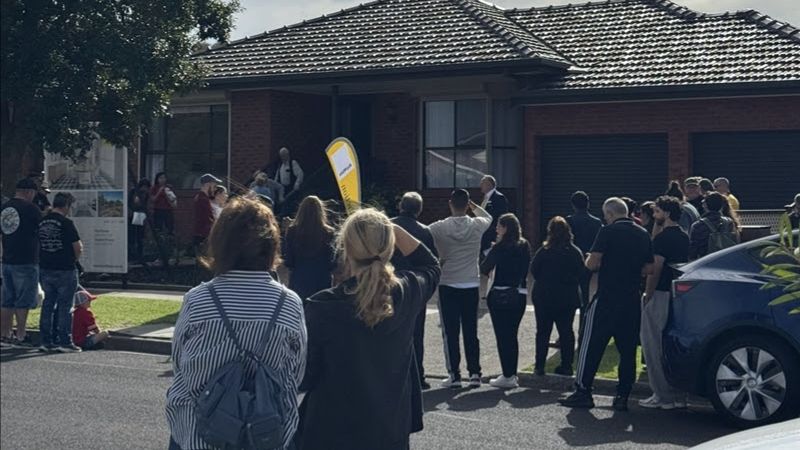
Auction conditions have softened across Australia this week as the market reacted to this week’s federal Budget, with early indicators showing lower buyer attendance, weaker clearance rates, and signs of hesitation at the inspection level.
“The Budget contained major changes to housing tax settings, particularly around negative gearing and capital gains tax. While these changes are not immediate, they are significant enough to add uncertainty for buyers, sellers and investors as the market works through what they will mean,” said Nerida Conisbee, chief economist for the Ray White Group.
The most immediate shift has been in open home activity; nationally, attendance fell to 2.1 attendees per property, down from 2.5 last week and well below 3.4 a year ago.
“This suggests that some buyers are stepping back, at least temporarily, as they assess the impact of recent policy changes, higher interest rates and broader economic uncertainty,” Ms Conisbee said.
Auction performance also eased and the preliminary clearance rate fell to 56.2 per cent nationally, down from 59.4 per cent last week and 65.6 per cent a year earlier.
Auction volumes remained steady at 666 properties nationally, compared with 574 in the same week last year.
Buyer competition held relatively stable, with average active bidding easing slightly to 2.1 bidders nationally – Sydney was an outlier, recording 2.5 active bidders, up despite softer broader conditions.
“This suggests that while fewer people may be attending open homes, committed buyers are still present in some markets,” he said.
“The main issue remains confidence. The Budget changes are substantial, and it will take time for households and investors to understand how they affect decision-making. Open home attendance is often one of the earliest indicators of sentiment, so the sharp fall this week is worth watching closely.
“Overall, this week’s data suggests buyers are becoming more cautious, particularly at the inspection stage. The next few weeks will be important in determining whether this is a short-term pause after a major policy announcement, or the beginning of a more sustained adjustment in demand.”
Investor data from Ray White shows investors currently account for 25 per cent of properties sold under the hammer. Of those, 72 per cent purchase in the $550,000 to $950,000 range, while 28 per cent are in the $1.2 million to $2.5 million bracket.
Investor participation has also eased, falling from 30 per cent in mid-2025 to 24 per cent currently.
Haesley Cush, CEO of the Ray White Collective said conditions remained uneven, with resilience still evident in parts of Brisbane’s middle and prestige markets.
“The general sentiment from the market is that the budget, specifically to deter investors, won’t do anything for Queensland prices,” he said.
“At Ray White Collective, we have sold less than two per cent of our properties to residential investors over the last six months. They have been losing out to the overstimulated first home buyers.”
He warned that reducing investor participation could have broader market consequences.
“Pulling them out of the market will remove underbidders from the market,” he said.
“The only impact it will have: making the problem worse for tenants. We have already had an issue with investors selling to first home buyers. On the rare chance that an investor would have beaten them, to create a rental property for more tenants, this will just dwindle that even further.”
“The problem is coming down the track when we need residential investors (for tenants) and they are all gone,” he said. “They are already usually the underbidders at the moment.”
“Investors haven’t really been at play and now they certainly won’t be,” he said.
“The thing that will bring investors back in will be the increase in rents off the back of limited supply; which isn’t good news for tenants.”