

Regional markets within reach of a capital city have significantly outperformed their nearest metro over the past decade, but the size of that gap depends heavily on which capital they sit near, according to new analysis from Ray White Group.
Chief Economist Nerida Conisbee compared median house price growth across selected regional local government areas near each capital city with the capital itself, covering the period from June 2016 to March 2026.
The comparison grouped the Central Coast, Wollongong and the Southern Highlands with Sydney; Geelong, Mornington Peninsula and Surf Coast with Melbourne; the Gold Coast and Sunshine Coast with Brisbane; Adelaide Hills, Barossa and Fleurieu Peninsula with Adelaide; and Mandurah, Busselton and Margaret River with Perth.
Melbourne-linked regional markets rose by around 86 per cent over the period, compared with 42 per cent for Melbourne itself.
Perth-linked regional markets rose by around 133 per cent, against 103 per cent for Perth.
Brisbane and Adelaide told a different story, with their nearby regional markets moving much more closely in line with the capital.
Nerida said that pattern in South East Queensland reflects what she described as Brisbane’s position as one of the strongest-performing capital city markets, with the Gold Coast and Sunshine Coast benefiting from the same population growth, interstate migration and lifestyle demand she said has driven Brisbane.
In Western Australia, she said the pattern was more pronounced, with Mandurah combining relative affordability with access to Perth, while Busselton and Margaret River have drawn on the state’s broader economic strength as well as their own lifestyle appeal.
Melbourne’s regional markets have outperformed the capital over the longer term, but she said the scale of that growth has been far weaker than in Queensland, Western Australia or the Adelaide-linked markets.
Proximity to a capital city helps, she said, but it is not enough on its own – the strength of the underlying capital city still matters.
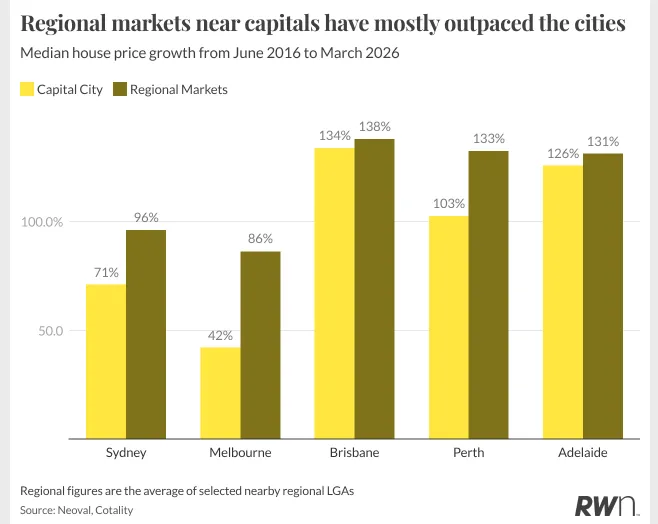
Sydney’s nearby markets sit somewhere in between.
The Central Coast and Wollongong have both performed strongly and are now at new highs, while the Southern Highlands has delivered strong long-term growth but softened more noticeably from its peak – a difference Nerida attributes to larger, more established regional cities holding up better than more discretionary lifestyle markets within the same catchment.
The clearest pattern across all five capitals, however, is that regional markets still move with the direction of their nearest metro.
When a capital has been strong, nearby regional markets have generally benefited; when conditions have softened, that weakness has flowed through too – particularly around Sydney and Melbourne.
With Sydney and Melbourne now slowing more quickly than Brisbane, Adelaide and Perth, Nerida said that is likely to have the greatest impact on their nearby regional markets, with the Central Coast, Wollongong, Geelong, Mornington Peninsula and Surf Coast remaining exposed to buyer confidence and affordability conditions in their nearest capital.
By contrast, she said regional markets linked to Brisbane, Adelaide and Perth should hold up better while those capitals remain stronger, with the Gold Coast, Sunshine Coast, Mandurah, Busselton and Margaret River also supported by lifestyle and population growth drivers that extend beyond simple proximity to a capital.