

There is a bronze T-Rex named Stan that sits at Google’s headquarters in Mountain View, California.
Stan serves as a permanent reminder of the cost of corporate complacency: evolve, innovate and adapt or face obsolescence.

This theme of “evolve or expire” became the definitive lens through which I viewed the recent Ray White USA study tour.
Over the course of the week, Ray White’s Chairman Elite business leaders moved through a diverse commercial landscape, from the engineering-first culture of Silicon Valley that we saw at Stanford University, Google and Amazon, to the lecture halls of industry scholar Mike Del Prete to the prestige towers of Manhattan.

We sat inside the boardrooms of the most influential real estate and technology businesses in the world, and despite the varying business models, one underlying truth kept surfacing:
The organisations winning at scale are no longer waiting for disruption; they are institutionalising it through aggressive consolidation and technological integration.

A vital anchor for this journey was the academic perspective provided by Mike DelPrete, Scholar-in-Residence at the University of Colorado Boulder.
Moving to a disciplined “classroom” environment allowed us to meet proven industry performers and get their unique perspectives.
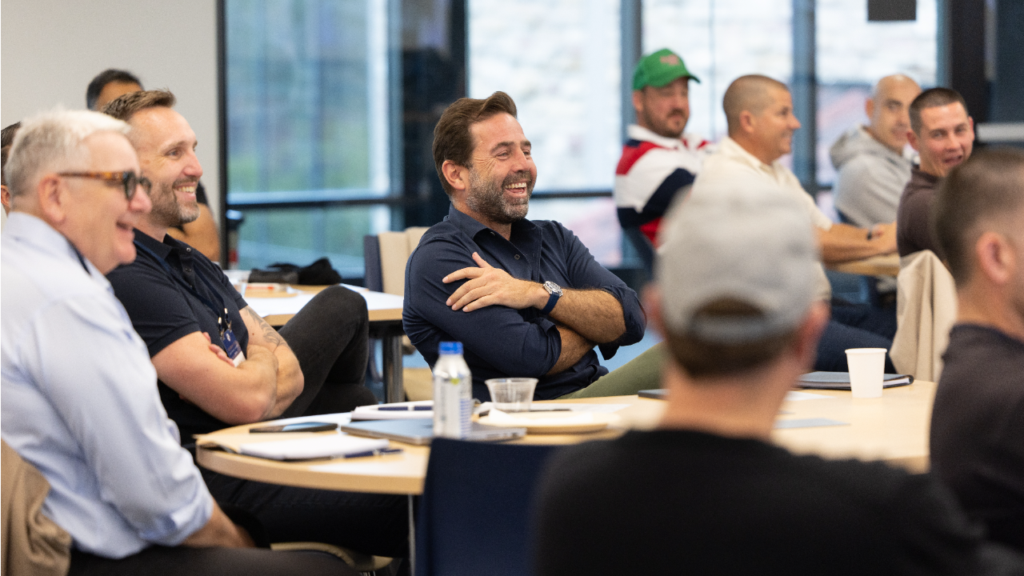
Mr DelPrete’s evidence-based analysis focused on the structural shifts in the industry, moving beyond what tech could do to what it is actually doing to agent economics. His insights from the CU Real Estate Center reminded us that while technology is the engine, a holistic strategy is the key.
From Engineering Culture to Agentic AI

At Google, our dialogue shifted from mere automation to the next frontier: Agentic Collaboration. We explored how Gemini is transforming Google Workspace from a responsive tool into an active partner. The strategic takeaway was underscored by Pat McCarthy, Vice President at Google, who issued a blunt warning:
“If you’re not doing something with AI, you’re paying an inaction tax.”
Pat challenged us to “see the whole board.”
In an industry as fragmented as real estate, those who focus only on the tactical “square” they are standing on will be out-maneuvered by those who understand the broader chessboard of technology, data, and global capital.
Amazon: The Discipline of Infinite Dissatisfaction
Our visit to Amazon (AWS) provided the operational blueprint for maintaining scale without losing speed. At Amazon, innovation is a DNA strand. Their leadership principles, from customer obsession to bias for action, are designed to keep the company in a perpetual state of Day 1.
As Jeff Bezos famously noted, customers are “beautifully, wonderfully dissatisfied,” even when they report being happy. In real estate, this means moving beyond simply providing a service and instead anticipating the friction points a customer hasn’t even realized yet.
This commitment to the “frontier” was most evident in the newly announced strategic partnership between Amazon and OpenAI. By bringing OpenAI’s most advanced models directly into the AWS ecosystem, Amazon is proving that “seeing the whole board” means prioritizing the best possible tools for the customer over keeping proprietary walls high.
Era of the mega-merger: dominating the network effect
The most visible evidence of this “evolve or die” mentality is the current wave of massive consolidation sweeping the US market. We are witnessing a fundamental race for the network affect – the idea that a platform becomes exponentially more valuable as its user base grows.
- Compass & Anywhere: With Compass’s recent acquisition of Anywhere Real Estate, we saw the acceleration of a true industry titan. By absorbing legacy powerhouses like Coldwell Banker and Century 21, Compass is attempting to layer its high tech stack over a massive global network of 340,000 professionals.
- Real Brokerage & REMAX: The Real Brokerage’s move to acquire REMAX Holdings for $880 million is equally telling. It is a “cloud meets brick and mortar” play, designed to inject Real’s AI-driven, digital first model into REMAX’s footprint.
These aren’t just transactions; they are strategic bets that scale, data, and technology must live under one roof to survive the next decade.
The Anatomy of Execution: The Compass Model
Our deep dive into Compass provided a masterclass in this high speed execution. Their success is anchored in core operating principles that dictate everything from leadership to culture:
Dream big & move fast: A mandate for execution over hesitation.
Learn from reality: Prioritising empirical market testing over endless theorising.
Bounce back with passion: In a shifting market, the businesses that survive are those that treat setbacks as data points for their next evolution.
The Inventory Debate – Transparency vs. Exclusivity
One of the most nuanced segments of the tour involved the friction between private listings and market transparency. In Australia, the debate around data ownership and buyer access is intensifying. In the US, the strategic logic behind “exclusive ecosystems” is clear: there are massive advantages in owning more of the customer journey directly. However, this must be balanced against the need for genuine market exposure. The thriving businesses of the future will be those capable of balancing technology and transparency with a superior consumer experience.
Human Connection in a Tech Driven World
Our visit to Douglas Elliman served as a vital reminder that at the premium end of the market, relationships carry enormous weight. While technology can accelerate a business, trust, reputation, and brand positioning remain the irreducible foundations of high-stakes real estate.
Throughout the tour, whether discussing network effects in massive ecosystems or the complexities of AI one conclusion remained inescapable:
Culture and brand recognition is the ultimate multiplier. Modern real estate firms are no longer just competing for listings; they are competing for attention, data supremacy, and operational speed.
We return to the lesson of Stan the dinosaur. The market is indifferent to historical success. The operators who will shape the next decade are those possessing the courage to disrupt their own success and aggressively pursue the network effect before the market forces them to. I return with a recalibrated perspective and a wealth of ideas to execute.
My gratitude to Ray White for the extraordinary access to the people and businesses helping shape the future of our industry. The evolution has already begun.